


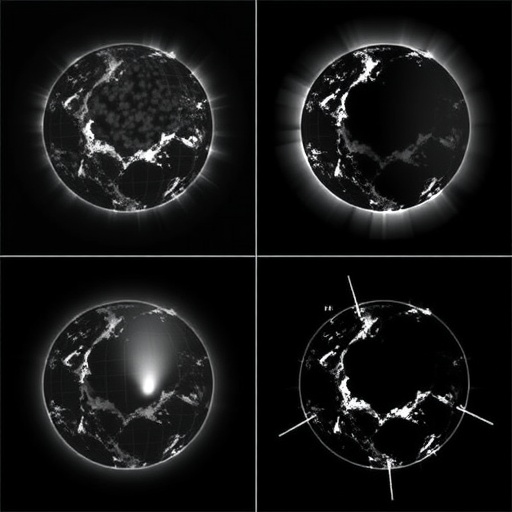
Solar eruptions are among the most explosive phenomena witnessed in our solar system, characterized by sudden, colossal expulsions of plasma and magnetic fields from the Sun’s corona. These eruptions can drastically impact space weather, influencing satellite operations, communication systems, and power grids on Earth. Yet, despite their significance, not all solar eruptions succeed in their escape from the Sun’s gravitational hold. Sometimes, the eruptive material—often a prominence embedded within a magnetic flux rope—initiates its ascent but ultimately fails to break free into the heliosphere. This intriguing phenomenon, known as a failed prominence eruption, offers a unique window into the underlying physics governing solar eruptive events and has profound implications for understanding why similar stars may not exhibit comparable coronal mass ejections (CMEs).
Recent groundbreaking research employing an unprecedented multi-viewpoint and multi-messenger observational approach has shed new light on the complex mechanics of such a failed eruption. By integrating simultaneous off-limb and on-disk imaging from multiple solar observatories, scientists have unveiled compelling evidence that magnetic reconnection—an essential driver of energy release and restructuring in solar flares—can occur at multiple, spatially distinct sites during a single eruptive event. This dual reconnection scenario not only enriches the traditional flare model but also challenges our grasp of how magnetic forces dictate the ultimate fate of eruptive structures.
At the heart of this failed eruption lies a magnetic flux rope, twisted bundles of magnetic field lines encapsulating cool, dense prominence plasma. In typical successful eruptions, this flux rope accelerates outward, driven by magnetic and plasma forces, eventually escaping into interplanetary space as a CME. However, observations reveal that in this case, a complex interplay between standard flare reconnection beneath the flux rope and an intense external reconnection occurring directly on the flux rope itself significantly alters the eruption dynamics. The flare reconnection process, traditionally understood to convert magnetic energy into thermal and kinetic energy behind the ascending structure, seems to act concurrently with strong external reconnection sites that erode magnetic flux from the flux rope and may serve to tether it more firmly to the solar surface.
Multi-wavelength imaging and high-resolution spectroscopy have been crucial in identifying the different reconnection signatures. Instruments sensitive to extreme ultraviolet and X-ray emissions capture the rapid heating and particle acceleration occurring at the reconnection sites, while spectroscopic data provide velocity and plasma diagnostics that confirm both the timing and spatial localization of reconnection events. These datasets, when combined with stereoscopic observations enabling three-dimensional reconstructions of the eruption, depict how external magnetic topologies impose a formidable magnetic confinement on the eruptive flux rope, robbing it of the magnetic flux essential for a successful escape.
The consequences of this magnetic flux loss are striking. As external reconnection progresses, the flux rope’s forward momentum decelerates measurably, culminating in a failed eruption that remains confined near the Sun’s surface. This deceleration and ultimate arrest under the magnetic canopy challenge simplistic models that consider only the upward forces acting on eruptions. In fact, such dynamics underscore the competitive relationship between various reconnection sites: while flare reconnection attempts to accelerate and liberate the flux rope, external reconnection exerts a counterbalancing effect, reinforcing magnetic confinement.
The insights derived from this multi-faceted observation campaign extend beyond solar physics to the broader stellar context. Many solar-like stars, despite possessing magnetic activity, rarely exhibit CMEs detectable by current means. Understanding the balance of magnetic forces and reconnection processes that govern whether an eruption succeeds or fails offers a plausible explanation for this discrepancy. Specifically, stars with magnetic environments promoting frequent external reconnection may preferentially inhibit the escape of eruption-associated plasma and magnetic fields, thus limiting observable mass ejections that would otherwise influence their space weather environments.
Furthermore, this study’s findings refine the standard flare model, which traditionally envisions a single main reconnection site beneath the rising flux rope as the locus of energy conversion. The discovery of intense external reconnection occurring on the flux rope itself revises this paradigm, suggesting that magnetic reconnection is a more spatially distributed and dynamically complex process. Such a shift in understanding demands reevaluation of solar eruption simulations, which must now incorporate multi-site reconnection dynamics to accurately reproduce observational phenomena.
The comprehensive approach, involving synchronized observations across different instruments and vantage points, emphasizes the importance of multi-messenger solar astronomy. By overcoming the limitations of single-line-of-sight observations, scientists can disentangle overlapping processes in convoluted solar atmospheric structures and gain a three-dimensional, time-resolved picture of eruptive events. This method sets a new standard for solar observational campaigns and anticipates future research that further integrates spectroscopic, imaging, and in-situ data streams.
Considering space weather forecasting, the implications of failed eruptions carry weighty consequences. Failed eruptions themselves may not directly promote geomagnetic storms as successful CMEs do; however, their occurrence influences the Sun’s magnetic topology and energy storage, potentially priming the environment for subsequent eruptions. Recognizing the signatures and precursors of failed eruptions could enhance predictive capabilities by identifying changes in the Sun’s magnetic landscape that signal heightened eruptive regimes.
Moreover, the findings encourage revisiting historical CME datasets with an eye toward pinpointing previously unrecognized failed eruptions. Such reevaluation could recalibrate statistics on solar eruptive activity, revealing a more nuanced picture of how frequently eruptions fail and the conditions under which this occurs. The balance between flare-induced acceleration and external reconnection governs this frequency, implicating solar magnetic complexity and flux distribution as key control parameters.
This research also impacts our conceptual models of stellar magnetic activity cycles. If, for example, cycles in magnetic flux emergence and reconnection dynamics modulate the relative dominance of external reconnection, it may explain variations in eruptive activity not only on the Sun but on other magnetically active stars. Understanding these mechanisms can illuminate stellar evolution in the context of magnetic phenomena and influence theories regarding the habitability of exoplanetary systems subjected to stellar space weather.
In summation, the multi-viewpoint observation of a failed prominence eruption expands the frontiers of solar physics by illustrating the intricate, competing reconnection processes that determine the fate of eruptive structures. By revealing how external reconnection on the flux rope intertwines with classical flare reconnection, this study deepens our understanding of magnetic flux evolution during eruptions and clarifies why some solar events remain confined. These insights ripple outward, influencing space weather prediction, solar-stellar comparative studies, and the modeling of magnetic reconnection itself.
As solar observational capabilities continue to evolve, the synergy between high-resolution imaging, spectroscopy, and multi-perspective data promises to unlock further secrets of our dynamic star. The careful monitoring of failed and successful eruptions alike will remain vital to constructing robust, predictive models of solar activity and mitigating the impacts of solar storms on technological systems. Ultimately, this comprehensive picture of eruption dynamics enriches our grasp of how magnetic fields sculpt the energetic and volatile nature of the Sun.
Cite Scienmag News
Grant Pearson. (May 20, 2026). Multi-View Study of Failed Solar Prominence Eruption. Scienmag. https://scienmag.com/multi-view-study-of-failed-solar-prominence-eruption/
Grant Pearson. "Multi-View Study of Failed Solar Prominence Eruption." Scienmag, 20 May 2026, https://scienmag.com/multi-view-study-of-failed-solar-prominence-eruption/. Accessed 3 September 2026.
Grant Pearson. "Multi-View Study of Failed Solar Prominence Eruption." Scienmag. May 20, 2026. https://scienmag.com/multi-view-study-of-failed-solar-prominence-eruption/


