


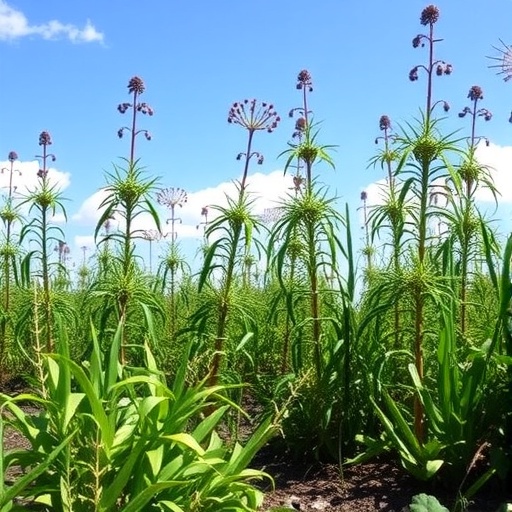
A groundbreaking analysis led by researchers at the University of Michigan has unveiled critical insights into the dynamic responses of plant communities to global warming. For years, ecologists have observed shifts in these communities where species favoring warmer climates become more prevalent, while those preferring cooler temperatures decline. However, until now, the direct causal links between rising temperatures and these compositional changes—known as thermophilization—remained elusive due to confounding environmental variables.
Utilizing data harvested from six rigorously controlled, long-term warming experiments spread across diverse ecosystems in Minnesota, Oklahoma, Wyoming, and California, the research team has conclusively demonstrated that anthropogenic climate warming is the key driver behind thermophilization. These experimental sites, each running for over seven years, manipulated environmental temperature independently of other factors, thus isolating the impacts of warming on plant community structure with unprecedented precision.
One of the most striking revelations from this study is the disproportionate role of just a handful of species in shaping the community’s thermal identity. While a typical plant community may comprise dozens of species, it is primarily a select few—those thermal “super-responders”—that dictate the overall temperature preference profile of the entire community. This overturns the conventional expectation that shifts in community composition are an aggregate result of uniform responses across many species.
Central to their methodology was the utilization of the Community Temperature Index (CTI), a sophisticated metric capturing a plant community’s effective thermal niche. CTI is computed by weighting the temperature preferences of individual species according to their relative abundance, offering a quantified snapshot of the community’s composite climate affinity. Tracking CTI trajectories under experimentally induced warming confirmed not just its consistent increase but revealed the specific species contributions driving these shifts.
Lead author Dr. Kara Dobson emphasized the ecological and practical significance of these findings. “Identifying the key species responsible for community thermophilization enables land managers and conservationists to more effectively anticipate and guide ecosystem responses under continued climate change pressures,” she remarked. The ability to focus management efforts on these pivotal species could optimize restoration and conservation strategies aimed at enhancing ecosystem resilience.
However, the research also underscores a profound spatial variability in which species assume these driver roles. Contrary to expectations, no shared phylogenetic traits or functional characteristics reliably predict which species will dominate thermophilization processes in any given ecosystem. This locale-specific dynamic complicates efforts to generalize findings across different biomes but deepens understanding of ecological complexity in the face of warming.
Co-author Professor Kai Zhu elaborated on the promising implications of this specificity. “By zooming in on the dominant species at each site, we can tailor conservation actions to local contexts, potentially simplifying what is otherwise a daunting task of managing entire species assemblages amidst accelerating global change,” he explained. This precision-guided approach to ecosystem management represents a paradigm shift from broad-brush strategies to site and species-specific interventions.
The controlled nature of the B4WarmED experiment in Minnesota, which was central to the dataset, exemplifies the power of experimental warming studies to disentangle causality in environmental sciences. Unlike observational studies, which often conflate temperature increases with other concurrent ecological changes, experimental manipulations provide a clearer attribution of community shifts directly to warming.
This research contributes to a deeper mechanistic understanding of thermophilization, a phenomenon increasingly observed across terrestrial ecosystems worldwide. By pinpointing the dominant species driving community thermal preferences, the study highlights the critical role of species-specific traits and their nonlinear influence on ecosystem function under changing climates.
Funding support from the U.S. National Science Foundation and Schmidt Sciences propelled this ambitious, multi-institutional collaboration. Researchers from the University of Wisconsin, University of Minnesota, and Utah State University joined forces with the University of Michigan team, creating a robust cross-disciplinary synergy that bolstered analysis depth and experimental scope.
Crucially, these findings invite a reevaluation of how biologists, conservationists, and land managers conceptualize community resilience and adaptation. If only a few species are pivotal in mediating temperature-driven community transformations, then protecting or promoting these species could catalyze broader ecosystem stability and function in a warming world.
As the climate crisis intensifies, this new paradigm—focusing on the small subset of key thermal responders—offers hope for more targeted, efficient stewardship of terrestrial ecosystems. Future research building on these results may uncover further intricacies of species interactions and adaptive capacities, refining humanity’s ability to safeguard nature amid unprecedented environmental shifts.
News Publication Date: 28-Apr-2026.
Web References:
DOI link
Cite Scienmag News
Gavin Prescott. (April 30, 2026). Only a Handful of Species Steer Plant Communities’ Reaction to Rising Temperatures. Scienmag. https://scienmag.com/only-a-handful-of-species-steer-plant-communities-reaction-to-rising-temperatures/
Gavin Prescott. "Only a Handful of Species Steer Plant Communities’ Reaction to Rising Temperatures." Scienmag, 30 April 2026, https://scienmag.com/only-a-handful-of-species-steer-plant-communities-reaction-to-rising-temperatures/. Accessed 4 September 2026.
Gavin Prescott. "Only a Handful of Species Steer Plant Communities’ Reaction to Rising Temperatures." Scienmag. April 30, 2026. https://scienmag.com/only-a-handful-of-species-steer-plant-communities-reaction-to-rising-temperatures/


