


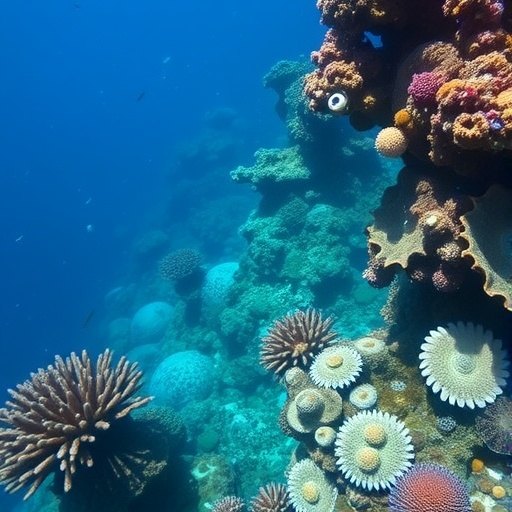
Tropical coral reefs are among the most diverse ecosystems on the planet, providing habitat and resources for a vast array of marine species. These intricate structures owe their existence to colony-forming corals that secrete calcium carbonate skeletons, gradually building complex underwater architectures. Despite their visual splendor, corals are highly vulnerable to environmental changes, particularly those induced by climate change, such as rising ocean temperatures and diminishing oxygen levels. New research from the University of Copenhagen has uncovered an unexpected biological mechanism by which increased seawater temperatures disrupt the oxygen supply to corals, potentially leading to severe oxygen stress and mortality.
This breakthrough study focuses on the microscopic, hair-like appendages known as cilia that densely cover the surface of corals. Unlike prior assumptions that corals passively absorbed oxygen from surrounding seawater, researchers now reveal that these cilia actively regulate oxygen intake by creating tiny water currents. These coordinated movements facilitate enhanced oxygen exchange, especially during nighttime when photosynthetic algae within corals cease oxygen production, making corals entirely dependent on environmental oxygen uptake.
Through a combination of laboratory experiments and advanced mathematical modeling, the research team examined how rising temperatures affect ciliary motion and, in turn, oxygen transport near the coral surface. At moderately elevated temperatures, corals appear to ramp up their ciliary beating rate, effectively increasing local water flow and compensating for their raised metabolic oxygen demand. This physiological adaptation suggests corals can temporarily stave off oxygen deficiency by increasing their ‘respiratory’ efficiency under mild thermal stress.
However, this compensatory mechanism has critical limits. Beyond a specific thermal threshold—approximately 37 degrees Celsius in controlled experiments—the cilia experience a dramatic decline in motility. The once-synchronized beating slows, loses coherence, and eventually ceases, despite ongoing increases in tissue oxygen consumption. The consequence is a localized depletion of oxygen in the thin boundary layer of seawater immediately adjacent to the coral surface. This acute oxygen deficit precipitates cellular damage, tissue degradation, and, if sustained, coral death.
Importantly, the study underscores that this critical temperature limit is not fixed but varies among coral species and environmental contexts, influenced by long-term acclimatization and local thermal histories. By integrating environmental and biological parameters into their predictive models, the scientists demonstrated that corals with steeper metabolic oxygen demand responses to temperature are at higher risk of surpassing lethal oxygen stress during marine heatwaves.
These findings illuminate a vital connection between thermal stress, oxygen dynamics, and coral bleaching. Historically, bleaching has been attributed to the breakdown of symbiosis between corals and their photosynthetic algae under heat stress. However, this research indicates that oxygen supply failure due to impaired ciliary function may contribute directly to physiological stress preceding or exacerbating bleaching. Oxygen deprivation could thus act as an early and potentially more insidious driver of coral degradation than previously recognized.
Microscale processes at the coral surface hence have profound implications for reef health and resilience. The ability of cilia to sustain oxygen fluxes represents a delicate frontline defense against environmental stress. Monitoring changes in ciliary activity might emerge as a sensitive early-warning indicator of thermal distress before visible bleaching or mortality manifests. This insight opens new avenues for investigating coral responses to climate change at intimate biological scales.
Beyond ecological understanding, these revelations carry practical import for reef conservation and restoration strategies. Enhanced knowledge of oxygen transport mechanisms can inform targeted interventions, such as selecting thermally resilient coral genotypes or managing local conditions to mitigate thermal peaks. However, the overarching solution to preserving coral ecosystems remains a concerted global effort to curb greenhouse gas emissions and limit ocean warming trajectories.
Furthermore, the implications of this work extend beyond corals. Numerous marine organisms, including sponges, sea anemones, and ascidians, rely on cilia for generating water flow and facilitating gas exchange. The newly described oxygen stress mechanism triggered by heat-induced ciliary dysfunction may therefore be widespread in marine biota, exacerbating the cumulative biological impacts of ocean warming and deoxygenation across ecosystems.
Technologically, this research leveraged advanced imaging and oxygen sensing technologies to visualize and quantify how ciliary beating modulates micro-scale hydrodynamics and oxygen gradients at the coral-water interface. These sophisticated methodologies overcame traditional observational barriers, given that these processes transpire within an ultra-thin water boundary layer from micrometre to millimetre scales. Integrating empirical data with rigorous mathematical simulations provided a powerful framework to predict coral oxygen dynamics under diverse environmental conditions.
The interdisciplinary nature of this study, involving biologists, physicists, and mathematicians, exemplifies the collaborative approach needed to unravel complex ecological phenomena in the context of climate change. Supported by international research foundations and carried out by teams across Denmark, Germany, Australia, and Saudi Arabia, this work represents a pioneering advance in marine biology and environmental science.
Conclusively, this research paints a detailed portrait of how incremental thermal rises can disrupt fundamental physiological processes at the microscopic interface between corals and their surrounding environment. By exposing the vulnerability of ciliary beating to acute heat stress, it prompts a reassessment of coral resilience mechanisms and highlights oxygen supply as a critical factor in coral survival during climate-induced heatwaves. As ocean temperatures climb globally, safeguarding these vulnerable reef systems will require integrating such nuanced biological insights into conservation policies and climate action frameworks to avert large-scale losses of vital marine biodiversity.
News Publication Date: 20-May-2026.
Web References: DOI: 10.1126/sciadv.aeg0950.
Cite Scienmag News
Violet Maxwell. (May 20, 2026). Rising Ocean Temperatures Threaten Coral Oxygen Levels, Leading to Widespread Coral Mortality. Scienmag. https://scienmag.com/rising-ocean-temperatures-threaten-coral-oxygen-levels-leading-to-widespread-coral-mortality/
Violet Maxwell. "Rising Ocean Temperatures Threaten Coral Oxygen Levels, Leading to Widespread Coral Mortality." Scienmag, 20 May 2026, https://scienmag.com/rising-ocean-temperatures-threaten-coral-oxygen-levels-leading-to-widespread-coral-mortality/. Accessed 3 September 2026.
Violet Maxwell. "Rising Ocean Temperatures Threaten Coral Oxygen Levels, Leading to Widespread Coral Mortality." Scienmag. May 20, 2026. https://scienmag.com/rising-ocean-temperatures-threaten-coral-oxygen-levels-leading-to-widespread-coral-mortality/


