


In a groundbreaking effort to harness the ecological habits of honeybees for environmental monitoring, researchers from the UK Centre for Ecology & Hydrology have unveiled compelling evidence supporting the use of honeybees as national-scale biosentinels. Published May 20, 2026, in the open-access journal PLOS One, this study breaks new ground by deploying advanced environmental DNA (eDNA) analysis to track diverse plant species based on pollen gathered by bees across the United Kingdom. This innovative approach demonstrates an intersection of citizen science and cutting-edge molecular techniques, offering unprecedented resolution into ecosystem dynamics over large geographic areas and extended time frames.
Honeybees, with their foraging radius spanning several kilometers, collect pollen and nectar from myriad wild and cultivated plants. This natural behavior makes them ideal biological samplers, concentrating environmental information into discrete honey samples. Traditional ecological surveys often require extensive fieldwork, specialist expertise, and significant resource investment. In contrast, honeybees inherently conduct broad, repetitive sampling, but their potential as bioindicators on a national scale has remained largely untapped—until now.
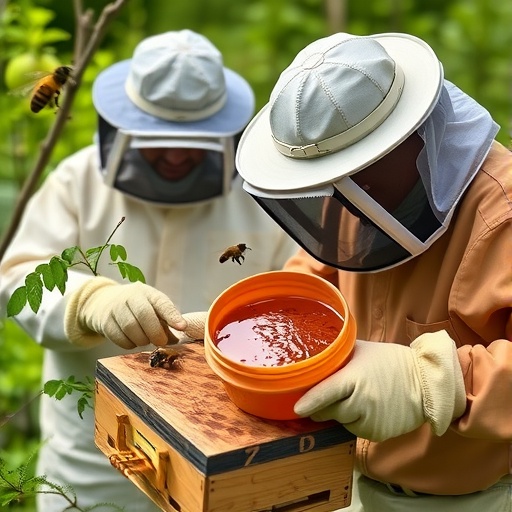
The UK National Honey Monitoring Scheme (NHMS), initiated in 2018, engaged over 3,500 volunteer beekeepers from England, Wales, Scotland, and Northern Ireland, collectively submitting 5,789 honey samples over seven years. Using high-throughput DNA extraction methods, researchers isolated pollen DNA from these samples, then applied metabarcoding techniques to identify the plant taxa represented. The results revealed an astonishing diversity, detecting over 800 distinct plant species, ranging from essential crops like canola and clover to invasive species such as Himalayan balsam, highlighting both cultivated and spontaneous flora visited by honeybees.
This study exemplifies a fusion of citizen science engagement with molecular ecology, illustrating how a well-orchestrated volunteer network can generate robust biological data at scales previously unimaginable. Beekeepers were integral not only as sample providers but also as co-developers of the monitoring framework, receiving regular communication and personalized feedback on their honey’s botanical composition. This two-way interaction likely enhanced participant retention and data quality, fostering a sustainable monitoring infrastructure.
Despite its breadth, the NHMS data reveals some inherent biases. The majority of samples originated from the southern regions of England, reflecting beekeeper density and distribution. Temporally, sample collection was skewed toward early and late summer periods, coinciding with peak honey flows. While these factors limit representativeness to some degree, the growing archive now offers a temporal and spatial tapestry capable of elucidating trends in pollinator activity, plant phenology shifts, and even environmental stressors such as pesticide exposure or pathogen invasions.
Environmental DNA (eDNA) analysis employed in this project capitalizes on genetic material shed by organisms into their surroundings, enabling the detection of species without direct observation. Pollen grains trapped in honey retain DNA from visited plants, providing a molecular snapshot of foraging landscapes. This non-invasive sampling circumvents logistical challenges associated with traditional vegetation surveys, presenting a scalable, cost-effective alternative that nevertheless maintains taxonomic precision.
The implications of these findings extend far beyond academic curiosity. Monitoring plant diversity and distribution through honeybee foraging has the potential to reveal insights into ecosystem health, biodiversity changes, and the spread of invasive species. For instance, documenting the prevalence of Himalayan balsam pollen indicates its encroachment and ecological impact. Simultaneously, fluctuations in crop pollen concentrations could signal agricultural management shifts or pollination service dynamics, both critical for food security and sustainable farming.
Moreover, this approach paves the way for integrative assessments of multi-stressor impacts on pollinators themselves. By correlating floral visitation patterns with pesticide residues or disease prevalence, scientists can better understand the complex pressures facing these vital insects. As honeybees are cornerstone pollinators supporting wild plants and crops alike, safeguarding their health is intertwined with broader ecosystem resilience.
The success of the NHMS underscores the power of collaborative science between researchers and the public. Engaging beekeepers as citizen scientists democratizes data collection and fosters environmental stewardship. Access to genetic results from their honey empowers participants with knowledge that can inform hive management and conservation awareness, cultivating a community invested in ecological monitoring and protection.
While challenges remain in standardizing sampling efforts and expanding geographic coverage to minimize bias, continued growth of the NHMS dataset promises richer insights. Future integration with climatic data, remote sensing, and pathogen surveillance could transform these honeybee-derived eDNA samples into a multipurpose tool for environmental monitoring, policy-making, and biodiversity conservation strategies on a national scale.
The study authors emphasize that monitoring environmental change at national levels has historically been hampered by the scale and cost constraints. The NHMS offers a scalable, cost-effective paradigm leveraging the natural behavior of pollinators combined with molecular innovations. This synergistic framework not only advances scientific understanding of wild plant communities and pollinator ecology but also equips societies to detect and respond to emerging threats ranging from pesticide impacts to diseases affecting these indispensable insects.
In conclusion, the pioneering work conducted by Shelton and colleagues heralds a new frontier in biological monitoring, where the humble honeybee evolves from a prolific pollinator to a sentinel of environmental health. This research demonstrates the feasibility and utility of large-scale, longitudinal eDNA biomonitoring using bee-collected pollen, setting the stage for future applications that could revolutionize biodiversity surveillance and conservation tactics globally.
Cite Scienmag News
Gavin Prescott. (May 20, 2026). Thousands of UK Beekeepers Contribute Honey to Advance Environmental Science. Scienmag. https://scienmag.com/thousands-of-uk-beekeepers-contribute-honey-to-advance-environmental-science/
Gavin Prescott. "Thousands of UK Beekeepers Contribute Honey to Advance Environmental Science." Scienmag, 20 May 2026, https://scienmag.com/thousands-of-uk-beekeepers-contribute-honey-to-advance-environmental-science/. Accessed 4 September 2026.
Gavin Prescott. "Thousands of UK Beekeepers Contribute Honey to Advance Environmental Science." Scienmag. May 20, 2026. https://scienmag.com/thousands-of-uk-beekeepers-contribute-honey-to-advance-environmental-science/


