


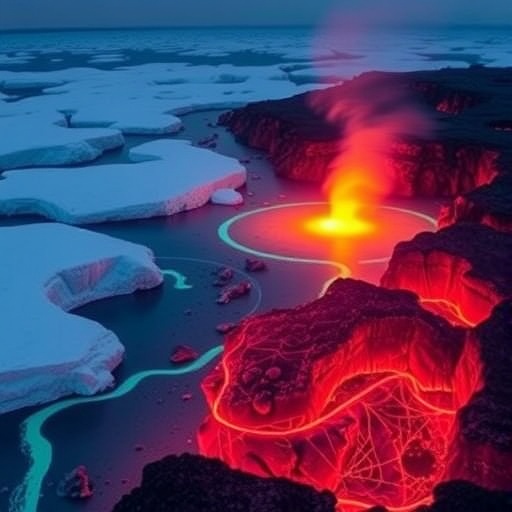
A groundbreaking study published in Nature Geoscience by a collaborative team led by Boston College researchers sheds new light on the intricate connections between seafloor volcanic activity and oceanic carbon cycles during ice-age transitions. This research reveals that iron supplied from deep-sea hydrothermal vents, triggered by sea-level declines that enhanced mid-ocean-ridge volcanism, may have played a crucial role as a natural ocean iron fertilizer, boosting plankton productivity and potentially amplifying carbon sequestration in the oceans.
Traditionally, scientists have recognized that certain ocean regions, despite ample nitrogen and phosphorus, experience limited phytoplankton growth due to a scarcity of iron, which acts much like a vital micronutrient or vitamin. Prior to this study, the dominant assumption was that iron primarily reached surface waters through dust transported by winds. However, this new inquiry challenges that paradigm by implicating hydrothermal iron released from mid-ocean ridges as a vital nutrient source during periods when sea levels dropped dramatically, such as during deglaciations.
The centerpiece of this research focuses on the eastern equatorial Pacific, where iron limitation sharply constrains phytoplankton growth. By analyzing sediment core samples dating back 200,000 years, the scientists meticulously measured nitrogen isotopes preserved in fossil shells of foraminifera, tiny marine organisms embedded within seafloor deposits. These isotopic records serve as proxies for historical nutrient utilization by phytoplankton, providing a window into ocean productivity fluctuations over glacial cycles.
Co-first author Tianshu Kong, who spearheaded the nitrogen isotope measurements, elaborated that the isotopic data highlighted two pronounced peaks during deglacial periods—intervals when ice sheets retreated and sea levels fell. These peaks aligned strikingly with independent sediment data indicating heightened hydrothermal iron emissions from the East Pacific Rise, a major undersea volcanic ridge. Alternative mechanisms like dust deposition, shifts in oxygen minimum zones, or changes in broader ocean nutrient dynamics were carefully evaluated but failed to match this pattern as precisely.
Assistant Professor Xingchen “Tony” Wang, the study’s lead author, described the unexpected linkage between volcanic activity thousands of meters below the ocean surface and nutrient dynamics at the sunlit ocean interface. He emphasized that declining sea levels reduced pressure on mid-ocean ridges, thereby enhancing volcanic activity and hydrothermal fluid release enriched with bioavailable iron. This enhanced iron supply could then ascend through ocean mixing and upwelling processes, ultimately fertilizing phytoplankton at the surface.
Supporting the geochemical data, ocean circulation models developed by co-author Xiaozhou Ruan demonstrated that iron introduced at depth along the ridge system could indeed be transported upward over time scales relevant to biological uptake. These models accounted for complex interactions between ocean currents, mixing, and seafloor topography, highlighting a plausible physical mechanism by which deep iron could reach the photic zone, where light-driven photosynthesis occurs.
This multi-institutional international effort—spanning Boston College, Boston University, University of Massachusetts Boston, National Taiwan University, and Princeton University—represents an impressive synthesis of paleoclimate proxies, geochemical analyses, and advanced modeling. Their multidisciplinary approach exemplifies the evolving nature of climate science toward integrating biological, geological, and chemical processes to decode Earth’s past climate feedbacks.
The implications of this discovery extend beyond academic curiosity. Recognizing hydrothermal iron’s role in natural fertilization prompts reconsideration of how marine carbon sequestration operated during glacial-interglacial cycles. Since phytoplankton fix atmospheric carbon dioxide and export it to the deep ocean when they die, periods of increased iron availability driven by tectonic and volcanic processes may have modulated greenhouse gas concentrations on geological time scales.
Importantly, the study clarifies that it does not advocate for artificial ocean iron fertilization as a geoengineering approach. Instead, it leverages natural experiments embedded in Earth’s climate history to uncover the dynamic coupling between the solid Earth and the biosphere. This improved mechanistic understanding could inform future climate models by including iron cycling modulated by geophysical factors, enhancing predictions of carbon cycle sensitivity.
Looking ahead, the research team plans to extend similar investigative frameworks to other ocean basins, particularly the Southern Ocean, where iron limitation strongly influences carbon uptake and where hydrothermal activity is also significant. Determining whether this seafloor-origin iron fertilization was localized to the eastern equatorial Pacific or a widespread phenomenon will be key to quantifying its global impact on past atmospheric CO2 trends.
In addition to the scientific findings, the study underscores the ocean’s remarkable complexity as a dynamic system where biological productivity, tectonics, and climate feedbacks are tightly interlinked across varying spatial and temporal scales. The collaborative nature and methodological innovation embodied in this work set an inspiring precedent for unraveling other Earth system processes that regulate climate over millennia.
As climate change accelerates in the modern era, insights gleaned from paleoclimate archives become increasingly valuable, offering clues about natural processes that have historically modulated atmospheric carbon dioxide. This study, by illuminating a previously underappreciated iron source, enriches our understanding of the Earth’s carbon budget and the sensitive interplay governing plankton-driven biological carbon pumps in marine ecosystems.
—
Subject of Research: Ocean iron fertilization linked to mid-ocean-ridge volcanism during ice-age sea-level changes
News Publication Date: June 9, 2026
Web References: DOI link
Cite Scienmag News
Violet Maxwell. (June 9, 2026). How Ice-Age Sea-Level Drops Could Have Transformed Seafloor Volcanoes into Ocean Fertilizers. Scienmag. https://scienmag.com/how-ice-age-sea-level-drops-could-have-transformed-seafloor-volcanoes-into-ocean-fertilizers/
Violet Maxwell. "How Ice-Age Sea-Level Drops Could Have Transformed Seafloor Volcanoes into Ocean Fertilizers." Scienmag, 9 June 2026, https://scienmag.com/how-ice-age-sea-level-drops-could-have-transformed-seafloor-volcanoes-into-ocean-fertilizers/. Accessed 3 September 2026.
Violet Maxwell. "How Ice-Age Sea-Level Drops Could Have Transformed Seafloor Volcanoes into Ocean Fertilizers." Scienmag. June 9, 2026. https://scienmag.com/how-ice-age-sea-level-drops-could-have-transformed-seafloor-volcanoes-into-ocean-fertilizers/


