


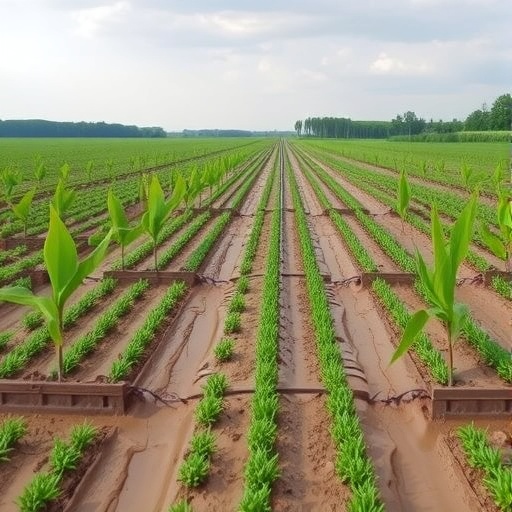
A major shift may be approaching in China’s agricultural pollution landscape. Climate change could move the country’s most rapidly emerging cropland nitrogen pollution hotspots away from the humid south and toward the arid and semi-arid north, according to a modeling study led by Professor Yongqiu Xia of the Institute of Soil Science, Chinese Academy of Sciences. The research suggests that regions historically considered less vulnerable could face sharp increases in nitrogen export as warming and more intense rainfall activate pollution pathways that have remained largely disconnected during dry periods.
The study used the Zhiyuan agricultural non-point source pollution model, an independently developed Water Network Framework designed to simulate how nitrogen moves from fields through rivers, lakes, reservoirs, and other aquatic systems. The research team combined 1,485 field observations with spatially explicit simulations of soil nitrogen processes, surface runoff, aquatic transport, and nitrogen removal. By linking what happens on farmland with what happens downstream, the researchers examined not only how much nitrogen leaves cropland, but also how much is retained or removed before reaching the ocean.
Nitrogen pollution begins when crops fail to absorb all of the nitrogen supplied through fertilizers or released naturally from soil organic matter. The remaining nitrogen can accumulate in the soil as nitrate and other mobile compounds. During rainfall, these compounds may be transported through surface runoff, drainage systems, and groundwater into streams and larger water bodies. Excess nitrogen can stimulate algal blooms, reduce water quality, disrupt aquatic ecosystems, and contribute to oxygen depletion. The danger is especially complex because the amount of nitrogen exported from a landscape does not necessarily equal the amount ultimately delivered to coastal waters.
For decades, southern China has been viewed as the country’s principal cropland nitrogen pollution hotspot. The region receives abundant rainfall and contains dense networks of rivers, lakes, reservoirs, and drainage channels, creating favorable conditions for nitrogen transport. In contrast, the drier northern agricultural regions have generally been considered less susceptible because limited rainfall restricts runoff and keeps many transport pathways inactive. The new analysis indicates that this distinction may weaken as climate conditions change.
The researchers estimate that southern China currently exports approximately 0.31 teragrams of cropland nitrogen to the ocean each year, nearly twice the 0.16 teragrams exported from the arid north. By 2050, however, northern nitrogen export is projected to rise by 18.8 percent under the intermediate-emissions pathway SSP2-4.5. Under the high-emissions pathway SSP5-8.5, the increase could reach 53.2 percent. The Hai River Basin appears particularly vulnerable, with nitrogen export projected to increase by as much as 88.1 percent under the high-emissions scenario.
The projected change is driven by several interacting mechanisms. Rising temperatures can accelerate microbial mineralization, the process through which soil microorganisms convert organic nitrogen into inorganic forms that plants can absorb but that can also be washed away. Meanwhile, more frequent or intense storms can deliver enough water to rapidly flush nitrogen accumulated during prolonged dry periods. In drylands, runoff networks may be effectively dormant for long intervals, but extreme rainfall can reconnect fields, channels, and rivers in a matter of hours. This sudden activation can produce disproportionately large pulses of nitrogen pollution.
Aquatic ecosystems complicate the picture by acting as both transport corridors and nitrogen filters. Lakes, reservoirs, wetlands, and rivers can remove nitrogen through biological uptake, sedimentation, and denitrification, in which microorganisms convert nitrate into nitrogen gases that return to the atmosphere. Southern China’s dense aquatic networks currently provide substantial opportunities for this removal, helping offset some of the nitrogen leaving cropland. If those systems remain healthy, southern exports may remain stable or even decline slightly by mid-century, despite continued agricultural pressures.
The findings point toward a climate-adaptive strategy rather than a single national solution. Northern regions should focus on preventing nitrogen accumulation before major storms occur. Weather-responsive fertilization could reduce applications when heavy rainfall is forecast, while controlled-release fertilizers would limit the sudden availability of nitrogen in soil. Splitting fertilizer applications across the growing season could also improve crop uptake and reduce the amount stored in fields between storms. These measures may become increasingly important in the Hai River Basin and other northern areas where short, intense rainfall events are expected to become more influential.
Southern regions will still require strong pollution controls, but their priorities may differ. Reducing fertilizer losses at the field level should be combined with restoration of riparian wetlands, careful management of aquatic vegetation, and decentralized retention systems that slow and treat runoff before it reaches larger waterways. Protecting the natural capacity of rivers, lakes, and wetlands to remove nitrogen could prevent greater quantities from reaching the ocean. The same climate-driven pattern may emerge in other dryland farming regions, including the North American Great Plains and Australia’s wheat belt, although local soil, rainfall, crop, and drainage conditions will determine the scale of the risk. The study’s central warning is clear: the places producing the most nitrogen pollution today may not be the places where pollution grows fastest tomorrow.
Web References: https://doi.org/10.1093/nsr/nwag455
References: National Science Review, DOI: 10.1093/nsr/nwag455
Cite Scienmag News
Sloane Callahan. (August 11, 2026). Climate change pushes cropland nitrogen pollution hotspots northward. Scienmag. https://scienmag.com/climate-change-pushes-cropland-nitrogen-pollution-hotspots-northward/
Sloane Callahan. "Climate change pushes cropland nitrogen pollution hotspots northward." Scienmag, 11 August 2026, https://scienmag.com/climate-change-pushes-cropland-nitrogen-pollution-hotspots-northward/. Accessed 4 September 2026.
Sloane Callahan. "Climate change pushes cropland nitrogen pollution hotspots northward." Scienmag. August 11, 2026. https://scienmag.com/climate-change-pushes-cropland-nitrogen-pollution-hotspots-northward/


