


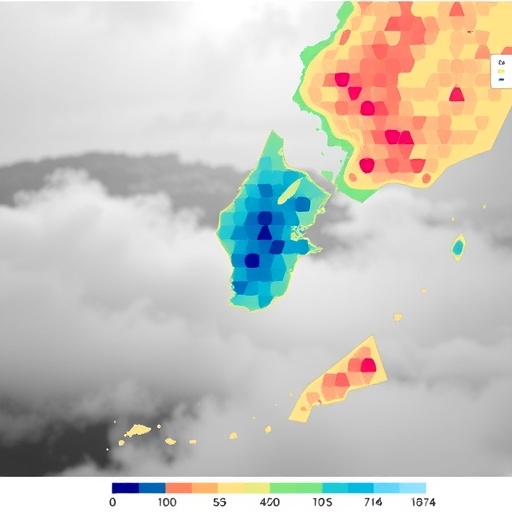
In recent years, the integration of artificial intelligence (AI) and machine learning (ML) into geospatial applications has revolutionized Earth system modeling and environmental monitoring. However, one critical obstacle remains: accurately quantifying the uncertainty associated with AI/ML predictions. Addressing this challenge is essential for fostering trust in these models and enabling decision-makers to utilize their outputs confidently. A groundbreaking new study published in the journal Big Earth Data rigorously evaluates cutting-edge methods and metrics for uncertainty quantification (UQ) specifically tailored to the complexities of geospatial AI/ML applications. This research not only advances theoretical understanding but also underpins practical implementations, particularly through a detailed case study focused on air quality calibration.
Earth system modeling involves intricate environmental dynamics intertwined with data quality issues, such as measurement errors and sensor inconsistencies. These factors compound the inherent uncertainties when deploying AI/ML models for geospatial analysis, necessitating robust and interpretable UQ frameworks. The study meticulously examines three prominent UQ methodologies—Deep Ensembles, Bayesian Neural Networks, and Monte Carlo Dropout—deploying them within real-world geospatial contexts, with an emphasis on predictive reliability and calibration accuracy. The integration of these UQ approaches aims to enhance transparency about model confidence, which is crucial for applications that influence public health policies and environmental regulations.
Central to the research is a PM2.5 air pollution case study, leveraging data from widely distributed sensor networks across California. The dataset includes observations from both PurpleAir low-cost sensors and EPA’s official monitoring stations. By situating these sensors in the context of land use and land cover (LULC) classes and urban centers, the study captures spatial heterogeneity and source variability key to air quality modeling. The application of UQ in this scenario demonstrates how AI/ML models can be calibrated not only for accuracy but also for reliable uncertainty estimates, thereby improving the credibility of air pollution forecasts used in health advisories.
One of the most striking findings of the study is the superior performance of Deep Ensembles in TensorFlow. This method exhibited the best balance of predictive accuracy and reliable uncertainty calibration, outperforming Bayesian Neural Networks and Monte Carlo Dropout variations. Deep Ensembles leverage a collection of independently trained models to capture epistemic uncertainty, integrating variance across predictions to quantify confidence intervals robustly. The study’s implementation confirmed the method’s adaptability to complex geospatial datasets and highlighted its potential as the leading strategy for AI-driven environmental analytics.
Bayesian Neural Networks, as implemented in TensorFlow, emerged as a close second, demonstrating commendable calibration and dependable accuracy. BNNs embrace a probabilistic framework, inferring posterior distributions over model weights. This inherent uncertainty modeling contributes to well-calibrated predictive distributions, essential for high-stakes geospatial decision-making. Although computationally intensive, BNNs’ ability to represent uncertainty at multiple levels makes them compelling candidates for future developments in Earth observation analytics and real-time forecasting.
Monte Carlo Dropout (MCD), a more computationally efficient UQ method, showed mixed results depending on the underlying framework. While TensorFlow’s MCD implementation delivered stable performance, it fell short during extreme PM2.5 values, exhibiting less adaptable uncertainty estimates. In stark contrast, PyTorch’s MCD method underperformed considerably, yielding lower prediction accuracy and poor calibration. These framework-specific discrepancies underscore the importance of software ecosystems and implementation nuances in deploying UQ methods effectively in geospatial AI/ML workflows.
The study also conducted an extensive evaluation of UQ metrics, which are critical for interpreting and validating uncertainty estimates. Metrics such as reliability diagrams, prediction interval coverage probability (PICP), and continuous ranked probability score (CRPS) were scrutinized for their roles in assessing calibration and sharpness of probabilistic predictions. The authors revealed that while some metrics reliably measure uncertainty quality, others need refinement or standardization to suit the dynamic range and spatial complexity typical of geospatial datasets.
Beyond performance benchmarking, this research addresses the urgent need for integration of UQ into real-time and large-scale Earth system models. Current barriers include computational overhead, data streaming constraints, and lack of unified frameworks for harmonizing AI/ML predictions with uncertainty outputs. The work advocates for enhanced toolkits and open-source support to enable scalable deployment, facilitating decision support systems that can actively communicate uncertainty alongside forecasts, thereby empowering stakeholders with a nuanced understanding of risk and confidence.
By highlighting key differences between TensorFlow and PyTorch ecosystems, the study sheds light on the importance of platform selection in geospatial uncertainty quantification. Such differences are not merely technical but impact the reproducibility, interpretability, and ultimately the trust users place in AI-powered environmental models. This insight calls for concerted efforts in community-driven benchmarking and transparency in framework-specific implementations to promote best practices across scientific domains.
Importantly, the interdisciplinary nature of this research bridges AI, geoscience, and data science. It acknowledges the complexities of Earth observation data—heterogeneous, spatially autocorrelated, and often noisy—daunting challenges that traditional ML methods are ill-equipped to handle without advanced UQ. By integrating theoretical advances with practical application, the study provides a roadmap for enhancing the reliability of predictive models that monitor critical phenomena like air pollution, land cover changes, and climate variables.
The implications of these findings extend beyond academic circles. Governments, environmental agencies, and public health organizations stand to benefit from improved models that transparently communicate uncertainty, fostering more informed, timely, and adaptive interventions. As AI/ML increasingly shape Earth sciences, embedding robust UQ mechanisms will be indispensable for transitioning from black-box predictions to actionable, trusted information.
In summary, this pioneering study represents a major step forward in the systematic evaluation and comparison of uncertainty quantification methodologies within geospatial AI/ML contexts. By focusing on practical, real-world challenges such as air quality calibration, it offers not only a theoretical foundation but a blueprint for implementation that balances accuracy, reliability, and computational feasibility. Its insights into framework dependencies and metric suitability stand to catalyze more effective, transparent use of AI in Earth system monitoring, heralding a new era of trustworthiness and accountability in environmental data science.
News Publication Date: 9-Mar-2026
Web References: http://dx.doi.org/10.1080/20964471.2026.2629680
References:
Malarvizhi, A. S., Smith, K., & Yang, C. (2026). Uncertainty quantification in geospatial AI/ML applications: methods, metrics, and open-source support with an air quality use case. Big Earth Data, 1–34.
Keywords
geoscience, remote sensing, Earth observation, GIS, data analysis, big data, visualization, uncertainty quantification, AI/ML, Deep Ensembles, Bayesian Neural Networks, Monte Carlo Dropout, air quality, PM2.5 calibration
Cite Scienmag News
Russell Cooper. (May 20, 2026). Exploring Uncertainty Quantification in Geospatial AI/ML: Methods, Metrics, and Open-Source Tools Highlighted in Air Quality Study. Scienmag. https://scienmag.com/exploring-uncertainty-quantification-in-geospatial-ai-ml-methods-metrics-and-open-source-tools-highlighted-in-air-quality-study/
Russell Cooper. "Exploring Uncertainty Quantification in Geospatial AI/ML: Methods, Metrics, and Open-Source Tools Highlighted in Air Quality Study." Scienmag, 20 May 2026, https://scienmag.com/exploring-uncertainty-quantification-in-geospatial-ai-ml-methods-metrics-and-open-source-tools-highlighted-in-air-quality-study/. Accessed 6 September 2026.
Russell Cooper. "Exploring Uncertainty Quantification in Geospatial AI/ML: Methods, Metrics, and Open-Source Tools Highlighted in Air Quality Study." Scienmag. May 20, 2026. https://scienmag.com/exploring-uncertainty-quantification-in-geospatial-ai-ml-methods-metrics-and-open-source-tools-highlighted-in-air-quality-study/


