


In the ongoing battle against climate change, forests have long stood as one of humanity’s most vital allies, acting as vast carbon reservoirs. These ecosystems sequester carbon dioxide from the atmosphere, mitigating the greenhouse effect that fuels global warming. Governments and corporations alike have invested heavily in forest conservation within the framework of carbon credit markets, relying on the assumption that forests will remain stable carbon sinks for decades. However, emerging research challenges this foundational premise by revealing that the protocols governing these carbon offset programs substantially underestimate the risks that climate-driven disturbances pose to forest carbon stocks.
A recent comprehensive study led by scientists at the University of Utah, in collaboration with global experts, has unearthed troubling evidence that many forests, especially in the parched regions of the U.S. West, are at significantly higher risk of carbon loss due to climate-induced wildfires, droughts, and insect outbreaks than previously accounted for. This revelation calls into question the reliability of carbon credits issued under current frameworks, which often fail to incorporate the accelerating impacts of climate change on forest health and longevity.
Central to this research is the concept of “buffer pools,” reserves of additional carbon credits set aside to offset carbon emissions lost when forests are damaged or destroyed prematurely. These buffer pools were intended as insurance mechanisms to safeguard the integrity of carbon offset programs, yet detailed climate-informed analysis shows that the sizes of these pools are woefully inadequate. On average, the study suggests that buffer reserves need to be approximately six times larger than those currently implemented to effectively neutralize projected carbon losses over the coming century.
This underestimation of risk stems from outdated assumptions embedded in forest carbon protocols, which traditionally consider disturbance risks to be stable across time and geographical areas. In reality, the frequency and severity of wildfires, prolonged droughts, and pest outbreaks are on the rise, driven by escalating global temperatures and shifting ecological dynamics. By combining extensive field plot data, satellite imagery, and cutting-edge machine learning algorithms, the research team created predictive models that map the likelihood of carbon reversals—events where stored carbon is rapidly released back into the atmosphere—across the continental United States.
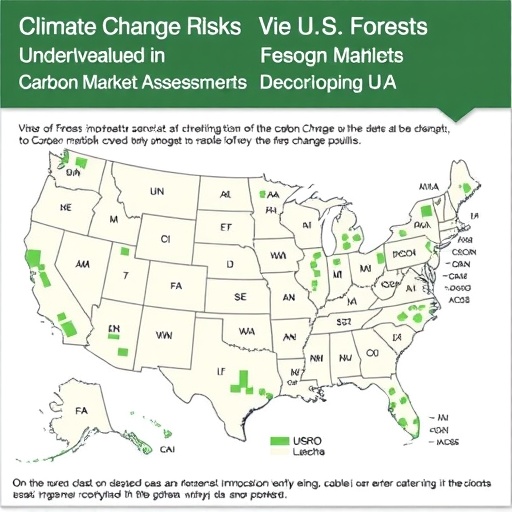
The spatial distribution of these risks is particularly alarming. The models show dramatic expansions in wildfire risk zones, with the proportion of the country vulnerable to carbon loss by wildfire increasing from 10% to 33%. Drought and insect infestation risks have also increased, albeit to a lesser extent, highlighting the compounding threats facing forest carbon stability. Specific regions such as California, the Intermountain West, Southern California, Idaho, Arizona, and New Mexico emerge as hotspots where the odds of experiencing devastating carbon losses within this century exceed 80%, signaling urgent priorities for climate-sensitive forest management.
This nuanced understanding of risk stratification offers a glimmer of hope within these unsettling findings. By integrating robust scientific data into carbon market policies, it is possible to strategically target conservation and reforestation efforts toward areas with lower vulnerability, thus maximizing the durability of carbon storage. The researchers emphasize that not all forest carbon projects are equally risky; selecting sites that are less prone to severe disturbances can enhance the effectiveness and credibility of nature-based climate solutions.
Forests serve a dual role in climate mitigation: they not only absorb atmospheric carbon but also lock it away for extended periods, ideally spanning centuries. The efficacy of carbon credits hinges on this temporal permanence. If trees succumb prematurely to fire, drought, or pests, the carbon previously accounted for as sequestered rapidly reenters the atmosphere, undermining climate goals. This phenomenon, known as “carbon reversal,” directly challenges the equivalency that carbon offsets claim with fossil fuel emissions reductions, revealing a critical vulnerability in current climate strategies.
The study’s implications extend beyond technical modeling; they highlight the urgency of reconceptualizing forest carbon governance. Adaptive policy frameworks must be built on dynamic risk assessments that reflect the evolving realities of a warming planet. This entails recalibrating buffer pools, enhancing monitoring systems, and investing in forest management practices designed to enhance resilience against climate disturbances.
Moreover, the researchers have developed interactive decision-support tools, empowering policymakers, land managers, and conservationists to visualize risk landscapes and optimize resource allocation. These tools represent a pivotal advancement toward embedding climate science directly into the mechanisms that guide carbon offset projects, fostering transparency and accountability.
From a broader perspective, the findings underscore a vital paradox: while forests continue to represent one of the most promising natural climate solutions, their vulnerability is intensifying in tandem with climate change itself. This paradox demands a reevaluation of how forest carbon credits are structured and highlights the indispensable role of scientific innovation in addressing climate complexities.
The extensive collaboration among eleven institutions worldwide, supported by major funding bodies including the National Science Foundation, NASA, and the Department of Energy, underscores the multidisciplinary effort needed to confront these challenges. This integrative approach ensures that the findings rest on rigorous data analysis combined with ecological expertise.
Ultimately, this research serves as a clarion call for the climate policy community to embrace sophisticated, climate-responsive models that can guide more effective forest carbon management. By doing so, carbon credit systems can evolve from vulnerable financial instruments into robust components of global climate strategy, safeguarding the vital role forests play in stabilizing Earth’s climate for generations to come.
News Publication Date: 15-May-2026
Web References:
https://www.nature.com/articles/s41586-026-10571-y
https://wilkes-center.github.io/carbon-reversal-risk/
References:
Anderegg, W., Wu, C., Wang, J., Yang, L., et al. (2026). Forest carbon protocols underestimate climate-driven carbon loss risks. Nature. DOI: 10.1038/s41586-026-10571-y
Cite Scienmag News
Sloane Callahan. (May 20, 2026). Climate Change Risks to U.S. Forests Undervalued in Carbon Market Assessments. Scienmag. https://scienmag.com/climate-change-risks-to-u-s-forests-undervalued-in-carbon-market-assessments/
Sloane Callahan. "Climate Change Risks to U.S. Forests Undervalued in Carbon Market Assessments." Scienmag, 20 May 2026, https://scienmag.com/climate-change-risks-to-u-s-forests-undervalued-in-carbon-market-assessments/. Accessed 4 September 2026.
Sloane Callahan. "Climate Change Risks to U.S. Forests Undervalued in Carbon Market Assessments." Scienmag. May 20, 2026. https://scienmag.com/climate-change-risks-to-u-s-forests-undervalued-in-carbon-market-assessments/


