


Forests are a cornerstone of Earth’s climate regulation system. By sequestering vast amounts of carbon in their biomass, they act as critical carbon reservoirs that help mitigate the accelerating impacts of anthropogenic climate change. Current environmental policies at corporate, national, and sub-national levels increasingly depend on forests’ ability to store carbon, often operationalized through carbon credit frameworks whereby polluting entities offset emissions by financing forest conservation and restoration initiatives. However, the stability of these natural carbon sinks is under significant threat from climate-driven disturbances such as wildfires, droughts, and insect outbreaks, which can reverse carbon storage by releasing greenhouse gases back into the atmosphere.
Recent collaborative research between the University of Utah, UC Santa Barbara, and an international cohort of experts has illuminated the geographical and temporal complexities behind forest carbon release risks, particularly within the United States. Utilizing an interdisciplinary approach that melds forest plot inventories, remote sensing data, and advanced machine learning, the study forecasts forest carbon loss probabilities over the coming century. These predictions reveal stark discrepancies between actual disturbance risks and those currently accounted for in carbon credit accounting systems. Notably, in the American West, a region increasingly parched and vulnerable due to climate change, the potential for significant carbon reversals far exceeds current buffer allocations.
Carbon credit mechanisms rely on buffer pools—reserves of credits set aside to absorb unexpected losses from forest die-back events. Nevertheless, this study finds that the scale of these buffers in programs such as California’s compliance market, managed by the California Air Resources Board (CARB), is inadequate. The analysis shows an urgent need to expand these buffers by a factor of approximately six to fully cover anticipated losses over multi-decadal time horizons. This insufficiency exposes systemic risks within carbon markets that could undermine their climate mitigation promises, as the actual carbon emissions from forest disturbances may not be effectively neutralized.
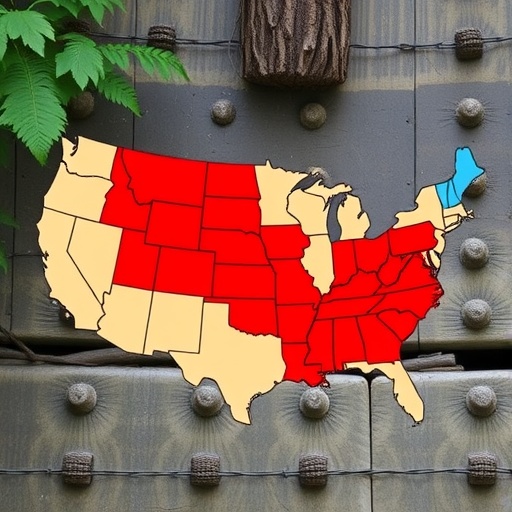
The investigators produced spatially explicit risk maps highlighting the probability of carbon loss induced by wildfire, drought, and insect infestation across the continental United States. These maps draw on historical disturbance patterns adjusted to incorporate future climate scenarios, unveiling how disturbance regimes are expected to evolve. Alarmingly, the land area prone to carbon reversals due to wildfire is projected to increase from 10% to 33%. Drought-related risks exhibit a more modest rise, from 19% to 21%, while insect-related risks expand from 23% to 25%. Certain high-risk zones, including Idaho, Southern California, Arizona, and New Mexico, show a greater than 80% likelihood of wildfire-driven carbon losses within the century.
Among these disturbance vectors, wildfire emerges as the predominant climate-sensitive threat to the durability of nature-based solutions based on forest carbon sequestration. This finding underscores the necessity of integrating robust, climate-informed risk assessments into the design of buffer pools and broader carbon offset methodologies. The failure to incorporate evolving disturbance dynamics could lead to overestimations of carbon permanence, thereby eroding the credibility and efficacy of carbon markets as tools in global climate strategy.
Developing predictive models and interactive tools that translate complex ecological and climatological data into actionable insights comprises a critical advance stemming from this research. The Wilkes Center has released such platforms to empower policymakers, forest managers, and conservationists in prioritizing regions for intervention that maximize ecological resilience and carbon storage longevity. This level of strategic planning represents a leap forward in aligning carbon credit projects with the realities of a changing climate.
Carbon credits are a major financial instrument facilitating nature-based climate solutions by incentivizing land stewardship practices that enhance carbon sequestration. By monetizing the carbon locked within living trees, these markets aim to provide economic drivers for forest preservation and reforestation. Yet, these benefits hinge fundamentally on the assumption that carbon stocks remain intact over centennial scales—an assumption increasingly challenged by climate-induced forest vulnerability.
The study authors emphasize that carbon offsets must be rigorously scrutinized to reflect the true permanence of their underlying sequestration. “A ton of carbon in the trees is not equivalent to a ton of fossil carbon emitted to the atmosphere if that tree carbon is at high risk of release in the near future,” explains William Anderegg, senior author and professor of biology. This conceptual nuance demands that carbon markets evolve to incorporate spatial heterogeneity and temporal trends in disturbance risk, elevating the scientific rigor in policy frameworks.
Current offset protocols often treat disturbance risks as spatially and temporally static, but this research conclusively demonstrates that such an assumption no longer holds. The variability in forest die-back susceptibility linked to climate change necessitates dynamic, adaptive buffering strategies that can respond to new evidence and emerging threats. Integrating cutting-edge predictive ecology with policy mechanisms offers a pathway to redesign offset systems that are both credible and resilient.
Additional investigations led by Anna Trugman’s lab at UC Santa Barbara continue to probe species-specific responses to climate stressors, aiming to identify which forest compositions may persist under future conditions and the management interventions most likely to bolster ecosystem resilience. This forward-looking research is critical for informing reforestation and restoration efforts that align with ecological realities rather than historical baselines.
Encouragingly, the research points to strategic opportunities: selectively focusing forest carbon projects in low-risk regions can enhance the durability of carbon storage investments. Avoiding areas with high probabilities of catastrophic disturbance allows carbon markets to better fulfill their climate mitigation promises. Moreover, this approach could incentivize refined conservation planning, ensuring resources are targeted where long-term carbon retention is viable.
Ultimately, this research represents a paradigm shift in how scientists and policymakers conceptualize forest carbon offsets. By explicitly accounting for uncertainties and incorporating climate projections into the design of carbon credit programs, the climate community can develop more robust safeguards against carbon reversals. This evolution is essential to maintain the integrity and ambition of nature-based climate solutions in the face of escalating global climate threats.
Keywords
Applied sciences and engineering, Environmental engineering, Environmental management, Deforestation, Silviculture, Forests, Carbon capture, Carbon sequestration, Carbon sinks, Carbon trading, Carbon emissions, Anthropogenic carbon dioxide, Droughts, Wildfires
Cite Scienmag News
Sloane Callahan. (May 20, 2026). Carbon Markets Undervalue Climate Change Threats to U.S. Forests. Scienmag. https://scienmag.com/carbon-markets-undervalue-climate-change-threats-to-u-s-forests/
Sloane Callahan. "Carbon Markets Undervalue Climate Change Threats to U.S. Forests." Scienmag, 20 May 2026, https://scienmag.com/carbon-markets-undervalue-climate-change-threats-to-u-s-forests/. Accessed 4 September 2026.
Sloane Callahan. "Carbon Markets Undervalue Climate Change Threats to U.S. Forests." Scienmag. May 20, 2026. https://scienmag.com/carbon-markets-undervalue-climate-change-threats-to-u-s-forests/


