


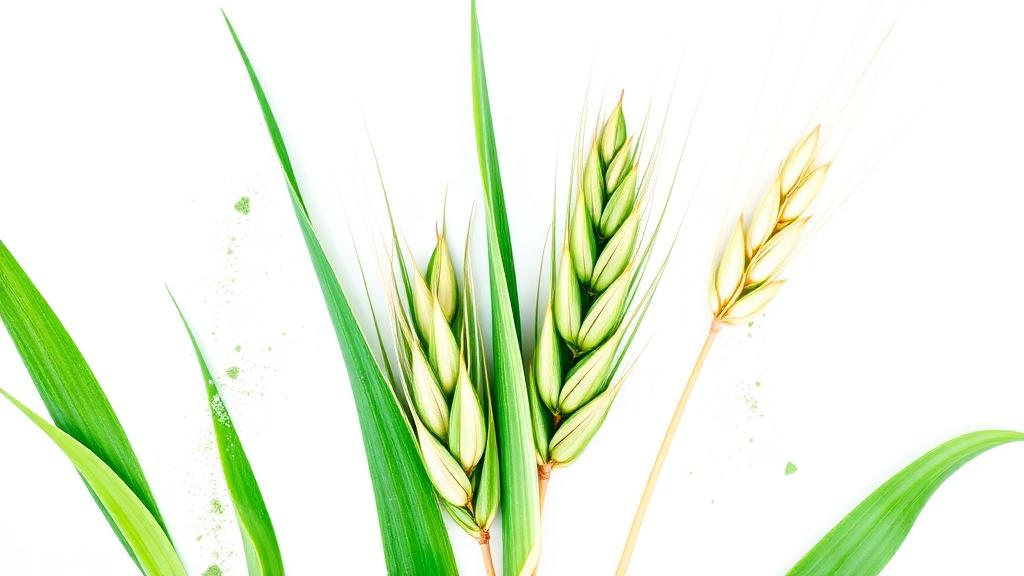
In the world of plant genetics, few phenotypes are as visually striking—and as scientifically revealing—as leaf variegation. Now, a team at the Leibniz Institute of Plant Genetics and Crop Plant Research (IPK) in Gatersleben, Germany, has cracked the genetic basis of a barley mutant whose leaves are streaked with white stripes, and the answer is unlike anything documented before in this crop. Writing in Theoretical and Applied Genetics, Hélène Pidon, Nils Stein and colleagues report that the variegation is not the work of a single faulty gene, as is typical for such mutants, but of two recessive mutations that must both be present before the stripes appear. The discovery marks the first time a digenic, epistatic control has been identified for a chloroplast-deficient mutant, and it points an unexpected finger at a cellular housekeeping system known as chloroplast proteostasis.
The story began when researchers spotted an unusual plant in a barley population treated with ethyl methane sulfonate, or EMS, a chemical mutagen that has been a workhorse of plant genetics since the 1950s. EMS sprinkles random point mutations throughout the genome, and when one of them disrupts a gene involved in chloroplast development, the result can be a plant with abnormal leaf coloration. The mutant in question, derived from the two-rowed winter barley cultivar Igri, displayed white stripes of varying intensity—some seedlings were nearly albino, while others bore only a few narrow white streaks. Crucially, unlike complete albinos, which die as seedlings because they cannot photosynthesize, variegated plants survive and set seed, making them ideal subjects for genetic analysis.
Under the microscope, the difference between green and white tissue was dramatic. Transmission electron microscopy of 14-day-old seedlings revealed that chloroplasts in the white sectors were significantly smaller than their healthy counterparts, still carrying prolamellar bodies—structures typical of immature plastids—and lacking the well-organized stacks of thylakoid membranes, called grana, that house the photosynthetic machinery. In other words, chloroplast biogenesis had stalled in the white sectors at an early stage of development. But the mutant held another surprise: after six months in the greenhouse, the white stripes gradually turned yellow, and electron microscopy showed that some plastids in these aging sectors had developed thylakoids and small grana. Chloroplast development, it seemed, could partially recover as the plant matured.
To dissect the inheritance of the trait, the team crossed the mutant with two green-fruited wild-type cultivars, Alraune and Igri, generating several large mapping populations. Reciprocal crosses produced similar proportions of variegated offspring regardless of which parent was the mutant, ruling out maternal or cytoplasmic inheritance and confirming that the trait is encoded in the nucleus. The segregation ratios in the second generation told an even more interesting story: they fit a 1:15 ratio, the classic signature of two recessive genes acting in duplicate dominant epistasis. In plain terms, a plant becomes variegated only if it is homozygous for the mutant allele at both loci simultaneously; a single functional copy of either gene is enough to keep the leaves green.
Mapping the two loci required a combination of modern genomic tools. The researchers used genotyping-by-sequencing on hundreds of F3 plants to build a linkage map, then applied interval mapping to pinpoint the regions associated with variegation. Two major loci emerged, one on chromosome 2H and one on chromosome 3H, which the team named Variegated 4 (var4) and Variegated 5 (var5), following barley gene-naming conventions. Neither interval overlapped with the regions previously linked to other barley variegation mutants such as albostrians, luteostrians or grandpa1.a, confirming that this was an entirely new genetic system. Because the intervals were initially enormous—spanning hundreds of millions of base pairs—the team turned to whole-genome resequencing of variegated and green progeny from a backcross to Igri to narrow the search.
The resequencing strategy exploited a key feature of EMS mutagenesis: it almost always converts cytosine to thymine or guanine to adenine. By filtering the thousands of polymorphisms in each interval for those with predicted moderate or high effects on proteins, and by requiring that the variants segregate correctly with the phenotype across six striped and twenty-four green plants, the researchers whittled each interval down to five candidate genes. At the var4 locus, one candidate stood out: a gene homologous to NBR1 in Arabidopsis, which encodes a selective autophagy receptor. In Arabidopsis, NBR1 recognizes photodamaged chloroplasts and directs their degradation through a microautophagy-like process, and it also regulates the levels of TOC proteins, the import machinery that controls which nuclear-encoded proteins enter the chloroplast. In the barley mutant, a glycine residue just sixteen amino acids upstream of the zinc finger domain is replaced by an aspartic acid—a negatively charged substitution that could distort the domain’s orientation and impair its binding efficiency.
At the var5 locus, the strongest candidate is a gene encoding a DNAJ-domain protein, a co-chaperone that works with HSP70 chaperones to keep chloroplast proteins properly folded. DNAJ proteins recognize unfolded or misfolded substrates and deliver them to HSP70s, which either refold them or route them to Clp proteases for degradation. In the mutant, a highly conserved serine—one present in 284 of 326 related proteins across monocots—is replaced by the bulky, hydrophobic phenylalanine within one of the protein’s two DUF3444 domains, a radical change likely to compromise function. Although the NBR1-like receptor and the DNAJ co-chaperone do not appear to interact directly, both sit at the heart of chloroplast proteostasis: the constant cycle of protein import, folding, assembly and degradation that keeps the organelle’s roughly 3,000 proteins—about 90 percent of them encoded in the nucleus and imported from the cytosol—in working order.
The epistasis now makes biological sense through a threshold model, echoing ideas developed for the classic Arabidopsis var2 mutant, in which a related protease partially compensates for the loss of its partner. Each of the two barley mutations, on its own, may inflict only a mild dent in proteostasis—too subtle to disturb chloroplast development. Together, however, the combined defects could push the system below a functional threshold, causing chloroplast biogenesis to collapse in some cells while others, perhaps by chance or through compensatory gene expression, recover sufficiently to stay green. The partial recovery observed in older plants fits this picture too: because the plastid proteome changes with developmental stage, the demands on proteostasis may ease over time, allowing some plastids in the formerly white sectors to resume development and turn yellow rather than staying white.
The researchers are careful to note that functional confirmation is still required. Only one of the ten candidate mutations is a predicted loss of function; the rest are amino acid substitutions with milder expected effects, which may be precisely why two loci had to combine before a phenotype appeared. Regulatory variants in non-coding regions, which the analysis did not exhaustively cover, cannot yet be ruled out, and finer mapping in populations where one locus is fixed will help confirm or refute the candidates. Still, the study delivers something genuinely new: a first glimpse of digenic control of chloroplast-deficient variegation, and a pair of candidate genes that tie the phenomenon to protein quality control inside the chloroplast. For a trait that has fascinated botanists for decades, the striped barley mutant suggests that sometimes it takes two wrongs—not one—to paint a leaf.
Subject of Research: Digenic epistatic control of leaf variegation and chloroplast proteostasis in an EMS-mutagenized barley line
Article Title: Leaf variegation in a barley EMS mutant is controlled by two epistatic mutations
Article References: Leaf variegation in a barley EMS mutant is controlled by two epistatic mutations. (n.d.). https://doi.org/10.1007/s00122-026-05370-y
Image Credits: AI Generated
DOI: 10.1007/s00122-026-05370-y
Keywords: barley, leaf variegation, chloroplast biogenesis, epistasis, EMS mutagenesis, proteostasis, NBR1, DNAJ, autophagy, genetic mapping, whole-genome resequencing, chloroplast
Cite Scienmag News
Alan Morgan. (October 14, 2026). Two Genes Team Up to Paint Barley Leaves in White and Green. Scienmag. https://scienmag.com/two-genes-team-up-to-paint-barley-leaves-in-white-and-green/
Alan Morgan. "Two Genes Team Up to Paint Barley Leaves in White and Green." Scienmag, 14 October 2026, https://scienmag.com/two-genes-team-up-to-paint-barley-leaves-in-white-and-green/. Accessed 14 October 2026.
Alan Morgan. "Two Genes Team Up to Paint Barley Leaves in White and Green." Scienmag. October 14, 2026. https://scienmag.com/two-genes-team-up-to-paint-barley-leaves-in-white-and-green/


