


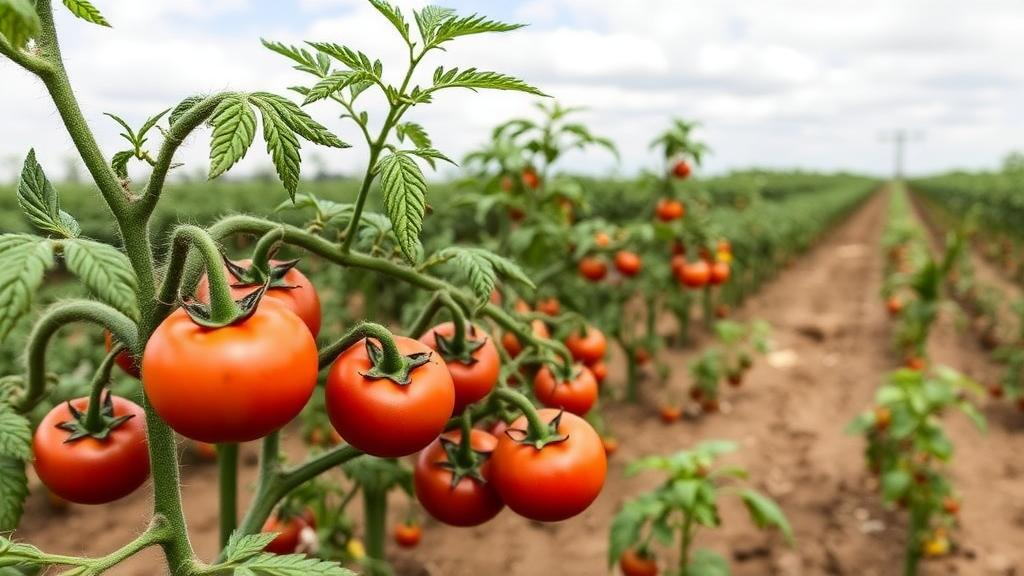
In the highland vegetable fields of Barangay Cabintan, Ormoc City, on the Philippine island of Leyte, tomato growers have watched their crops wilt and collapse for years without knowing exactly which microbe was to blame. A new study published in Discover Plants has now closed that gap, combining classical microbiology with DNA sequencing to confirm that the bacterium Ralstonia solanacearum is behind the bacterial wilt devastating local tomato and potato plantings. The work, led by Ailyn A. Abrantes of Visayas State University together with Ruben M. Gapasin, Anna Martha C. Monsanto, and Robelyn T. Piamonte, provides the first molecularly confirmed baseline for this important vegetable-producing region and lays the groundwork for future disease management strategies.
Bacterial wilt is one of the most feared diseases of solanaceous crops worldwide. Members of the Ralstonia solanacearum species complex, a group of closely related bacterial strains, attack an extraordinarily wide range of host plants, persist in soil and irrigation water for long periods, and can kill plants rapidly once they invade the water-conducting vascular tissue. In tropical and subtropical production areas such as the Philippines, the disease is a chronic constraint on vegetable farming. Previous surveys in Eastern Visayas reported an average bacterial wilt incidence of 30 percent in tomato, with incidence climbing to 78 percent in the open-field production area at Visayas State University in Baybay City. Despite this documented burden, the pathogen circulating in Cabintan had never been formally confirmed through molecular identification and pathogenicity testing, leaving farmers and extension workers without a reliable diagnostic foundation.
Cabintan is a significant vegetable hub where tomato is the dominant crop, grown mainly from January to June. Survey data collected over three years by the Australian Centre for International Agricultural Research had consistently recorded bacterial wilt symptoms during this cropping window, but symptoms alone can be deceptive. Closely related Ralstonia strains differ in their host associations and virulence, and colony appearance on culture media is not sufficient to distinguish them. The research team therefore set out to isolate bacteria from diseased plants and infested soil, characterize them morphologically, confirm their identity through 16S rRNA gene sequencing, and test their ability to cause disease in three tomato varieties commonly grown by local farmers.
Field collection was deliberately broad. Symptomatic tomato plants were gathered from six farming sites in Cabintan, while potato plants showing wilt were collected from a single site that had previously been planted with tomato. Because tomato and other solanaceous crops were off-season at several locations during the sampling period, the team also collected soil from four sites with a confirmed history of bacterial wilt and used a baiting technique, planting susceptible tomato seedlings in the soil, to recover any pathogen lurking there. For comparison, infected tomato plants were collected from the vegetable production area at Visayas State University. In the laboratory, stem tissue was surface-disinfected, suspended in sterile water, and streaked onto tetrazolium chloride agar, a selective medium on which typical Ralstonia colonies develop a distinctive creamy to light pink, fluidal, irregular appearance.
The isolates recovered, designated CAB01, CAB02, CAB03, and VSU, all displayed the hallmark morphology on tetrazolium chloride agar, with slightly raised to convex colonies ranging from creamy to light pink. Gram staining under the microscope at 1000 times magnification revealed pink-stained, rod-shaped cells, confirming that all four isolates were Gram-negative, consistent with Ralstonia. Genomic DNA was then extracted and the 16S rRNA gene, the standard workhorse of bacterial identification, was amplified using the universal primers 27F and 1492R, with additional internal primers 785F and 907R employed to improve sequence coverage. Bidirectional sequencing on an ABI PRISM analyzer produced high-quality reads that were compared against the NCBI database.
The molecular results were strikingly uniform. BLAST analysis showed that all four isolates shared 99.84 percent nucleotide identity with a reference R. solanacearum strain across the aligned region, and 100 percent similarity with one another, indicating a high level of genetic homogeneity among the bacteria associated with bacterial wilt in the study area. A phylogenetic tree built from the 16S rRNA sequences placed all four isolates firmly within the Ralstonia solanacearum species complex, clustered near reference sequences from the Philippines and Korea. The authors caution, however, that 16S rRNA has limited discriminatory power among closely related Ralstonia strains, so finer questions about population structure and diversity will require more discriminating molecular markers.
With identity confirmed, the team turned to pathogenicity testing, the gold standard for proving that a suspected pathogen actually causes the observed disease. Three-week-old seedlings of three commercially popular tomato varieties, Avatar TY F1, Diamante Max F1, and Jewel F1, were inoculated with 100 milliliters per pot of a standardized bacterial suspension containing approximately 1 times 10 to the eighth colony-forming units per milliliter. Roots were gently wounded before inoculation to facilitate bacterial entry, and plants were held in a humidity chamber for 48 hours before being transferred to a screenhouse and monitored for two weeks. Uninoculated controls receiving sterile water remained completely healthy throughout, and the inoculated bacteria were successfully re-isolated from symptomatic plants, satisfying the classical requirements for demonstrating pathogenicity.
The results revealed meaningful differences in aggressiveness among the isolates. The VSU isolate was the most virulent, causing 100 percent infection in all three tomato varieties, with symptoms appearing just three days after inoculation and infection climbing to 96.67 percent by nine days. The Cabintan isolates were generally less aggressive: CAB03 produced infection levels ranging from 23.3 to 56.7 percent depending on the variety, CAB01 from 16.7 to 50 percent, and CAB02 was the least aggressive, reaching only 13 to 20 percent. Area under the disease progress curve values, which integrate disease severity over time, mirrored this pattern, with the VSU isolate recording values of 410 to 530 across varieties compared with much lower figures for most Cabintan isolate and variety combinations. Statistical analysis by two-way analysis of variance confirmed that differences among isolates were significant, but differences among the three tomato varieties were not, and there was no significant isolate by variety interaction, meaning all varieties responded similarly to each isolate.
The authors are careful about what these findings do and do not imply. Jewel F1 and Diamante Max F1 are marketed as having intermediate resistance to bacterial wilt, while Avatar TY F1 is described as susceptible, yet all three developed disease under inoculation. The researchers emphasize that this should not be interpreted as evidence of resistance breakdown, since the study did not examine pathogen races, resistance genes, or the mechanisms of host resistance. They also note that the cooler nighttime temperatures of Cabintan, roughly 19 to 22 degrees Celsius, compared with the warmer conditions at Visayas State University, may influence the expression of virulence factors in Ralstonia, though environmental conditions were not experimentally controlled and this remains a hypothesis for future investigation.
For a region where tomato farming underpins rural livelihoods, the study delivers something deceptively simple but essential: proof of what the enemy actually is. By confirming the identity and pathogenicity of Ralstonia solanacearum isolates from Cabintan, the research establishes a baseline for future work on pathogen diversity, varietal response, and disease management, including breeding and screening programs that will need larger sample sizes, additional isolates, and higher-resolution genetic markers to tease apart the factors driving the observed variation in aggressiveness. In the meantime, the finding that all tested commercial cultivars can be infected underscores the urgency of developing integrated management approaches suited to the highlands of Leyte, where this persistent soil- and water-borne pathogen continues to stalk the fields each growing season.
Subject of Research: Morphological and molecular identification and pathogenicity testing of Ralstonia solanacearum isolates causing bacterial wilt of tomato in Cabintan, Philippines
Article Title: Morpho-molecular identification and pathogenicity of Ralstonia solanacearum associated with bacterial wilt in Cabintan, Philippines
Article References: Morpho-molecular identification and pathogenicity of Ralstonia solanacearum associated with bacterial wilt in Cabintan, Philippines. (n.d.). https://doi.org/10.1007/s44372-026-00945-x
Image Credits: AI Generated
DOI: 10.1007/s44372-026-00945-x
Keywords: Ralstonia solanacearum, bacterial wilt, tomato, 16S rRNA sequencing, pathogenicity, plant pathology, Philippines, Leyte, phytopathology, disease resistance, agriculture, species complex
Cite Scienmag News
Alan Morgan. (October 14, 2026). Bacterial Wilt Pathogen Confirmed in Philippine Tomato Fields by DNA Sequencing. Scienmag. https://scienmag.com/bacterial-wilt-pathogen-confirmed-in-philippine-tomato-fields-by-dna-sequencing/
Alan Morgan. "Bacterial Wilt Pathogen Confirmed in Philippine Tomato Fields by DNA Sequencing." Scienmag, 14 October 2026, https://scienmag.com/bacterial-wilt-pathogen-confirmed-in-philippine-tomato-fields-by-dna-sequencing/. Accessed 14 October 2026.
Alan Morgan. "Bacterial Wilt Pathogen Confirmed in Philippine Tomato Fields by DNA Sequencing." Scienmag. October 14, 2026. https://scienmag.com/bacterial-wilt-pathogen-confirmed-in-philippine-tomato-fields-by-dna-sequencing/


