


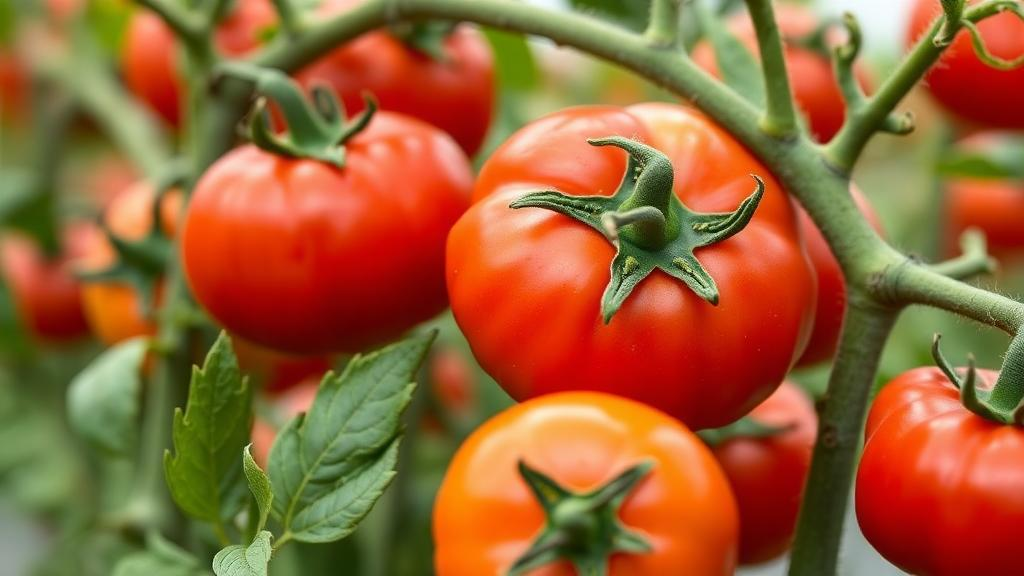
In the crowded, leafy chaos of a commercial greenhouse, a tomato fruit is rarely seen in full. Leaves drape over its shoulders, stems cross its face, neighboring fruits crowd its flanks, and a single camera captures only whatever surface happens to face the lens. For breeders and growers who depend on precise measurements of fruit size, shape, and weight, that partial view has long been a stubborn source of error. A new study published in Smart Agricultural Technology now shows that a deep learning system can digitally reconstruct the missing geometry of an occluded tomato from a single viewpoint, and that this reconstruction translates directly into more accurate estimates of diameter, volume, and weight.
The system, called ABox-PC, was developed by a research team working at a vegetable experimental station in Yan’an, Shaanxi Province, China. The team scanned tomato plants of the cultivar Jinpeng101 using a high-precision time-of-flight RGB-D camera capable of millimeter-level depth sensing across a range of 0.25 to 5.46 meters. Each scan file contained roughly 800,000 points describing the scene. After harvesting, the researchers manually measured each fruit’s horizontal diameter, vertical diameter, volume, and weight three times, averaging the values to create ground-truth references. In total, 222 fruits were collected, each annotated at the fruit level and paired with manual phenotypic measurements, forming the first such systematically paired dataset at the station.
The core problem the researchers set out to solve is geometric rather than photographic. A tomato fruit is a compact, approximately closed organ whose key traits, including its horizontal diameter, vertical diameter, shape ratio, and volume, are determined by its external contour and surface curvature. When occlusion removes part of the observable contour, the estimated centroid shifts, the principal orientation changes, and the measured spatial extent shrinks. Multi-view acquisition systems and rotating platforms can improve coverage, but in dense greenhouse canopies, occlusion is essentially unavoidable, and registration errors and complex acquisition logistics limit their practicality. The question was whether missing regions in an incomplete single-view point cloud could be recovered reliably before any downstream measurement was attempted.
Building the training data required careful experimental design. Of the 222 fruits, 113 had relatively complete single-view point clouds and were used to construct paired incomplete-reference samples: the researchers artificially deleted portions of each fruit’s surface, using local edge deletion at ratios of 15, 30, 45, and 60 percent, plus central deletion, while retaining the original scan as the reference. Rotation, scaling, and jittering augmented these pairs into 5,085 samples, split into 4,050 for model training and 1,035 for paired validation. The remaining 109 naturally occluded fruits were reserved as an independent real-scene test set. Because these fruits had no corresponding complete references, their reconstruction could only be assessed through visualization and downstream phenotypic accuracy against manual measurements, a distinction the authors emphasize throughout.
ABox-PC itself is a generative adversarial network built around a generator and a discriminator. The generator follows an encoder-decoder architecture: the encoder extracts global shape features from the partial input and produces a coarse 256-point cloud, while the decoder progressively refines the output through two refinement stages, expanding 512 seed points selected by farthest point sampling into 1,024 and then 2,048 points. The discriminator, trained on convolutional layers, multi-head self-attention, and adaptive max pooling, learns to distinguish generated clouds from real reference scans, pushing the generator toward plausible tomato geometry. Training combined a multi-stage Chamfer distance loss, applied at the coarse, intermediate, and final stages with weights annealed during training, and an adversarial loss that stabilized the output distribution.
The most distinctive component is the lightweight spatial transformer, or LST module, which addresses a problem specific to single-view greenhouse data: uneven point density. Rather than relying on a fixed neighborhood size across the whole dataset, the module estimates a local spatial scale for each query point from the average distance to its neighbors, then constructs an axis-aligned box that expands in sparse regions and contracts in dense ones. Neighboring points inside the box are grouped, their relative positions encoded, and their features aggregated through attention. Ablation experiments showed the value of this design: replacing the adaptive box with a fixed box size of 0.1 increased the average L1 Chamfer distance by 14.62 percent, with the penalty growing as deletion severity increased, while positional encoding and an eight-neighbor grouping each proved important for consistent performance.
The quantitative results are striking. On the paired-validation subset, ABox-PC achieved a squared L2 Chamfer distance of 784.76 square millimeters, the lowest among all tested models, reducing error by 57.72 percent relative to the strong CRA-PCN baseline and by more than 90 percent relative to the PointAttN baseline. Component ablations showed that self-normalization alone cut baseline error by 30.81 percent, while the LST module and adversarial learning individually reduced it by roughly 86 and 82 percent, with the full combination performing best. On the generic PCN benchmark of eight object categories, ABox-PC achieved an average L1 Chamfer distance of 6.53, comparable to AdaPoinTr and competitive with leading methods, indicating the architecture transfers beyond tomatoes without claiming state-of-the-art status on thin, branching objects such as lamps and tables.
Crucially, the improvements carried through to actual phenotyping. For the 109 naturally occluded fruits, the coefficient of determination for horizontal diameter estimation rose from 0.47 before completion to 0.79 after, and for vertical diameter from 0.57 to 0.78, with root mean square errors falling to 5.32 and 5.07 millimeters respectively. A paired statistical test confirmed a significant reduction in vertical diameter error, with a Holm-adjusted p-value below 0.001. The team also introduced an axis-weighted oriented bounding box method that downweights the sparse depth axis during principal-direction estimation, which outperformed both standard axis-aligned and oriented bounding boxes across all conditions.
Weight estimation showed perhaps the most dramatic gain. Using a spheroid volume formula combined with an empirical fruit density of 0.93 grams per cubic centimeter, drawn from historical breeding records independent of the study fruits, the direct physical estimate improved from an R-squared of 0.53 to 0.83 after completion, with root mean square error dropping from 48.76 to 29.77 grams and mean absolute percentage error from 20.12 to 10.26 percent. Because the formula and density value were held constant, the gains stem purely from better geometric inputs. Sensitivity analysis across densities from 0.90 to 0.95 grams per cubic centimeter showed the results were robust within that narrow, cultivar-specific range, though the authors caution that applications beyond Jinpeng101 would require recalibration.
The study also tested robustness under controlled deletion severity, comparing ABox-PC against spherical fitting, ellipsoidal fitting, mirror-symmetry completion, and CRA-PCN. The geometry-assumption methods degraded sharply at 45 and 60 percent deletion, while ABox-PC maintained the best horizontal-diameter accuracy at all four deletion levels and the best vertical-diameter accuracy from 30 to 60 percent, with weight-estimation errors propagating far less severely. The authors are candid about limitations: validation covered one cultivar, one greenhouse, one maturity stage, and one sensing configuration; the completed clouds recover only the visible surface, not the unobserved back side; and localized deviations persist under severe occlusion or when time-of-flight artifacts leave irregular points near boundaries. Processing takes roughly half a second per fruit on a consumer-grade RTX 4070 GPU, suggesting the pipeline could eventually run on handheld or robotic platforms. Future work will expand the dataset across cultivars, seasons, and devices, pair natural occlusions with geometric references from multi-view reconstruction, and explore uncertainty-aware completion, steps toward making single-shot, AI-corrected fruit measurement a routine tool in the greenhouse.
Subject of Research: Deep learning-based point cloud completion for single-view tomato fruit phenotyping in greenhouses
Article Title: ABox-PC: Adaptive box-guided completion of single-view tomato fruit point clouds for improved greenhouse phenotyping
Article References: Zhu, T., Wang, F., Feng, C., Huang, L., Mou, Q., Lu, X., Min, W., Hu, X., & Nie, Y. (2026). ABox-PC: Adaptive box-guided completion of single-view tomato fruit point clouds for improved greenhouse phenotyping. Smart Agricultural Technology, 15, Article 102625. https://doi.org/10.1016/j.atech.2026.102625
Image Credits: AI Generated
DOI: 10.1016/j.atech.2026.102625
Keywords: point cloud completion, tomato phenotyping, greenhouse sensing, generative adversarial network, 3D reconstruction, RGB-D camera, deep learning, fruit diameter estimation, weight estimation, occlusion, spatial transformer, precision agriculture
Cite Scienmag News
Alan Morgan. (October 14, 2026). AI Rebuilds Hidden Tomato Surfaces From a Single Camera Shot, Boosting Greenhouse Phenotyping. Scienmag. https://scienmag.com/ai-rebuilds-hidden-tomato-surfaces-from-a-single-camera-shot-boosting-greenhouse-phenotyping/
Alan Morgan. "AI Rebuilds Hidden Tomato Surfaces From a Single Camera Shot, Boosting Greenhouse Phenotyping." Scienmag, 14 October 2026, https://scienmag.com/ai-rebuilds-hidden-tomato-surfaces-from-a-single-camera-shot-boosting-greenhouse-phenotyping/. Accessed 14 October 2026.
Alan Morgan. "AI Rebuilds Hidden Tomato Surfaces From a Single Camera Shot, Boosting Greenhouse Phenotyping." Scienmag. October 14, 2026. https://scienmag.com/ai-rebuilds-hidden-tomato-surfaces-from-a-single-camera-shot-boosting-greenhouse-phenotyping/


