


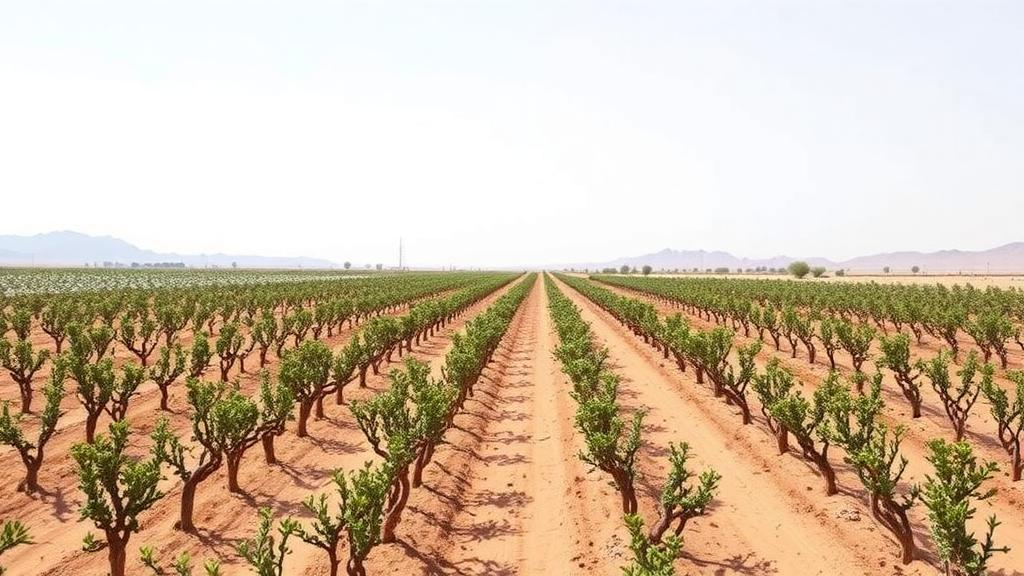
On the northwestern edge of the Taklamakan Desert, where annual rainfall can dip below 83 millimeters and summer soil temperatures climb into the high twenties, farmers have long coaxed cotton and jujube trees from unforgiving ground. Now a two-year field experiment conducted in Alar, in China’s Xinjiang Uygur Autonomous Region, offers one of the most detailed portraits yet of how nitrogen fertilizer shapes the climate footprint of such desert agroecosystems. The study, published in the Journal of Agriculture and Food Research, tracked carbon dioxide and methane fluxes, soil chemistry, crop yields, and a composite sustainability score across four nitrogen application rates, and its central finding is strikingly simple: more fertilizer is not better, and neither is none at all.
Agriculture contributes roughly 10 to 12 percent of global anthropogenic greenhouse gas emissions, and nitrogen fertilizer is one of its principal drivers. In China, where the government has pledged to peak carbon emissions by 2030 and achieve carbon neutrality by 2060, the stakes of getting fertilizer rates right are enormous. Yet most research on fertilizer-driven emissions has focused on monocultures. Intercropping systems that pair perennial trees with annual crops, such as the jujube-cotton combination widely grown in arid northwestern China, remain poorly studied, even though their aboveground and belowground interactions could fundamentally alter how soils exchange greenhouse gases with the atmosphere.
The research team, led by Yaru Zhao and Jinbin Wang of Tarim University and collaborators, set up a randomized complete block experiment on the upper reaches of the Tarim River, at 1,015 meters elevation on the desert’s edge. The jujube orchard had been established by direct seeding in 2012 and grafted with the Junzao cultivar in 2014. Cotton was planted in a distinctive one-row-to-four-rows pattern, with four cotton rows flanking each jujube row in a narrow-wide-narrow configuration at a density of 180,000 plants per hectare. Four nitrogen treatments were tested: zero fertilizer as a control, and 140, 280, and 420 kilograms of nitrogen per hectare, applied as urea in six proportional doses across the cotton growing season.
Gas measurements relied on the closed static chamber method, a technique that traps gases accumulating above a defined soil area so that fluxes can be calculated from the rate of concentration change. Stainless steel chambers were sampled every ten days, with extra collections one and three days after fertilization and irrigation events, always between 11:00 and 13:00 to minimize diurnal variability. Samples were analyzed within 24 hours on a gas chromatograph equipped with electron capture and flame ionization detectors. The researchers also measured soil temperature and moisture at each sampling, tracked total carbon and nitrogen at two soil depths, and computed a soil quality index and a nine-indicator sustainability index that integrated emissions, warming potential, emission intensity, and nutrient status.
The results revealed a clear dose-response relationship. Carbon dioxide fluxes surged one to three days after each fertilization event and peaked during the cotton flowering stage in mid to late July, when fertilization and irrigation coincided. Cumulative carbon dioxide emissions climbed steadily with nitrogen rate, reaching 5,803 kilograms per hectare in 2023 and 6,414 kilograms per hectare in 2024 under the highest rate. Cutting the rate from 420 to 280 kilograms per hectare reduced cumulative carbon dioxide emissions by 16.36 percent in 2023 and 11.48 percent in 2024, and lowered the combined carbon dioxide-methane global warming potential by 16.41 and 11.49 percent respectively.
Methane told the opposite story. Throughout both growing seasons, fluxes remained negative in every treatment, confirming that the dry intercropping soil acted as a net methane sink, a hallmark of aerobic desert ecosystems where methanotrophic bacteria oxidize atmospheric methane. But nitrogen suppressed this service. Under the highest fertilizer rate, cumulative methane uptake fell by 56.5 percent in 2023 and 38.6 percent in 2024 relative to the unfertilized control, likely because accumulated ammonium interferes with the methane monooxygenase enzyme that methanotrophs use to consume the gas. The moderate 280-kilogram rate preserved substantially more uptake, exceeding the high-rate treatment by nearly 16 percent in 2023.
The most consequential metric was the greenhouse gas intensity, which expresses emissions per unit of cotton lint yield and therefore captures both economic and environmental performance. This index followed a U-shaped curve: it fell as nitrogen increased from zero to 280 kilograms per hectare, then rose again at 420. The moderate rate reduced intensity by 22.17 percent in 2023 and 18.96 percent in 2024 compared with the high rate, and by 15.71 and 12.84 percent compared with no fertilizer at all. The lesson is that minimizing absolute emissions is not the same as minimizing the climate cost of production, because unfertilized plots yielded too little cotton to offset their smaller emission totals.
Yields reinforced the case for moderation. In 2023, the 280-kilogram treatment produced the highest seed cotton yield at 4,238 kilograms per hectare, 27.48 percent above the control and 11.13 percent above the high rate, while jujube yields were 18.03 percent higher than under the heaviest fertilization. In 2024, yield differences among treatments were not statistically significant, meaning that cutting nitrogen by a third imposed no measurable production penalty. Soil quality followed the same pattern: total carbon peaked at 30.49 grams per kilogram under the moderate rate, total nitrogen reached 1.31 to 1.43 grams per kilogram, and the soil quality index in the surface layer was 137.78 percent higher than in unfertilized plots, while the excessive rate actually degraded quality relative to moderation.
The sustainability index, which weighted nine indicators by their variability across treatments, ranked the moderate rate highest in both years, exceeding the control by 17.14 percent in 2023 and 21.70 percent in 2024. Crucially, the researchers stress-tested this ranking with sensitivity analyses, substituting equal weights for their coefficient-of-variation weights and replacing min-max normalization with Z-score standardization. The treatment ranking remained identical under all three schemes, with Spearman rank correlations of exactly 1.000, indicating the conclusion was not an artifact of a single statistical method.
The authors are candid about the limits of their findings. Nitrous oxide, a potent greenhouse gas closely tied to nitrogen transformations in fertilized soils, was not measured, so the reported warming potential and emission intensity are partial estimates that likely understate the true climate impact, particularly under high nitrogen inputs. The path model linking soil properties to emissions was exploratory, built on only twelve independent field plots. Still, the practical message stands on solid ground within the measured components: under the hot, dry conditions of southern Xinjiang, trimming nitrogen from 420 to 280 kilograms per hectare cut the emission burden per unit of lint, preserved the soil’s methane sink, avoided nitrate accumulation and leaching risk to groundwater, and sustained yields of two of the region’s most valuable crops. For desert farmers weighing fertilizer costs against environmental consequences, the middle path appears to be the right one.
Subject of Research: Nitrogen fertilizer optimization for greenhouse gas mitigation and soil quality in arid jujube-cotton intercropping systems
Article Title: Intercropping systems of jujube and cotton in arid regions: synergistic effects of nitrogen application on greenhouse gas emissions, soil quality, and system sustainability
Article References: Zhao, Y., Wang, J., Li, T., Song, Q., Cui, Z., Qiao, H., Li, X., Gulinigaer, T., Wan, S., & Chen, G. (2026). Intercropping systems of jujube and cotton in arid regions: synergistic effects of nitrogen application on greenhouse gas emissions, soil quality, and system sustainability. Journal of Agriculture and Food Research, Article 103370. https://doi.org/10.1016/j.jafr.2026.103370
Image Credits: AI Generated
DOI: 10.1016/j.jafr.2026.103370
Keywords: intercropping, nitrogen fertilizer, greenhouse gas emissions, carbon dioxide, methane uptake, soil quality, jujube, cotton, arid agriculture, Xinjiang, sustainability index, global warming potential
Cite Scienmag News
Alan Morgan. (October 14, 2026). Less Nitrogen, More Balance: Fine-Tuning Fertilizer Cuts Emissions in Desert Jujube-Cotton Farms. Scienmag. https://scienmag.com/less-nitrogen-more-balance-fine-tuning-fertilizer-cuts-emissions-in-desert-jujube-cotton-farms/
Alan Morgan. "Less Nitrogen, More Balance: Fine-Tuning Fertilizer Cuts Emissions in Desert Jujube-Cotton Farms." Scienmag, 14 October 2026, https://scienmag.com/less-nitrogen-more-balance-fine-tuning-fertilizer-cuts-emissions-in-desert-jujube-cotton-farms/. Accessed 14 October 2026.
Alan Morgan. "Less Nitrogen, More Balance: Fine-Tuning Fertilizer Cuts Emissions in Desert Jujube-Cotton Farms." Scienmag. October 14, 2026. https://scienmag.com/less-nitrogen-more-balance-fine-tuning-fertilizer-cuts-emissions-in-desert-jujube-cotton-farms/


