


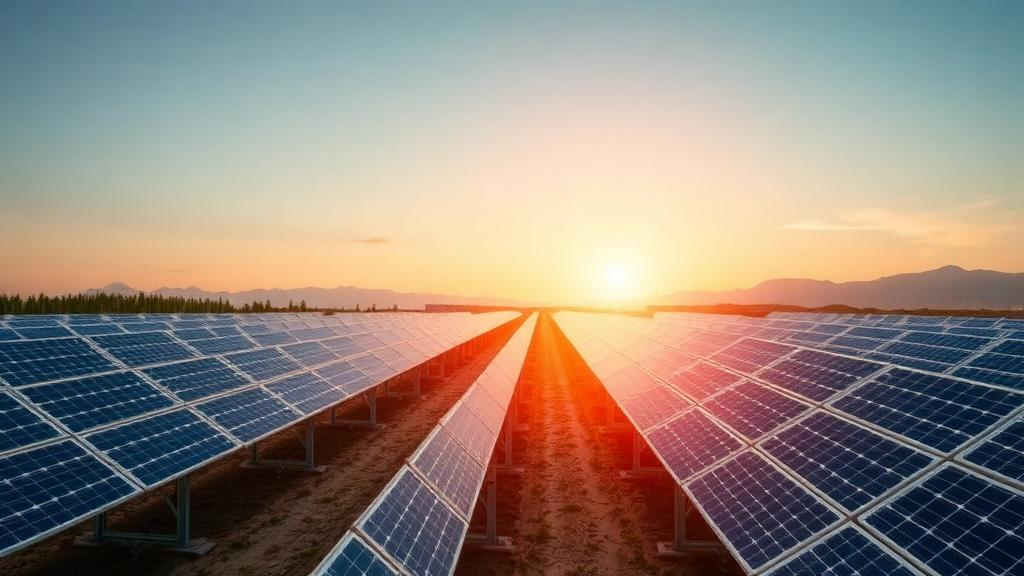
Solar power and farming have long competed for the same scarce resource: productive land. Now a field-tested digital platform developed in Türkiye promises to manage both at once, treating agrivoltaic installations not as awkward hybrids of two separate enterprises but as a single, intelligent system that senses, decides and reports in real time. The platform, deployed and evaluated throughout the 2025 growing season at a pilot site in Ayaş, Ankara, combines Internet of Things sensing, cloud-based data management, irrigation decision support and a novel economic indicator into one unified architecture, according to a study published in Smart Agricultural Technology.
The context is urgent. Global installed solar capacity reached approximately 2.39 terawatts in 2025 following a record annual addition of 511 gigawatts, and the COP28 commitment to triple renewable capacity by 2030 will demand even more land. Agrivoltaic systems, in which photovoltaic panels share ground with crops, offer an elegant answer, with partial shading reducing heat stress, improving soil-moisture retention and enhancing water-use efficiency, while dual income streams strengthen farm economics. Yet despite rapid deployment in Germany, France, Italy, Japan and China, Türkiye, despite averaging 2,640 sunshine hours and 1,527 kilowatt-hours per square metre of annual solar irradiation, has seen few practical implementations. The Ayaş pilot was designed to fill that gap under semi-arid Central Anatolian conditions.
What distinguishes the new work from previous digital agrivoltaics efforts is integration. Earlier projects have typically addressed only fragments of the problem: conceptual IoT frameworks without field validation, digital twins focused on panel control but blind to water, low-cost sensors with no decision layer, or fertigation platforms with no photovoltaic management or financial module. The Ayaş platform, by contrast, weaves environmental monitoring, crop observation, irrigation scheduling, photovoltaic operational modules and techno-economic evaluation into a single decision-support environment. The authors state that, to their knowledge, no previous study has reported a field-deployed platform combining all of these functions within one architecture.
The hardware foundation is a layered sensor network. Two meteorological stations track air temperature, humidity, rainfall, pressure, wind and solar irradiance every 15 minutes. Pyranometers measure incoming radiation on both the front and rear faces of the bifacial modules, while photosynthetically active radiation sensors quantify the light actually available to crops under the panels and in the open field. Twelve soil-moisture probes and twelve soil-temperature sensors, distributed between 10 and 60 centimetres deep in both shaded and unshaded plots, feed the irrigation logic, alongside flow meters and solenoid valves on the irrigation lines. An ESP32-based gateway and remote terminal units timestamp every record, and an edge-processing layer validates the data before it reaches the cloud, flagging physically implausible values, duplicates and isolated spikes, and buffering measurements during communication outages rather than fabricating replacements.
The pilot installation itself pairs a 122-kilowatt-peak array of bifacial crystalline-silicon modules, elevated 3.72 metres above ground with a 36 percent ground coverage ratio, against an adjacent 1,613-square-metre open-field reference plot of identical size. Four horticultural crops, table tomato, processing tomato, capia pepper and bell pepper, were transplanted into both zones on 31 May 2025 at identical densities, with more than 5,800 seedlings established in total. Because the two plots shared soil characteristics, irrigation practice and climatic exposure, differences in performance could be attributed to the shading environment rather than to other variables.
The crop results tell a strikingly species-dependent story. Capia pepper proved remarkably tolerant of the agrivoltaic microclimate, yielding 3,064 kilograms per decare against a reference yield of 3,104, a reduction of just 1.3 percent. Bell pepper lost 15.6 percent, while table tomato and processing tomato fell by 23.5 and 34.7 percent respectively, revealing the greater sensitivity of tomatoes to reduced incident radiation. Just as intriguing, the shading extended the harvest window: open-field table tomato production ended on 17 September 2025, whereas plants beneath the panels kept producing until 23 October. Processing tomato and capia pepper showed the same pattern, suggesting that agrivoltaic conditions can stagger and prolong harvests in ways that may carry real market value for growers.
On the water side, the irrigation module fuses root-zone soil moisture, soil temperature and rainfall observations with the FAO-56 Readily Available Water methodology. Crop-specific thresholds were derived from field capacity and permanent wilting point estimates, the latter calculated for Ayaş’s heavy clayey soils using Saxton–Rawls pedotransfer functions. A recommendation to irrigate is issued only when the soil-moisture index drops below the threshold, root-zone temperature sits within the 15 to 30 degree Celsius window suitable for crop development, and no significant rainfall has occurred in the preceding 12 hours, with confirmation required across two consecutive 15-minute measurement intervals. Across five monthly monitoring periods the module generated 15 recommendation days: seven for processing tomato, five for bell pepper, three for capia pepper and none for table tomato, whose soil moisture stayed marginally above threshold. Notably, average soil-water depletion remained around 11 percent of available capacity, well below the FAO-56 allowable limits of 30 to 40 percent, indicating that the site’s conventional fixed schedule was probably over-irrigating, and that demand-based scheduling could deliver substantial water savings.
The economic innovation is arguably the paper’s boldest contribution. Conventional levelized cost of electricity metrics capture only power generation, ignoring the crops that agrivoltaic land also produces. The team therefore proposes the Levelized Cost of the Agrivoltaic System, or LCOAS, which adds agricultural operating costs to the numerator and converts crop revenue into electricity-equivalent energy by dividing it by the prevailing electricity price. Applied to the 2025 season, with a unit capital cost of 1,230 euros per kilowatt-peak totalling 150,060 euros and seasonally allocated through a capital recovery factor, the pilot returned an LCOAS of 0.0846 euros per kilowatt-hour equivalent. Total seasonal income reached 8,093.20 euros, of which 6,080 euros came from electricity and 2,013.20 euros from crops, against 6,850.07 euros in expenses, leaving a seasonal net benefit of 1,243.13 euros and a positive net agricultural profit of 301.98 euros. For a system in its first season, the framework offers operators a single comparable number spanning both enterprises.
Two further modules, a panel-cleaning advisor that recommends washing only when accumulated soiling losses exceed cleaning costs, and a multi-objective panel-angle manager balancing energy yield against crop light needs, are presented as proof-of-concept components with integrated interfaces but were not executed or validated in the field. The authors are candid about this and about the study’s other limits: one site, one season, four crops. Still, the demonstration matters. It shows that a working farm-scale agrivoltaic array can be run through a single digital nervous system, converting streams of raw sensor data into irrigation advice, crop comparisons and integrated economics, and it offers a practical template for the multi-site, multi-season validation that will determine whether agrivoltaics can scale from promising niche to mainstream land-use strategy.
Subject of Research: An IoT-based decision-support platform for managing agrivoltaic solar and crop production
Article Title: An integrated IoT-based decision-support platform for agrivoltaic systems: Design, implementation and pilot-scale field evaluation
Article References: Gümüş, H., Çubukçu, M., Kuzyaka, D., Çolak, N., Yüksel, M., Altındişli, A., Zafer, C., & Özden, T. (2026). An integrated IoT-based decision-support platform for agrivoltaic systems: Design, implementation and pilot-scale field evaluation. Smart Agricultural Technology, 15, Article 102579. https://doi.org/10.1016/j.atech.2026.102579
Image Credits: AI Generated
DOI: 10.1016/j.atech.2026.102579
Keywords: agrivoltaics, Internet of Things, precision agriculture, photovoltaics, irrigation scheduling, decision-support platform, smart farming, LCOAS, soil moisture sensors, renewable energy, food security, Türkiye
Cite Scienmag News
Alan Morgan. (October 14, 2026). Smart Platform Puts Solar Farms and Crops Under One Digital Brain. Scienmag. https://scienmag.com/smart-platform-puts-solar-farms-and-crops-under-one-digital-brain/
Alan Morgan. "Smart Platform Puts Solar Farms and Crops Under One Digital Brain." Scienmag, 14 October 2026, https://scienmag.com/smart-platform-puts-solar-farms-and-crops-under-one-digital-brain/. Accessed 14 October 2026.
Alan Morgan. "Smart Platform Puts Solar Farms and Crops Under One Digital Brain." Scienmag. October 14, 2026. https://scienmag.com/smart-platform-puts-solar-farms-and-crops-under-one-digital-brain/


