


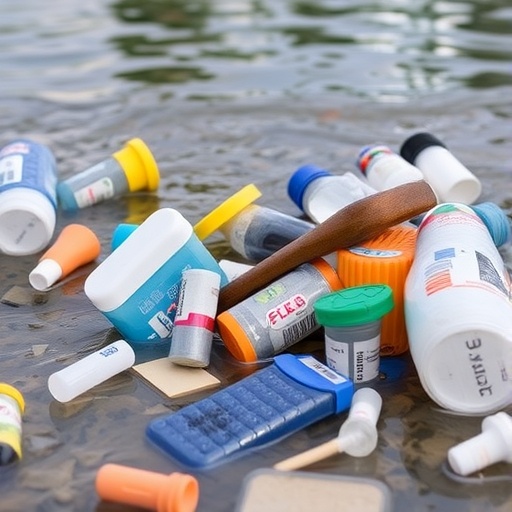
In recent years, the proliferation of plastic pollution in aquatic environments has raised substantial concerns about its ecological and public health impacts. A groundbreaking study conducted by Yinglong Su and colleagues at East China Normal University, published in Biocontaminant in early 2026, has unveiled critical insights into how different types of plastics—specifically biodegradable and conventional polymers—shape the dynamics of antibiotic resistance genes (ARGs) and virulence factors (VFs) within microbial communities forming on their surfaces. This research challenges longstanding assumptions about the inherently safer profiles of biodegradable plastics and calls for a more nuanced understanding of the environmental risks associated with plastic debris in water systems.
Plastics entering aquatic systems rapidly develop complex biofilms commonly referred to as the “plastisphere.” This biofilm serves as an ecological niche that selectively enriches microorganisms distinct from those found in the surrounding water. Among these microbes are bacteria that harbor ARGs and VFs, which are genetic components capable of promoting antibiotic resistance and pathogenicity. Importantly, these traits can be disseminated between microorganisms via mobile genetic elements (MGEs) such as plasmids, transposons, and insertion sequences, thereby amplifying the potential for horizontal gene transfer. This process increases the persistence of resistant and virulent strains in the environment, posing substantial threats to ecosystem stability and human health.
Conventional plastics like polyvinyl chloride (PVC) and polystyrene (PS) are known for their longevity, able to persist in the environment for decades. In contrast, biodegradable plastics such as polylactic acid (PLA) have been introduced as ostensibly eco-friendlier alternatives designed to break down more quickly under environmental conditions. However, the complex interplay between these materials and microbial colonizers—specifically how they influence the accumulation and turnover of ARGs and VFs over time—has remained largely unexplored in realistic environmental settings until now.
In a meticulously designed 88-day in situ incubation experiment within a natural tidal river environment, Su and his team systematically investigated the temporal dynamics of microbial communities and associated antibiotic resistance across the surfaces of PLA, PVC, and PS plastics. By integrating time-series sampling with high-throughput metagenomic sequencing, along with ordination analyses, gene functional profiling, and genome-resolved metagenomics, the researchers elucidated how plastic polymer types distinctly influence plastisphere assembly and risk profiles.
Principal coordinates analysis (PCoA) at the genus level strikingly demonstrated that all plastic types fostered microbial communities significantly different from those in ambient river water, confirming the establishment of a specialized plastisphere niche. Notably, PLA and PS communities exhibited partial overlap, while PVC biofilms diverged more distinctly along secondary axes, implying that the chemical and physical properties of the plastic materials impose specific selective pressures on colonizing microorganisms, thereby driving unique community structures.
The dominant colonizers identified across these plastispheres included Limnohabitans spp., Burkholderiales bacteria, and Caudovirales phages. These organisms were originally sourced from the surrounding water but were notably enriched on plastic surfaces, highlighting the selective amplification effect exerted by plastic substrates. This selective colonization is critical because it effectively concentrates microbial populations with distinct genetic repertoires, including those possessing ARGs and VFs.
Functionally profiling resistance genes revealed divergent trajectories among the plastic types. Although ARG diversity was lower on plastics than in the surrounding water—indicative of selective enrichment rather than mere accumulation—the prevalence of multidrug resistance genes was predominant across all plastisphere samples. PVC consistently exhibited the highest absolute abundance of ARGs and associated MGEs, including an elevated presence of transposases and insertion sequences, which are key components facilitating horizontal gene transfer. This finding positions PVC as a persistent environmental reservoir with strong capacities for resistance gene proliferation.
Conversely, PS plastic supported relatively stable but moderate resistance profiles, suggesting a less dynamic but consistent risk. The biodegradable PLA exhibited a markedly different pattern. Initially, resistance gene levels were suppressed; however, during mid-degradation phases, PLA biofilms showed transient but intense spikes in multidrug and glycopeptide resistance genes. This pronounced surge signals acute but short-lived risk windows associated with the biodegradation process, a dimension of environmental hazard previously underappreciated in discussions about biodegradable plastics.
Network analyses further delineated the coupling between ARGs and MGEs, which was strongest in the PVC plastisphere and river water samples. In contrast, PLA and PS communities exhibited more specific and limited ARG–MGE associations, reinforcing the concept of material-dependent variation in resistance gene mobilization potential. The implications are stark, as strong ARG–MGE linkage enhances the spread of resistance determinants among microbial populations.
Crucially, genome-resolved metagenomic reconstruction allowed the direct association of ARGs, VFs, and MGEs within individual microbial genomes. This approach identified high-risk PVC-associated microbial strains harboring pathogenicity and resistance genes alongside mobile elements, underscoring the heightened threat posed by conventional plastics as reservoirs of multi-trait risk. The presence of such strains increases the probability of pathogenic, antibiotic-resistant bacteria entering food chains or human-contact environments.
Together, these insights reveal that plastic type is a fundamental determinant of microbial niche assembly and antibiotic resistance risk dynamics in aquatic environments. Conventional plastics act as chronic hubs, facilitating the long-term accumulation and horizontal transfer of resistance genes. In contrast, biodegradable plastics, while reducing environmental persistence, may elicit acute episodic health risks due to intensified microbial activity during degradation bursts.
This study critically reframes the environmental risk discourse surrounding plastic pollution, emphasizing that assessments must move beyond simplistic degradability metrics to encompass an entire lifecycle perspective. Environmental policies and mitigation strategies must balance the long-lived contamination risks associated with traditional plastics against the short-term but potentially hazardous microbial upheavals induced by biodegradable materials.
In conclusion, the juxtaposition of sustained resistance gene reservoirs in conventional plastics with transient but acute spikes in biodegradable plastics highlights a complex risk landscape. This necessitates comprehensive, polymer-specific research methodologies and regulatory frameworks to safeguard ecosystem and human health in the face of escalating plastic pollution challenges.
Cite Scienmag News
Juliet Wilcox. (March 25, 2026). Tracing Antibiotic Resistance: How Various Plastics in River Debris Pose Distinct Environmental Risks. Scienmag. https://scienmag.com/tracing-antibiotic-resistance-how-various-plastics-in-river-debris-pose-distinct-environmental-risks/
Juliet Wilcox. "Tracing Antibiotic Resistance: How Various Plastics in River Debris Pose Distinct Environmental Risks." Scienmag, 25 March 2026, https://scienmag.com/tracing-antibiotic-resistance-how-various-plastics-in-river-debris-pose-distinct-environmental-risks/. Accessed 4 September 2026.
Juliet Wilcox. "Tracing Antibiotic Resistance: How Various Plastics in River Debris Pose Distinct Environmental Risks." Scienmag. March 25, 2026. https://scienmag.com/tracing-antibiotic-resistance-how-various-plastics-in-river-debris-pose-distinct-environmental-risks/


