


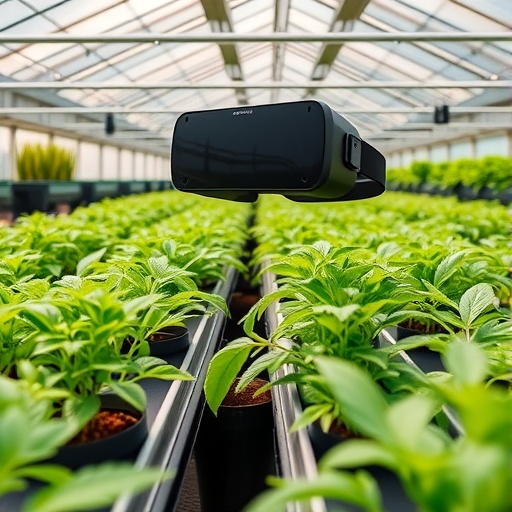
In a groundbreaking advancement blending agriculture and cutting-edge technology, engineers at Binghamton University, State University of New York, have unveiled a revolutionary system that bridges the gap between physical farming and virtual reality. This innovative platform enables users to monitor and interact with real plants through an immersive digital twin of an actual farm. By integrating sensor data into a fully navigable three-dimensional virtual environment, this technology promises to reshape how cultivation is managed, particularly enhancing accessibility for older adults and individuals with disabilities.
Traditional farming and greenhouse monitoring rely heavily on sensor networks that collect essential parameters such as temperature, humidity, and gas concentrations in the environment. However, conventional monitoring systems typically present this information through two-dimensional dashboards and graphs, which lack spatial context and the intuitive depth perception one gains from being physically present among crops. Recognizing this limitation, the team at Binghamton University engineered a mixed reality solution that virtualizes a real greenhouse, allowing the user to traverse the space and inspect plants as if physically on-site.
At its core, the system functions by capturing photographic images of plants and converting them into high-fidelity three-dimensional objects within a virtual scene. Embedded microcontrollers placed at the soil level or in proximity to each plant continuously measure critical environmental variables—humidity, temperature, and gaseous emissions like CO2 or ethylene—which are then transmitted in real time to the digital twin environment. This real-time data integration ensures that the virtual representation mirrors the conditions of the physical farm instantaneously, providing an unprecedented level of remote interaction and monitoring capability.
Users equipped with virtual reality goggles can immerse themselves in a meticulously detailed virtual greenhouse that replicates their actual farming environment. They can navigate through rows of plants, inspect individual specimens, and access current sensor readings on each plant via interactive visual cues. This mixed reality interface allows for a hands-on experience without the need for physical presence, which is particularly transformative for growers with mobility constraints or those who reside far from their farms.
Beyond accessibility, the digital twin farm offers an invaluable educational tool. Students and researchers in biological and agricultural sciences can engage with living plant ecosystems virtually, gaining insights into plant development and environmental influences through direct interaction with sensor-driven data. This hands-on experiential learning could enhance comprehension of complex growth dynamics, disease progression, and resource management in a controlled but realistic setting.
The engineering challenges to synchronize sensor data with realistic 3D models were significant. Developing miniaturized, reliable sensor nodes that communicate wirelessly to a centralized system required advances in biosensor technology and embedded systems engineering. The IoT (Internet of Things) sensor nodes are designed to be both durable and energy-efficient while maintaining sufficient precision to capture subtle yet critical variations in microclimate conditions affecting plant health.
The immersive digital twin harnesses mixed reality to blend data visualization seamlessly with naturalistic representation. Rather than overlaying raw numbers, the system integrates environmental readings contextually, empowering users to intuitively understand the plant’s state by any variations in ambient conditions or health metrics. This approach transforms abstract data into actionable knowledge while preserving the engaging qualities of virtual exploration.
As per Anwar Elhadad, assistant professor of electrical and computer engineering at Binghamton University, the core value of the platform lies in how it replicates the experience of being physically present in a greenhouse without the need for travel or physical exertion. By bridging this experiential gap, the technology has the potential to democratize agricultural management, making it accessible to populations that previously faced barriers due to physical or geographic challenges.
Lead researcher Mohamed Gallai, a PhD student specializing in electrical and computer engineering, highlights that the design principles prioritize user accessibility. The system’s interfaces are developed to be intuitive and easily navigable, ensuring that even users unfamiliar with traditional farming technology or VR systems can benefit from comprehensive monitoring capabilities.
Looking forward, the researchers envision scaling the system to accommodate a large number of sensor nodes dispersed across extensive agricultural operations. This scalability would allow commercial farms to integrate digital twin technology, facilitating more precise monitoring, early disease detection, and optimized environmental control, ultimately enhancing yield quality and sustainability.
The integration of virtual reality with IoT-driven sensor data represents a paradigm shift in agricultural technology. This “immersive digital twin” framework opens avenues for enhanced remote farm management, reduces dependency on physical labor for routine monitoring, and enriches data-driven decision-making processes. While still in early development stages, the project’s potential to transform agricultural engineering and applied biosciences is substantial.
Contributors to this pioneering project include PhD students Azaz-Ur-Rehman Nasir and Ofelia Huerta, who have been instrumental in system design and data integration frameworks. Their collaborative work culminated in a publication titled “Immersive Digital Twin Framework for Reliability Monitoring of IoT Sensor Nodes Using Mixed Reality,” which was presented at the prestigious 35th Microelectronics Design and Test Symposium.
This research initiative exemplifies the synergetic possibilities when engineering disciplines converge with agricultural sciences, offering a forward-looking perspective on how digital technology can enhance sustainability, accessibility, and education in farming. As sensor technologies continue to miniaturize and computational models grow increasingly sophisticated, digital twin farms may become a cornerstone in the future of precision agriculture worldwide.
Cite Scienmag News
Alan Morgan. (May 27, 2026). Your Private VR Greenhouse: Remotely Monitor and Manage Crops with Cutting-Edge Technology. Scienmag. https://scienmag.com/your-private-vr-greenhouse-remotely-monitor-and-manage-crops-with-cutting-edge-technology/
Alan Morgan. "Your Private VR Greenhouse: Remotely Monitor and Manage Crops with Cutting-Edge Technology." Scienmag, 27 May 2026, https://scienmag.com/your-private-vr-greenhouse-remotely-monitor-and-manage-crops-with-cutting-edge-technology/. Accessed 3 September 2026.
Alan Morgan. "Your Private VR Greenhouse: Remotely Monitor and Manage Crops with Cutting-Edge Technology." Scienmag. May 27, 2026. https://scienmag.com/your-private-vr-greenhouse-remotely-monitor-and-manage-crops-with-cutting-edge-technology/


