


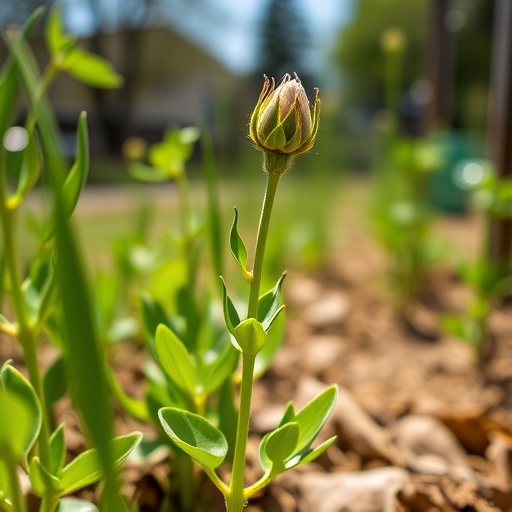
A sunflower may look recovered after a drought, but inside its stem and leaves, the damage can remain permanently etched into the plant’s water-transport system. New research from Colorado State University, the University of Colorado Boulder and the U.S. Department of Agriculture has challenged the widely held idea that sunflowers can repair drought-induced blockages in their xylem after water returns. The findings suggest that a plant’s visible revival can conceal lasting damage deep within its vascular tissue, raising important questions about how crops survive increasingly severe and frequent droughts.
When soil becomes dry, plants face a hydraulic crisis. Water is pulled upward from the roots through the xylem, a network of microscopic conduits that supplies stems, leaves and flowers. This movement is driven largely by tension created as water evaporates from leaf surfaces during transpiration. Under drought conditions, that tension becomes extreme. If the water column inside a xylem vessel breaks, air can enter and form an embolism, essentially a gas bubble that interrupts the continuous pathway needed to transport water.
Embolisms are comparable to air locks in a plumbing system, but they occur within living plant tissue and can spread through the xylem as drought intensifies. Once a conduit is blocked, water must move through alternative pathways, placing greater pressure on the remaining functional tissue. If enough conduits fail, leaves may lose their ability to maintain hydration, expand and carry out photosynthesis. In severe cases, the plant’s entire hydraulic system can collapse, resulting in tissue death or plant mortality.
For years, however, sunflowers were considered a striking exception to this pattern. Earlier studies reported that drought-stressed sunflowers could recover their hydraulic function after being watered, apparently by refilling embolized xylem conduits. The proposed process, known as embolism refilling, suggested that plants might actively remove air from damaged vessels and restore the flow of water. Such a mechanism would have major implications for agriculture because it could explain how some crops resume growth after drought without rebuilding their entire vascular system.
The new study finds no evidence that this refilling occurs in intact sunflowers. Although the plants appeared to recover rapidly after watering, embolisms accumulated in their stems and leaves remained visible. The research team used microcomputed tomography, or microCT, to observe the internal structure of living plants without cutting them apart. The technique produces detailed three-dimensional images of xylem tissue, allowing researchers to track air-filled conduits in the same plant over time and to determine whether those conduits actually returned to a water-filled state.
This distinction is crucial because destructive sampling can unintentionally create the appearance of recovery. Cutting a dehydrated stem may alter water pressures inside the tissue, introduce air into conduits or cause existing bubbles to shift. Researchers examining separate pieces of a plant before and after rewatering may therefore mistake an artifact of handling for a biological repair process. By scanning intact sunflowers, the team was able to monitor the same xylem network during drought and after rehydration, avoiding some of the mechanical disturbances that complicate conventional measurements.
“The strain of extracting water from dry soil can introduce air into the tissue responsible for moving water from the roots to leaves,” said Troy Ocheltree, an associate professor in Colorado State University’s Warner College of Natural Resources and a co-author of the study. “Once this happens, the air blockage prevents the leaves from getting the water they need to grow and photosynthesize.” The observation helps explain why plants can regain a healthy appearance without fully restoring their internal water-transport capacity. Rehydrated leaves may regain firmness as surviving conduits begin carrying water again, but the damaged conduits themselves may remain blocked.
The study also complicates the idea that embolism refilling is either impossible or widespread across the plant kingdom. In earlier work, the same research group documented complete reversal of embolism and full hydraulic recovery in barnyard grass within 24 hours of watering. That study provided direct evidence that an intact plant could refill embolized tissue. The contrasting results in sunflowers indicate that refilling may depend on species-specific anatomy, physiology or environmental strategy rather than representing a universal response to drought.
“Most researchers’ opinions fall into one of two dichotomous extremes: refilling never occurs, or refilling is relatively common,” said Jared Stewart, the study’s lead author and a postdoctoral researcher at Colorado State University and the University of Colorado Boulder. “The combination of our two studies means almost everyone is wrong.” The researchers argue that the key question is no longer whether plants refill embolized xylem in general, but which plants can do it, under what conditions and through which mechanisms. The answers could help scientists identify crops that maintain or restore hydraulic function after water shortages.
The findings are particularly relevant as drought reshapes agricultural production in many regions. A sunflower that survives a dry spell may still carry hidden vascular damage that limits later growth, photosynthetic performance or seed development. Plants with the capacity to refill embolized conduits could have a substantial advantage in environments where rainfall is erratic, while species that cannot refill may need different adaptations, such as deeper roots, tighter control of water loss or more redundant xylem networks. Understanding these differences could guide breeding programs aimed at producing crops that remain productive during repeated drought cycles rather than merely surviving a single episode.
The researchers emphasize that apparent recovery should not be confused with complete physiological recovery. Sunflowers may restore leaf water content and resume some photosynthesis through the xylem conduits that remain functional, even while a significant portion of their vascular system stays embolized. This partial recovery may allow the plant to continue living, but it does not erase the consequences of drought. The new work therefore presents a more nuanced picture of resilience: recovery can be visible, rapid and biologically meaningful while still falling short of true repair.
The article, titled “No evidence of xylem embolism refilling during recovery from drought stress in intact sunflowers,” is published in the Journal of Experimental Botany. By pairing non-destructive imaging with comparisons across plant species, the study offers a clearer view of how drought affects the microscopic plumbing that sustains plant life. Its central message is both sobering and useful: watering a wilted sunflower may bring it back to life, but it may not restore everything that drought took away.
News Publication Date: 17 June 2026
Web References: https://academic.oup.com/jxb/advance-article/doi/10.1093/jxb/erag294/8709375?login=false; https://source.colostate.edu/drought-resilient-plant/
References: Journal of Experimental Botany, DOI: 10.1093/jxb/erag294
Cite Scienmag News
Alan Morgan. (August 17, 2026). New study overturns earlier findings on how plants recover from drought. Scienmag. https://scienmag.com/new-study-overturns-earlier-findings-on-how-plants-recover-from-drought/
Alan Morgan. "New study overturns earlier findings on how plants recover from drought." Scienmag, 17 August 2026, https://scienmag.com/new-study-overturns-earlier-findings-on-how-plants-recover-from-drought/. Accessed 4 September 2026.
Alan Morgan. "New study overturns earlier findings on how plants recover from drought." Scienmag. August 17, 2026. https://scienmag.com/new-study-overturns-earlier-findings-on-how-plants-recover-from-drought/


