


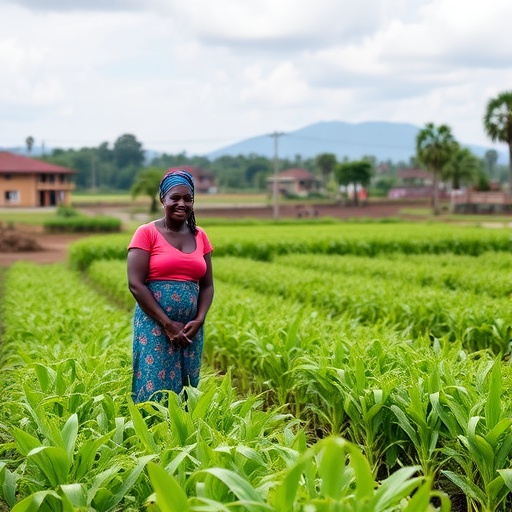
Farmer groups and digital agricultural networks are helping smallholders in sub-Saharan Africa sell crops, access information and coordinate their economic activities—but a new study suggests that these gains do not automatically give women a stronger voice in leadership or household and community decision-making. Research published in Food and Energy Security finds that participation in Uganda’s MasterCard Farmer Network was associated with higher levels of collective agency among common bean farmers, yet the program did not close persistent gender gaps. In some measures, network participation appeared to widen the difference between men and women, revealing a central challenge for development programs: improving market access is not the same as transforming power relations.
The study examined 653 common bean farmers across 13 districts in Uganda, comparing members of farmer groups supported by the MasterCard Farmer Network, or MFN, with members of similar groups that did not receive the same support. MFN is a digital platform designed to connect farmers with markets, payments and agricultural information. The researchers focused on a concept known as “individual-level collective agency,” which describes a person’s ability to work with others to pursue shared or personal goals. Rather than measuring empowerment only through income or market participation, the analysis considered several dimensions of agency, including leadership, collaboration, collective action and collective marketing.
The distinction is important because economic participation and decision-making power can move at different speeds. A farmer may sell more produce through a cooperative, receive digital payments or gain access to buyers without acquiring greater influence over how the group operates. The researchers therefore treated collective agency as a broader social and institutional outcome. It includes whether farmers feel capable of leading, whether they participate in joint activities and whether they can coordinate with others to improve their economic position. By separating these dimensions, the study tested whether a market-oriented digital intervention also altered the balance of influence between men and women.
Overall, farmers connected to MFN-supported groups recorded higher collective-agency scores than farmers in unsupported groups. The average score was 0.68 among MFN members, compared with 0.63 among non-MFN participants. The clearest difference appeared in collective marketing, a practice in which farmers combine their produce or coordinate sales to negotiate with buyers more effectively. Approximately half of MFN members reported marketing their produce collectively, while only 28 percent of farmers in unsupported groups did so. Collective marketing can reduce transaction costs, strengthen bargaining power and make it easier for smallholders to reach larger or more reliable markets.
The results became more complicated when the researchers examined individual dimensions of agency. MFN members were more active in collective marketing and market engagement, but farmers in unsupported groups expressed greater confidence in their potential to become leaders. About 81 percent of farmers in unsupported groups reported this confidence, compared with 70 percent of MFN members. The unexpected pattern suggests that economic integration does not necessarily produce a stronger sense of leadership. A program can make farmers more effective sellers while leaving their perceptions of authority, representation and influence unchanged—or even producing new tensions over who benefits and who speaks for the group.
Gender was a more persistent predictor of agency than group membership. Across nearly every comparison, men reported greater confidence in their leadership potential and higher participation in collective marketing than women. Support from the digital network did not eliminate these differences. Instead, the gender gap appeared to widen on the leadership measure among MFN participants. The finding does not mean that women failed to benefit from the program. Women gained opportunities to take part in group-based economic activities, but their increased participation did not translate into equal influence. Social expectations surrounding land ownership, household responsibilities, mobility and public leadership continued to shape who could make decisions and who was heard.
The study also found that the pathways associated with agency differed between women and men. Agricultural training was more strongly linked to increased agency among women, suggesting that practical knowledge and dedicated learning opportunities may help them participate more confidently in collective institutions. For men, extension services showed a stronger relationship with agency. The distinction may reflect differences in how farmers encounter agricultural support and how social norms determine who can access it. Older women reported particularly low levels of collective agency, possibly because caregiving responsibilities, accumulated restrictions on land access and reduced control over productive resources intensify as women age.
These findings carry implications far beyond Uganda’s bean sector. Digital agriculture is often presented as a rapid route to inclusion because mobile platforms can connect farmers to buyers, financial services, weather information and technical advice without requiring traditional intermediaries. But technology operates within existing social systems. If men are more likely to control land, manage finances or represent households in public spaces, a digital platform may improve the efficiency of a group without changing its internal hierarchy. Increased connectivity can therefore coexist with unequal authority. The study indicates that gender equality must be treated as an explicit program objective rather than an assumed consequence of participation.
The authors argue that future farmer networks should combine economic tools with gender-transformative measures, including targeted leadership training, stronger support for women’s access to agricultural knowledge and sustained community engagement on social norms. Such interventions would aim not only to bring women into markets but also to change how decisions are made inside households, cooperatives and producer organizations. As the United Nations prepares to mark 2026 as the International Year of the Woman Farmer, the research offers a timely warning and a practical direction: women’s participation in agrifood systems is essential, but participation, income and digital access should not be mistaken for equal agency. Closing the gender gap will require programs designed from the beginning to change both economic opportunities and the rules governing power.
News Publication Date: 20-Jul-2026
Web References: https://onlinelibrary.wiley.com/doi/full/10.1002/fes3.70290
References: Food and Energy Security, DOI: 10.1002/fes3.70290
Cite Scienmag News
Alan Morgan. (August 18, 2026). Uganda’s digital farmer networks boost bargaining power, but gender gaps persist. Scienmag. https://scienmag.com/ugandas-digital-farmer-networks-boost-bargaining-power-but-gender-gaps-persist/
Alan Morgan. "Uganda’s digital farmer networks boost bargaining power, but gender gaps persist." Scienmag, 18 August 2026, https://scienmag.com/ugandas-digital-farmer-networks-boost-bargaining-power-but-gender-gaps-persist/. Accessed 5 September 2026.
Alan Morgan. "Uganda’s digital farmer networks boost bargaining power, but gender gaps persist." Scienmag. August 18, 2026. https://scienmag.com/ugandas-digital-farmer-networks-boost-bargaining-power-but-gender-gaps-persist/


