


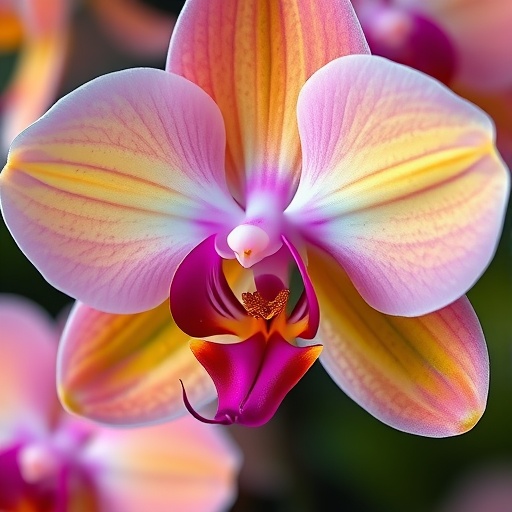
In a finding that is already rippling through the world of ornamental plant science, researchers in China have pieced together, gene by gene and pigment by pigment, the molecular machinery that paints the petals of the moth orchid, Phalaenopsis aphrodite Rchb.f. The study, published in Plant Cell Reports, combines transcriptomics and metabolomics across three cultivars spanning the orchid’s commercial color spectrum—pristine white, rose red, and deep crimson—and distills from that data a single, indispensable hub gene in the flavonoid assembly line. When the team silenced that gene, the flowers visibly blanched, offering the most direct demonstration yet of how the moody palette of one of the world’s most valuable cut flowers is written into its genome.
The commercial stakes are anything but trivial. Flower color is the single most decisive trait determining the market value of Phalaenopsis, the moth orchid that anchors a global floriculture industry worth billions of dollars annually. Breeders have long manipulated color through classical crossing, but the underlying biochemistry—why one cultivar emerges snow-white while a sibling seedling blushes deep crimson—has resisted full molecular explanation. The new research, led by Yuqing Sun and Na Meng of the Marine Agriculture Research Center at the Tobacco Research Institute of the Chinese Academy of Agricultural Sciences, together with colleagues at the Shandong Center of Technology Innovation for Flower Technology and Weifang Engineering Vocational College, provides that explanation at both the metabolite and gene-expression levels, and then goes one step further by functionally validating the key player.
To build the picture, the team selected three cultivars designated Pa_1 (white), Pa_2 (rose red), and Pa_3 (dark red) and subjected their petals to parallel transcriptome and metabolome profiling. Transcriptome sequencing captures the full complement of messenger RNAs—the instructions being actively read out of the genome at a given moment—while untargeted metabolomics inventory the small molecules, including pigments, that those instructions ultimately produce. By overlaying the two datasets, the researchers could ask a question neither approach can answer alone: which metabolic pathways are actually running at full tilt in the dark-red petals, and which genes are turning the crank?
The answer converged decisively on flavonoids. Integrated analysis confirmed that flavonoids and their glycosides—flavonoid molecules chemically decorated with sugar groups, which improves their solubility and stability inside the cell’s vacuole—are the primary pigments governing color variation among the three cultivars. Two interconnected metabolic highways, the phenylpropanoid pathway and the flavonoid biosynthesis pathway that branches off it, emerged as the core, conserved regulatory routes. The phenylpropanoid pathway is one of plant biology’s great trunk lines: it converts the amino acid phenylalanine into a cascade of aromatic compounds that feed everything from lignin to the anthocyanins responsible for red, purple, and blue hues across the flowering world. In the orchid petals, the team found that this trunk line and its flavonoid tributary were dramatically more active in dark-colored tissue.
The gene-expression data pinpointed the structural genes doing the heavy lifting. Four in particular stood out: Chalcone synthase (CHS), which catalyzes the first committed step of flavonoid synthesis by stitching together the carbon scaffold common to all flavonoids; Flavanone 3-hydroxylase (F3H), which adds a hydroxyl group that steers the scaffold toward later branches; Dihydroflavonol 4-reductase (DFR), which primes intermediates for conversion into anthocyanidins; and Anthocyanidin synthase (ANS), which performs the final chemical rearrangement that yields colored anthocyanidins. All four were significantly upregulated in the dark red petals, and their elevated activity tracked precisely with the accumulation of upstream flavonoid metabolites such as naringenin, luteolin, hesperetin, taxifolin, and leucocyanidin—chemical waypoints along the route that ends in anthocyanin, the pigment that gives the deep cultivars their saturated color.
Identifying correlations, however, is only half the task of modern plant biology; the other half is proving causation. For that, the researchers turned to weighted gene co-expression network analysis, or WGCNA, a computational method that sifts thousands of genes for clusters whose expression rises and falls in lockstep with a trait of interest—in this case, pigment content. Within the module most tightly correlated with anthocyanin accumulation, one gene sat at the network’s hub: a member of the chalcone synthase family the team named PhaCHS-R1, for Phalaenopsis Chalcone synthase-Red1. As the first committed enzyme in the entire flavonoid pathway, chalcone synthase has long been viewed as a classic rate-limiting control point, and the network analysis suggested that in the orchid petal, PhaCHS-R1 occupies exactly that gatekeeping role.
The functional proof came through virus-induced gene silencing, or VIGS, an elegant technique that hijacks a plant virus to carry a fragment of the target gene into the plant. Once inside, the viral payload triggers the plant’s own RNA-silencing defenses, which recognize and degrade the matching native mRNA, effectively dialing the gene’s expression down without ever touching the genome. In the VIGS-treated orchid flowers, anthocyanin and flavonoid contents dropped significantly, and the petals turned a distinctly lighter shade—a visible, pigmented echo of the molecular intervention. The result demonstrates that PhaCHS-R1 performs a conserved, limiting catalytic function in flavonoid synthesis in Phalaenopsis petals, meaning that without it, the whole pigment assembly line slows to a trickle.
The word “conserved” carries real weight here. Chalcone synthase is ancient and near-universal in the plant kingdom, and the study situates the orchid enzyme within a long evolutionary lineage of pathway control. The team even cross-checked their findings against the well-characterized Arabidopsis thaliana transparent testa 4 (tt4) mutant, a classic chalcone synthase knockout whose seeds famously lack pigment, homology comparisons between PhaCHS-R1 and the Arabidopsis protein underscoring how deeply conserved this enzymatic function is. What the new work adds is the explicit demonstration that in orchids—a lineage of monocots separated from Arabidopsis by well over a hundred million years of evolution—the same bottleneck governs the same pigment pathway, in the same direction, in the commercially most important tissue of all.
For breeders, the implications are immediate. Armed with the identity of a core hub gene, molecular breeding programs can now screen seedlings for favorable PhaCHS-R1 expression profiles or alleles long before the first flower opens, compressing breeding cycles that traditionally take years of wait-and-see phenotyping. Beyond selection, the gene is a natural target for genome editing: the Phalaenopsis genome has been sequenced since 2015, and CRISPR-based approaches have already been used in related ornamentals to tweak pigmentation and plant architecture. Overexpressing or editing PhaCHS-R1, or tuning its upstream regulators, offers a rational route to designing petal colors to order—deeper reds for premium markets, or novel shades no conventional cross has yet produced. The study’s authors frame the work as providing “important conserved gene resources for molecular breeding of flower color in Phalaenopsis and ornamental plants,” a claim the VIGS data squarely supports.
The research also adds a chapter to a broader scientific story about the MYB–bHLH–WD40 regulatory complex, the transcriptional trio known to switch anthocyanin genes on and off in many species, with prior work in Phalaenopsis identifying R2R3-MYB factors that pattern floral pigmentation. The new study maps the structural, enzyme-coding side of that ledger with unusual completeness, connecting the regulators’ downstream targets to measurable pigment chemistry. It likewise complements earlier findings that glycosyltransferases and vacuolar transporters such as NHX-type antiporters fine-tune final color by modifying and storing the pigments once made.
The datasets underpinning the study have been deposited in the Genome Sequence Archive under accession number subCRA064706 for the transcriptome data, with metabolome data accompanying the paper as supplementary material, ensuring other labs can interrogate the resource. The work was funded by the Key Research and Development Program of Shandong Province, and the authors note no conflicts of interest. For an industry built on the visual allure of a single flower, the ability to read—and eventually rewrite—the pigment circuitry of Phalaenopsis petals marks a shift from breeding by chance to engineering by design, with a single chalcone synthase gene now standing as the master dial on the orchid’s color palette.
Cite Scienmag News
Juliet Wilcox. (September 5, 2026). Multi-omics reveals metabolic regulation of petal color in Phalaenopsis. Scienmag. https://scienmag.com/multi-omics-reveals-metabolic-regulation-of-petal-color-in-phalaenopsis/
Juliet Wilcox. "Multi-omics reveals metabolic regulation of petal color in Phalaenopsis." Scienmag, 5 September 2026, https://scienmag.com/multi-omics-reveals-metabolic-regulation-of-petal-color-in-phalaenopsis/. Accessed 5 September 2026.
Juliet Wilcox. "Multi-omics reveals metabolic regulation of petal color in Phalaenopsis." Scienmag. September 5, 2026. https://scienmag.com/multi-omics-reveals-metabolic-regulation-of-petal-color-in-phalaenopsis/


