


In the realm of winter operations and heavy machinery management, optimizing vehicle control and enhancing safety in harsh environments remain paramount challenges. Snow groomers, excavators, and cranes operate under conditions where visibility can be compromised, and terrain irregularities impose physical strain on operators. Addressing these challenges, an international research consortium, including the Institute of Visual Computing at Graz University of Technology (TU Graz), embarked on an ambitious project—THEIA-XR—that leverages extended reality (XR) technologies to redefine human-machine interaction in these demanding settings.
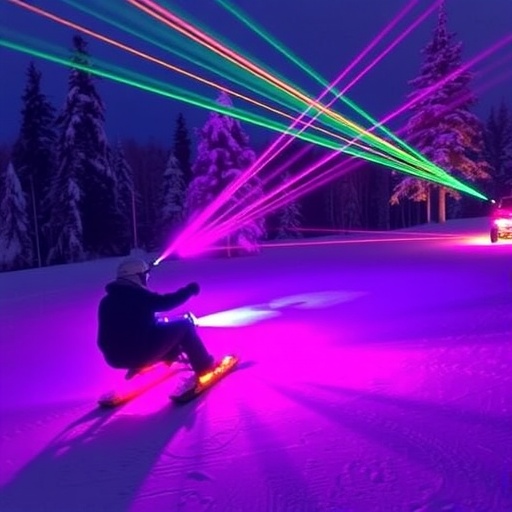
Traditional approaches to augmenting operator perception, such as deploying virtual reality (VR) headsets or presenting raw data screens, have revealed significant limitations. VR devices impose substantial ergonomic burdens, especially during prolonged use, leading to neck muscle fatigue and motion sickness due to the constant jostling inherent on uneven terrain. Recognizing these shortcomings, the research team pursued an innovative yet deceptively simple solution: repurposing a disco laser system to project critical operational data directly onto the snow surface ahead of the vehicle.
This method of laser projection sidesteps the physical discomfort caused by VR gear while offering real-time, intuitive visual augmentation within the operator’s natural field of view. Speed metrics, navigation tracks, and orientation cues can be illuminated vividly on the snow, providing seamless situational awareness without diverting the operator’s attention. Additionally, virtual boundaries and warning signals are cast onto the environment to alert personnel nearby, bolstering collective safety. Particularly intriguing is how these laser projections become visually pronounced in adverse meteorological conditions such as fog or snowfall, where aerosol particles scatter the laser beams, effectively extending the operator’s visual horizon beyond natural limits.
Beyond enhancing the operator’s interface, the project made strides into environmental perception and situational analysis. One of the research highlights includes the development of a prototype featuring a 360-degree thermal imaging camera uniquely tailored for snow groomer operations. This system aids operators in detecting living entities around the vehicle, providing a critical layer of safety by alerting drivers to the presence of people or animals obscured by snow or darkness. However, field feedback revealed that while collision avoidance functionalities were appreciated, the most significant advantage came from enabling operators to more precisely assess snow compaction levels. This capability translates directly into better slope grooming precision—an essential factor in maintaining ski-run quality and safety.
These technological advances align with a broader vision of remotely operated heavy machinery, a direction motivated by occupational health concerns. Operating vehicles in rough terrain subjects drivers to intense vibrations, posing long-term orthopedic and neurological risks. THEIA-XR’s work on improving depth perception through enhanced camera feeds represents a meaningful step toward viable remote control setups. By providing operators with improved monocular and stereoscopic cues extracted from remote video streams, the system significantly reduces the cognitive load involved in judging distances and spatial relationships via monitors.
Collaboration was a defining characteristic of the THEIA-XR initiative, uniting expertise from multiple institutions and industries. Besides TU Graz’s significant contribution, Prinoth—a manufacturer specializing in snow groomers—provided practical industrial contexts and testing grounds. Dresden University of Technology, partnering with Stuttgart Media University, extended research to excavator control interfaces, striving to translate XR benefits across vehicle types. The VTT Technical Research Centre of Finland focused on port environments, examining forklifts and loading machines used by companies such as Kalmar, thereby broadening the scope of industrial applicability.
A key insight from the project centers on reconciling theoretical research objectives with real-world operator needs. Clemens Arth, a leading researcher at TU Graz, emphasized the importance of aligning ergonomic design, perceptual augmentation, and operational utility. The development lifecycle entailed iterative feedback from professional drivers, whose experiential knowledge shaped the usability and functional priorities of the XR interventions. This participatory approach strengthened the relevance and adoption potential of the developed technologies.
Safety protocols were also advanced through the anonymization and ethical handling of operator performance data. The University of Luxembourg contributed significantly by devising methods to ensure personal information was protected while maintaining the integrity of analytical processes designed to optimize machine control. Leveraging sensor data without infringing on privacy concerns establishes a critical precedent for future human-centered automation systems.
Complementing these human-factor innovations, technical contributions from companies like Creanex Oy and Haption enhanced simulator fidelity and control device responsiveness. These technological underpinnings are vital for fine-tuning the complex sensory feedback loops required in remote operation scenarios. The enhanced simulators provide safe and controlled environments to validate interfaces before field deployment, thereby minimizing risks associated with real-world experimentation.
The photonic approach using laser projections onto snow represents a compelling example of cross-disciplinary ingenuity. By adopting technology traditionally confined to entertainment and repurposing it for critical industrial application, the research team demonstrated the value of creative technological convergence. The laser’s ability to delineate virtual pathways, boundaries, and warnings in the physical world bridges the gap between digital data and tactile understanding, fostering intuitive interaction models that transcend conventional display paradigms.
In summary, the THEIA-XR project represents a multifaceted leap forward in heavy vehicle operation under adverse environmental conditions. From wearable technology limitations to laser projection visualization, from environmental sensing technologies to remote control readiness, the initiative offers a holistic framework for safer, more efficient, and operator-friendly machine management. These developments have profound implications not only for winter sports facility maintenance but for a broad spectrum of industries where heavy machinery must navigate sensitive, complex environments.
Looking ahead, the foundational insights garnered pave the way for widespread adoption of remotely controlled machinery, which promises significant occupational safety benefits by extricating operators from physically demanding and hazardous environments. The integration of real-time XR visualization, advanced sensor fusion, and ergonomic user interfaces forms a template for next-generation vehicle control systems. Given the increasing demand for automation and enhanced worksite safety, such innovations will likely catalyze transformative shifts across industrial sectors globally.
This research, supported by robust academic-industrial collaborations, underscores the potential of XR technologies as enablers of not just operational efficiency but holistic human-technology symbiosis. As the boundaries between virtual and physical environments continue to blur, the lessons from THEIA-XR’s pioneering work with snow groomers and beyond highlight the indispensable role of human-centric design in crafting the future landscape of heavy machinery operation.
Cite Scienmag News
Denise Maddox. (May 28, 2026). Innovative Disco Lasers Enhance Snow Groomer Safety. Scienmag. https://scienmag.com/innovative-disco-lasers-enhance-snow-groomer-safety/
Denise Maddox. "Innovative Disco Lasers Enhance Snow Groomer Safety." Scienmag, 28 May 2026, https://scienmag.com/innovative-disco-lasers-enhance-snow-groomer-safety/. Accessed 4 September 2026.
Denise Maddox. "Innovative Disco Lasers Enhance Snow Groomer Safety." Scienmag. May 28, 2026. https://scienmag.com/innovative-disco-lasers-enhance-snow-groomer-safety/


