


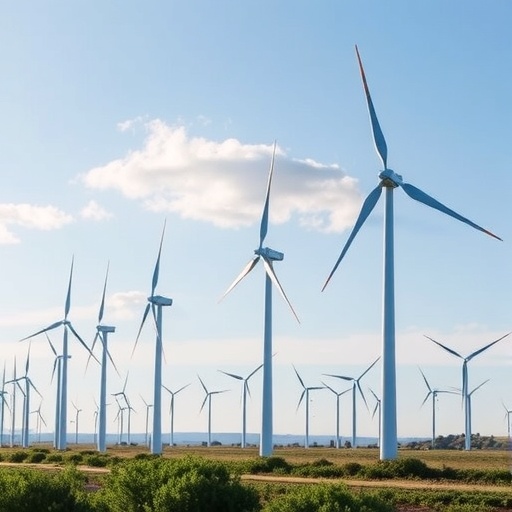
In the rapidly evolving landscape of renewable energy, wind power has emerged as a cornerstone for achieving climate neutrality. Yet as nations accelerate their shift away from fossil fuels, a persistent challenge looms large: the unpredictable fluctuations in power output caused by turbulent wind conditions. Modern wind turbines, equipped with advanced technology and sometimes supported by battery storage systems, are capable of impressive efficiency. However, a sudden gust or atmospheric instability can trigger abrupt power surges, creating ripple effects that threaten the stability of entire electrical grids. These surges not only jeopardize the safety and reliability of energy supply but also risk triggering widespread outages, especially as wind farms grow in scale and wind energy takes up a larger slice of the global power pie.
Addressing this challenge requires tools that transcend conventional engineering approaches. Researchers at the Okinawa Institute of Science and Technology’s Nonlinear and Non-equilibrium Physics Unit have introduced a transformative statistical framework designed to predict power fluctuations at every scale—from single turbines to sprawling wind farms and even interconnected grid systems. By tapping into existing geospatial data and long-term wind and power-generation records, this novel method applies principles rooted in the physics of turbulence to offer unprecedented predictive power. This framework essentially translates the chaotic, nonlinear behavior of atmospheric turbulence into actionable insights for energy system planners, engineers, and policymakers.
The statistical model is built on an extensive dataset gathered over five years, capturing the performance of 80 wind turbines scattered across a 20-kilometer stretch in the United States. The continuous data, collected at ten-minute intervals, revealed that wind farms defy simple characterization as collections of independent turbines. Instead, their output behaves as a single turbulent system where fluctuations in power production are tightly correlated with the underlying turbulent dynamics of the wind. This insight is pivotal: it shifts the analysis from isolated units to a holistic, collective system perspective. By understanding how turbulence shapes the aggregated power output, the model predicts how power fluctuations scale from individual turbines to entire wind farm clusters and finally, across the broader energy grid.
What makes this discovery profound is its capacity to enable precise risk assessment for both existing and future wind power installations. Energy planners and grid operators can use this physics-based predictive tool to simulate how new turbine placements or expanded wind farms are likely to behave under varying atmospheric conditions. The ability to anticipate fluctuations at multiple spatial scales helps in designing infrastructure that is not only resilient but also optimized to minimize disruptive surges. This eliminates guesswork, replacing it with data-driven foresight closely modeled on the natural physics driving turbulence.
Such predictive power also highlights the critical need for geographical diversification in renewable energy development. The research underscores that spatially sparse distributions of turbines and farms reduce large-scale fluctuations, providing a natural damping effect that enhances grid stability. Moreover, integrating a portfolio of diverse energy generation methods further buffers against sudden surges. Effective collaboration among wind farm operators, grid managers, and policymakers is indispensable to optimize this interconnected system. Aligning turbine siting strategies with the statistical insights of turbulence dynamics will ensure that wind power’s rapid expansion does not come at the cost of grid reliability.
The implications of this work are especially urgent in light of wind power’s expected ascendancy. Renewables are projected to eclipse coal as the dominant source of global power generation by the end of 2026, with wind energy contributing a substantial share. Last year alone witnessed the installation of 165 gigawatts of new wind capacity—a staggering 40% increase compared to the previous year. As projects scale up to megawatt levels and beyond, the risk of power surge events grows concomitantly. This new predictive framework equips stakeholders with a tool to preempt and manage these risks effectively, enabling large-scale wind deployments that are both ambitious and sustainable.
Beyond immediate risk mitigation, the research challenge extends to the fundamental understanding of atmospheric physics in real-world energy production. Turbulence, by its nature, is a nonlinear, highly complex phenomenon often resistant to traditional predictive models. The work from Okinawa Institute of Science and Technology effectively bridges this gap, marrying statistical physics with renewable energy engineering. By capturing the collective nonlinear structure of wind-power correlations, the model reveals deeper insights into how energy production systems inherently interact with environmental turbulence. This integration of physics and data science heralds a new paradigm in renewable energy research.
Another key takeaway from this research is the analogy drawn between their approach and financial forecasting. Just as economists use sophisticated models to predict market volatility based on diverse datasets and interdependent factors, wind farm designers can now employ physics-informed statistical tools to evaluate the likelihood and magnitude of power output fluctuations. This convergence of physics-based modeling with statistical forecasting represents a leap forward for energy systems engineering, allowing the design of wind farms that are adaptive to both the micro-scale variabilities of turbine output and macro-scale instabilities of regional grids.
The collaborative nature of future energy systems management is emphasized throughout the findings. Managing wind power’s intrinsic variability is not solely a technical problem but also an organizational and policy challenge. Grid operators must work in tandem with renewable developers to integrate diverse real-time data streams into operational strategies that anticipate and regulate power surges. Encouragingly, the framework’s scalability means it can be embedded within existing grid management platforms, fostering seamless integration between forecasting and control systems.
As the global energy landscape accelerates towards a decarbonized future, the pressing need for reliable renewable power underpins the transformative impact of this research. Accurate prediction and management of wind power fluctuations will be central to enabling high penetrations of wind energy without compromising grid integrity. Ultimately, the combination of diversified geographic placements, diverse energy portfolios, and collaboration informed by advanced physics-based models holds the promise of harnessing the tremendous potential of wind energy safely and efficiently.
The findings by Dr. Samy Lakhal and Professor Mahesh Bandi exemplify the power of cross-disciplinary innovation, leveraging statistical physics to confront one of the most complex and urgent challenges in renewable energy development. Their work sets the stage for a new generation of predictive tools that can transform how we design, operate, and expand wind power infrastructure. With renewables positioned to dominate the energy mix in the coming years, tools that bring transparency and predictability to the inherently turbulent behavior of wind power systems have never been more critical. This research is not just a scientific breakthrough but a beacon of hope for building resilient, sustainable energy futures worldwide.
Cite Scienmag News
Faith Mcneil. (May 28, 2026). Renewable Power Fluctuations Now Predictable, Reducing Risk. Scienmag. https://scienmag.com/renewable-power-fluctuations-now-predictable-reducing-risk/
Faith Mcneil. "Renewable Power Fluctuations Now Predictable, Reducing Risk." Scienmag, 28 May 2026, https://scienmag.com/renewable-power-fluctuations-now-predictable-reducing-risk/. Accessed 4 September 2026.
Faith Mcneil. "Renewable Power Fluctuations Now Predictable, Reducing Risk." Scienmag. May 28, 2026. https://scienmag.com/renewable-power-fluctuations-now-predictable-reducing-risk/


