


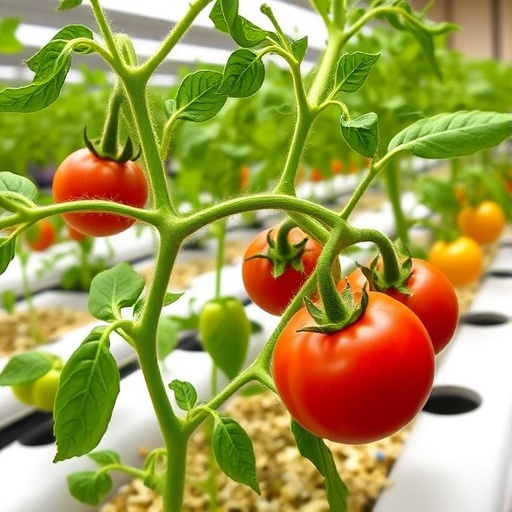
In a groundbreaking stride toward sustainable agriculture, researchers have unveiled a novel approach to hydroponic tomato cultivation utilizing synthetic microbial communities. This research, recently published in npj Sustainable Agriculture, articulates how engineered consortia of microorganisms can dramatically enhance tomato growth and yield in soilless systems, promising a paradigm shift in urban agriculture and food security.
Hydroponics, by bypassing soil, offers an efficient medium to grow crops in controlled environments. However, these systems often lack the intricate microbial interactions essential for optimal plant health, nutrients, and disease resistance that are naturally afforded in soil-based agriculture. The study led by Wilkinson et al. constructs synthetic microbial communities specifically designed to mimic these natural interactions, allowing for tailored microbial ecosystems that support tomato plants in hydroponic settings.
The researchers employed a bottom-up design strategy to assemble microbial consortia composed of bacteria and fungi with demonstrated plant growth-promoting traits. Instead of relying on bulk soil inoculants or natural microbiomes, this synthetic approach enables precise control over microbial composition, synergy, and function. This ensures consistent performance, reproducibility, and the possibility to finely tune the microbiome to environmental or crop-specific needs.
Mechanistically, the synthetic communities boost tomato plants by several intertwined routes. Prominent among these is their capacity to solubilize phosphate, fix nitrogen, produce phytohormones such as auxins, and synthesize siderophores facilitating iron uptake. Such functions directly translate to improved nutrient availability, enhanced root growth, and strengthened plant immunity. The study provides extensive molecular and physiological data confirming these multifactorial benefits.
Employing state-of-the-art omics techniques, including metagenomics and metabolomics, the study characterizes the dynamic interactions within the microbial consortia and their influence on plant physiology. This multi-omics approach reveals how specific microbial members cooperatively modulate metabolite profiles in the rhizosphere and within plant tissues, opening avenues to decipher complex microbe-plant signaling networks.
Trials conducted in controlled hydroponic systems demonstrated significant increases in tomato biomass, fruit yield, and overall plant vigor when inoculated with these synthetic communities. Compared to conventional hydroponic nutrient solutions alone, treated plants exhibited up to 30% greater biomass and enhanced fruit quality, highlighting the practical value of these engineered microbiomes.
Importantly, the synthetic microbial communities also impart heightened resistance against common tomato pathogens. The biocontrol effect is attributed to both direct antagonism of pathogens by microbial members producing antimicrobial compounds and induction of systemic resistance pathways in the plants. This dual defensive role reduces the need for chemical pesticides, aligning hydroponic tomato farming with environmentally sustainable practices.
The implications of this research extend well beyond tomatoes or hydroponics. The framework of designing functionally robust synthetic microbial communities could be adapted to a wide spectrum of crops and cultivation systems, offering a scalable solution to increase agricultural productivity sustainably. This is particularly critical as climate change and global population growth exert mounting pressure on food production systems.
Furthermore, the synthetic consortia approach circumvents some challenges of traditional biofertilizers, such as inconsistent field performance and survival, by allowing pre-selection and optimization under defined conditions. The modular nature of designed communities offers opportunities for incremental refinement, adaptation to regional crops, and integration with other agronomic innovations.
The study also posits that such microbial consortia could contribute to carbon sequestration and reduced greenhouse gas emissions by enhancing plant growth efficiency and lowering dependency on synthetic fertilizers. This aligns with broader goals to develop climate-resilient agricultural practices and mitigate environmental impacts.
Looking ahead, the research team advocates for pilot studies in commercial-scale hydroponic farms to validate scalability, cost-effectiveness, and long-term impacts on crop health and ecosystem stability. Additionally, regulatory frameworks for deploying engineered microbiomes must evolve to address biosafety and environmental concerns while facilitating innovation.
From a biotechnological perspective, advances in synthetic biology, microbial ecology, and systems biology are opening unprecedented possibilities to tailor plant-associated microbiomes for precise agricultural outcomes. This landmark study exemplifies how interdisciplinary efforts can translate cutting-edge science into tangible agronomic solutions.
In conclusion, the integration of synthetic microbial communities into hydroponic tomato production heralds a transformative approach to cultivating food in sustainable, efficient, and environmentally responsible ways. By harnessing the intricate symbiosis between plants and microbes, this research paves the path toward resilient urban agriculture systems capable of meeting future global food demands.
The promise of synthetic microbiomes is vast, with potential to reconfigure conventional agricultural paradigms. As precision agriculture evolves, microbial engineering will undoubtedly become central in designing resilient and productive cropping systems. Wilkinson and colleagues’ pioneering study marks a seminal contribution toward realizing this vision, embedding microbiome orchestration at the heart of sustainable food production.
Cite Scienmag News
Morgan Morrow. (May 26, 2026). Synthetic Microbial Communities Boost Hydroponic Tomato Growth. Scienmag. https://scienmag.com/synthetic-microbial-communities-boost-hydroponic-tomato-growth/
Morgan Morrow. "Synthetic Microbial Communities Boost Hydroponic Tomato Growth." Scienmag, 26 May 2026, https://scienmag.com/synthetic-microbial-communities-boost-hydroponic-tomato-growth/. Accessed 3 September 2026.
Morgan Morrow. "Synthetic Microbial Communities Boost Hydroponic Tomato Growth." Scienmag. May 26, 2026. https://scienmag.com/synthetic-microbial-communities-boost-hydroponic-tomato-growth/


