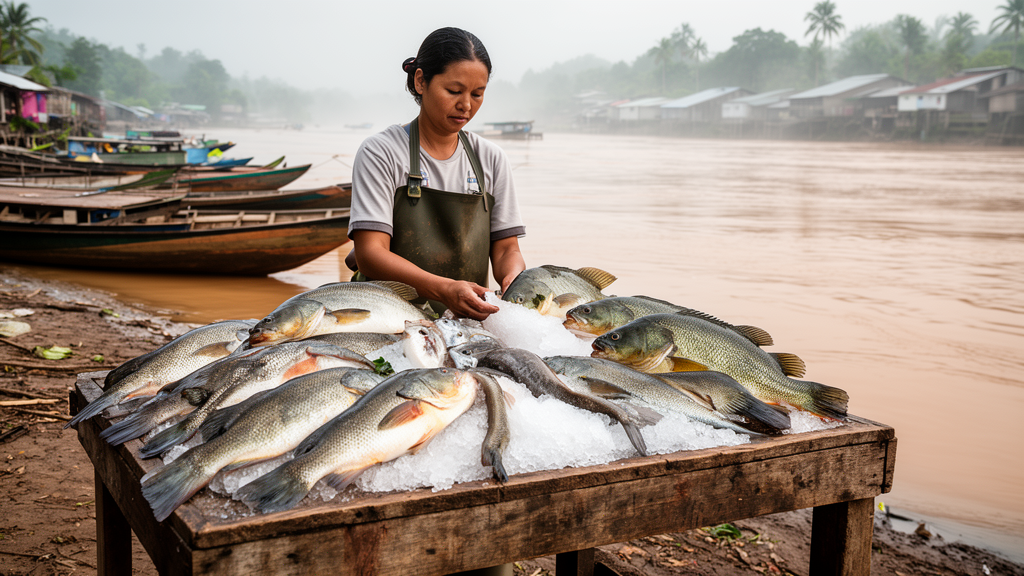
Brazil holds roughly 12 percent of the planet’s freshwater, and the fish swimming in its rivers feed millions of people. But a sweeping new systematic review of 52 studies published between 2020 and 2025 concludes that many of those fish carry burdens of toxic metals that regularly exceed legal safety limits, with potentially serious consequences for the communities that depend on them most. The review, published in Environmental Monitoring and Assessment, synthesizes research on trace metal contamination in Brazilian freshwater fish and maps out where the contamination comes from, which species are most affected, and who is at greatest risk.
The research team, led by Danielma Silva Maia and Guilherme Sgobbi Zagui of the University of Ribeirão Preto together with colleagues at the University of Barcelona, screened 255 articles from PubMed, Scopus, SciELO, and Web of Science using the PRISMA framework. After removing duplicates and studies focused on marine species, 52 investigations met the eligibility criteria. The analysis reveals a striking geographic imbalance in the science itself: 26 of the studies come from Brazil’s Northern region, concentrated in the states of Pará and Amazonas, while the Northeast contributed only a single study. That uneven distribution, the authors note, may leave less-studied basins effectively unmonitored even as contamination pressures grow.
The regional pattern of contamination tells its own story. In the Amazon, mercury dominates, driven largely by artisanal and small-scale gold mining, which uses the metal to amalgamate gold, and by deforestation. Forest fires add a second, less obvious source: Amazonian soils are naturally enriched in mercury, and the rainforest acts as an atmospheric sink, so burning vegetation volatilizes mercury accumulated over decades and allows it to travel long distances before redepositing on soils and waterways. In the Southeast, the picture is shaped by catastrophic mining dam failures at Mariana and Brumadinho, which released metal-rich tailings into the Doce and Paraopeba rivers, compounded by industrial effluents, tanneries, and urban sewage. In the Pantanal and Cerrado of the Central-West, agricultural expansion, pesticide use, and pasture conversion emerge as the leading drivers, while the South and Northeast show primarily industrial and agricultural signatures.
Which metals end up in which fish is not random. The review found that trophic level, feeding strategy, and position in the water column strongly shape bioaccumulation. Carnivorous and piscivorous species such as peacock bass (Cichla spp.), trahiras (Hoplias spp.), and piranhas (Pygocentrus spp.) sit at the top of the food chain and accumulate the highest mercury loads, because mercury is the one trace element with consistent evidence of biomagnification across ecosystems. In Indigenous communities of the Tapajós region, piscivorous fish carried mercury levels roughly four times higher than non-piscivorous species. One study found that 70 percent of analyzed samples exceeded recommended mercury guidelines for consumption, and another reported liver concentrations in Cichla reaching 26.7 milligrams per kilogram dry weight.
At the other end of the ecological spectrum, detritivorous species such as the curimbatá (Prochilodus spp.) face a different hazard. These fish feed on organic detritus in constant contact with river sediments, which act as long-term reservoirs for chemical contaminants. As a result, they tend to accumulate lead and chromium rather than mercury. Omnivorous species such as the mandi (Pimelodus maculatus) and piau (Leporinus spp.) occupy an intermediate position but can still build up significant metal loads when they consume benthic organisms or contaminated sediment. The review also notes that metal concentrations vary dramatically among organs: metabolically active tissues like liver, gills, and kidneys accumulate far more than muscle, although muscle is what humans typically eat.
The metals of greatest toxicological concern identified across the studies were lead, cadmium, chromium, and mercury, with arsenic appearing less frequently but still exceeding limits in specific cases. Cadmium stood out for its extraordinary bioconcentration factor, reaching levels in fish up to ten times higher than in the surrounding water. In one alarming study from urban Amazonian waters, cadmium exceeded the maximum limit permitted by Brazilian legislation in all ten species evaluated; another found eight of eleven species above the legal threshold. Lead exceeded Brazilian limits in multiple investigations, with one study reporting concentrations above 2 milligrams per kilogram and another finding 41 percent of samples over national standards. Chromium, whose toxicity depends heavily on chemical form, showed a trophic biodilution pattern, with higher concentrations in herbivorous and detritivorous fish than in predators.
What does this mean for human health? The review’s risk assessments paint a sobering picture, particularly for Amazonian riverine and Indigenous communities. While the global average fish consumption is about 20.5 kilograms per person per year, Amazonian riverine populations can consume 100 to 550 grams daily, roughly 148 to 169 kilograms annually. At those intake levels, estimated daily intake of mercury exceeded reference doses in nearly all Amazonian scenarios studied. Hazard quotient values above 1.0, indicating potential harm, were reported for methylmercury across all fish species in one study, and for lead with values ranging from 1.75 to 3.60 in another. Children appear especially vulnerable, with mercury intake reaching or exceeding safety thresholds in multiple assessments. Cadmium and lead also produced hazard quotients above 1 in several studies, suggesting possible carcinogenic risk from chronic consumption.
The authors are careful to note an important caveat: total metal concentrations do not necessarily translate directly into human exposure. For a metal to cause systemic toxicity, it must first be released from the food matrix during digestion and then cross the intestinal barrier, a property known as bioaccessibility. Incorporating bioavailability and bioaccessibility measurements into risk assessments could refine exposure estimates and reduce overestimation. The review also flags a frequently overlooked variable: cooking. Most studies analyze raw fish, yet recent work found that elemental concentrations, particularly aluminum, copper, and mercury, tended to increase after cooking, meaning risk calculations based on fresh tissue may understate real-world exposure.
Hydrology adds another layer of complexity. Seasonal flood pulses mobilize contaminants and alter their bioavailability, and hydroelectric reservoirs act as sinks where altered water stratification promotes metal accumulation. Evidence from extreme events raises further concern: after the May 2024 floods in the Sinos River Basin, researchers found soil chromium concentrations ranging from 2,400 to 107,560 milligrams per kilogram, and during the extreme Amazon drought of 2023, shifts in temperature, oxygen, and pH in the Negro and Solimões rivers were linked to increased fish mortality. Studies from the Paraíba do Sul basin found that drought itself elevated total mercury and methylmercury in most fish species evaluated, and climate change is expected to make such events more frequent.
The review closes with a call to action that goes beyond monitoring. The authors argue that national and international safety limits, including those set by Brazil’s ANVISA and aligned with European Union standards, may be fundamentally insufficient to protect communities whose lifetime fish consumption far exceeds the national average, and they urge the development of regional regulatory limits reflecting local dietary realities. They also identify persistent research gaps: too few studies distinguish between the chemical forms of metals, such as the far more toxic hexavalent chromium or methylmercury, which makes up more than 80 percent of the mercury in fish muscle, and the reproductive and nervous systems of neotropical fish remain rarely investigated. Until enforcement of mercury controls strengthens and monitoring expands to neglected basins, the fish that sustain Amazonian communities will continue to carry an invisible load, and the people who eat them will keep absorbing it.
Subject of Research: Trace metal contamination in Brazilian freshwater fish and associated human health risks
Article Title: Trace metals contamination in freshwater fish in Brazil: related factors, environmental impacts, and risks to human health
Article References: Maia, D. S., Sierra, J., Martí, E., & Zagui, G. S. (2026). Trace metals contamination in freshwater fish in Brazil: related factors, environmental impacts, and risks to human health. Environmental Monitoring and Assessment, 198(11), Article 1163. https://doi.org/10.1007/s10661-026-15977-9
Image Credits: AI Generated
DOI: 10.1007/s10661-026-15977-9
Keywords: heavy metals, freshwater fish, Brazil, mercury, bioaccumulation, biomagnification, Amazon, mining, food safety, risk assessment, water pollution, ecotoxicology
Cite Scienmag News
Phoebe Ingram. (October 8, 2026). Toxic Metals Are Piling Up in Brazil’s Freshwater Fish, Review Finds. Scienmag. https://scienmag.com/toxic-metals-are-piling-up-in-brazils-freshwater-fish-review-finds/
Phoebe Ingram. "Toxic Metals Are Piling Up in Brazil’s Freshwater Fish, Review Finds." Scienmag, 8 October 2026, https://scienmag.com/toxic-metals-are-piling-up-in-brazils-freshwater-fish-review-finds/. Accessed 8 October 2026.
Phoebe Ingram. "Toxic Metals Are Piling Up in Brazil’s Freshwater Fish, Review Finds." Scienmag. October 8, 2026. https://scienmag.com/toxic-metals-are-piling-up-in-brazils-freshwater-fish-review-finds/