


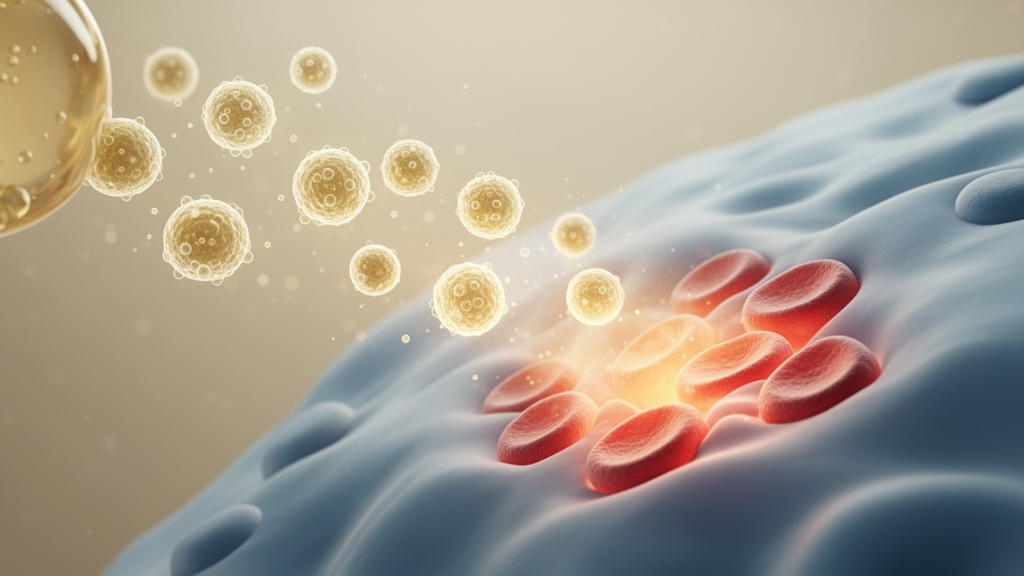
Deep inside an arthritic knee, billions of microscopic bubbles drift through the lubricating fluid that bathes the joint. These particles, known as extracellular vesicles, are far from inert debris. New research from Spanish scientists suggests they may act as chemical diplomats, quietly dialing down the inflammatory fires that drive osteoarthritis, one of the most common and debilitating age-related diseases in the world.
The study, published in Frontiers in Aging, examined vesicles isolated from the synovial fluid of patients with advanced knee osteoarthritis. When researchers applied these vesicles to human synoviocytes and chondrocytes, the two key cell types that maintain joint function, they observed a striking pattern. The vesicles reduced production of inflammatory molecules and matrix-degrading enzymes while simultaneously boosting hyaluronic acid, the slippery polysaccharide that keeps joints moving smoothly. The findings hint that the joint’s own fluid may contain built-in anti-inflammatory signals that could one day be harnessed therapeutically.
Osteoarthritis affects hundreds of millions of people worldwide, and its prevalence continues to climb as populations age. The disease is characterized by chronic low-grade inflammation and progressive degradation of the extracellular matrix, the structural scaffold that gives cartilage its resilience. In a healthy joint, chondrocytes maintain cartilage by synthesizing type II collagen and other matrix components, while synoviocytes produce the synovial fluid that lubricates and cushions the joint. In osteoarthritis, this delicate balance collapses. Inflammatory cytokines such as interleukin-1β and tumor necrosis factor-α push chondrocytes toward a catabolic state, flooding the joint with matrix metalloproteinases and other enzymes that chew through cartilage.
Extracellular vesicles have emerged as major players in intercellular communication. These membrane-bound particles, ranging from roughly 30 to several hundred nanometers in diameter, carry a diverse cargo of proteins, lipids, non-coding RNAs, metabolites, and signaling molecules between cells. Prior research has painted a complicated picture of their role in joint disease. Some vesicles appear to worsen cartilage degradation, while others, particularly those derived from mesenchymal stem cells, show protective and chondroregenerative properties. The new study adds a crucial piece to this puzzle by examining vesicles harvested directly from the synovial fluid of osteoarthritic patients.
The research team, led by scientists at the Interuniversity Research Institute for Molecular Recognition and Technological Development in Valencia, collected synovial fluid, cartilage, and synovial tissue from 68 patients undergoing total knee replacement surgery. After rigorous quality control, 25 synovial fluid samples, 14 synovial tissue samples, and 12 cartilage samples made it into the final analysis. The team isolated vesicles using size exclusion chromatography, a technique that separates particles based on their size and allows enrichment of vesicles while minimizing contamination from soluble proteins.
Characterization of the isolated vesicles revealed a heterogeneous population with a mean diameter of approximately 261 nanometers and a concentration of roughly 7 × 10⁸ particles per milliliter. The vesicles carried canonical markers including the tetraspanins CD9 and CD81, along with the endosomal proteins TSG101 and PDCD6IP. Transmission electron microscopy confirmed their membrane-bound morphology, and immunogold labeling detected the exosomal marker CD63 on vesicle surfaces. Importantly, the negative marker calnexin, which would indicate contamination from intracellular membranes, was undetectable in the preparations.
With their vesicle preparations validated, the researchers turned to functional experiments. They cultured primary synoviocytes and chondrocytes from osteoarthritic patients and stimulated them with interleukin-1β, a potent pro-inflammatory cytokine that mimics the inflammatory environment of an arthritic joint. When vesicles were added to the cultures, the results were remarkable. In synoviocytes, the vesicles significantly reduced interleukin-1β-induced proliferation and suppressed production of interleukin-6 and matrix metalloproteinase-3, two key drivers of joint inflammation and cartilage breakdown. Simultaneously, the vesicles increased hyaluronic acid production, suggesting a shift toward a more homeostatic cellular state.
The effects on chondrocytes were equally compelling. Vesicle treatment reduced interleukin-6 and matrix metalloproteinase-13, the enzyme primarily responsible for degrading type II collagen in cartilage. Perhaps most intriguingly, the vesicles enhanced production of interleukin-1 receptor antagonist, an endogenous anti-inflammatory molecule that naturally counteracts interleukin-1 signaling. This finding suggests that synovial fluid vesicles may not only suppress inflammation directly but also amplify the joint’s own protective feedback mechanisms. The effects persisted over 48 and 96 hours, indicating sustained biological activity rather than a transient response.
Notably, the researchers observed distinct responses between synoviocytes and chondrocytes exposed to the same vesicle preparation. Synoviocytes responded with reduced proliferation and altered inflammatory output, while chondrocytes showed more pronounced changes in matrix-related gene expression. This cell-type specificity underscores the complexity of vesicle-mediated signaling within the joint microenvironment, where different resident cell populations interpret the same molecular messages in unique ways depending on their intrinsic signaling machinery and functional roles.
The study’s authors caution that their findings represent the net effect of a heterogeneous mixture of vesicles from multiple cellular sources, including synoviocytes, chondrocytes, immune cells, and vascular cells. The molecular cargo responsible for the observed effects remains unidentified, and the in vitro model does not fully capture the complexity of the living joint. Nevertheless, the work provides compelling evidence that endogenous synovial fluid vesicles carry anti-inflammatory and anti-catabolic signals within the osteoarthritic joint. As researchers continue to unravel the cargo and mechanisms of these tiny messengers, they may unlock new strategies for treating a disease that currently has no cure and few options beyond pain management and joint replacement.
Subject of Research: Extracellular vesicles from osteoarthritic synovial fluid modulate inflammatory and matrix-related responses in human synoviocytes and chondrocytes
Article Title: Synovial fluid-derived extracellular vesicles modulate joint cell function in osteoarthritis
Article References: Compañ, A., Carrabs, V., Ferrándiz, M. L., Silvestre, A., Muñoz, I., Carceller, M. C., & Guillén, M. I. (2026). Synovial fluid-derived extracellular vesicles modulate joint cell function in osteoarthritis. Frontiers in Aging, 7, Article 1894052. https://doi.org/10.3389/fragi.2026.1894052
Image Credits: AI Generated
DOI: 10.3389/fragi.2026.1894052
Keywords: osteoarthritis, extracellular vesicles, synovial fluid, synoviocytes, chondrocytes, hyaluronic acid, interleukin-1 beta, matrix metalloproteinases, inflammation, cartilage degradation, joint homeostasis, aging
Cite Scienmag News
Beatrice Stafford. (October 17, 2026). Tiny Messengers in Joint Fluid Calm Inflammation in Osteoarthritis Cells. Scienmag. https://scienmag.com/tiny-messengers-in-joint-fluid-calm-inflammation-in-osteoarthritis-cells/
Beatrice Stafford. "Tiny Messengers in Joint Fluid Calm Inflammation in Osteoarthritis Cells." Scienmag, 17 October 2026, https://scienmag.com/tiny-messengers-in-joint-fluid-calm-inflammation-in-osteoarthritis-cells/. Accessed 17 October 2026.
Beatrice Stafford. "Tiny Messengers in Joint Fluid Calm Inflammation in Osteoarthritis Cells." Scienmag. October 17, 2026. https://scienmag.com/tiny-messengers-in-joint-fluid-calm-inflammation-in-osteoarthritis-cells/


