


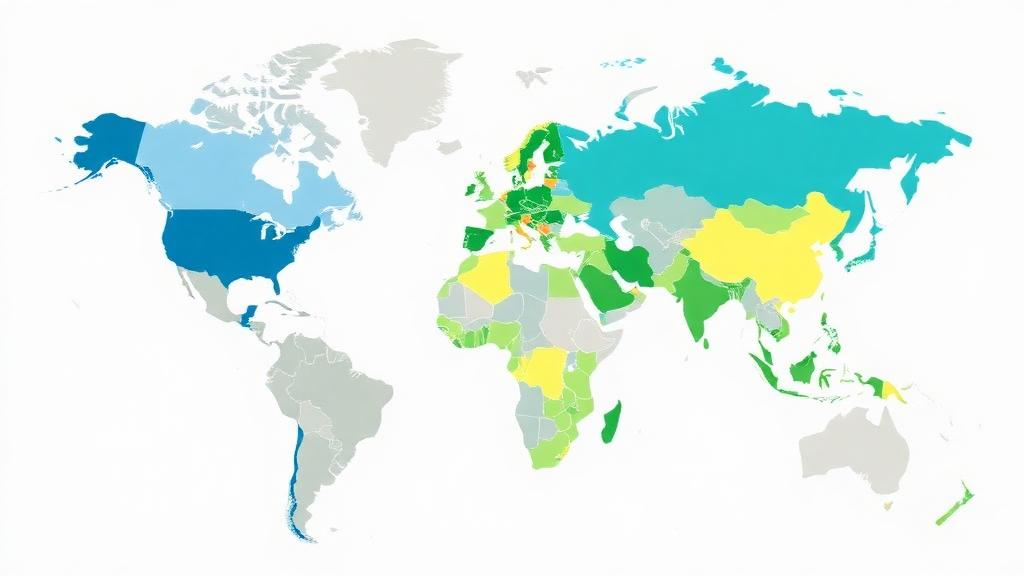
For decades, the geopolitics of climate change has been narrated in broad strokes: oil producers resist, island states plead, great powers hedge. A new study published in Nature Sustainability replaces that impressionistic picture with something far more consequential—a quantitative atlas of who gains and who loses as the world decarbonizes. Researchers led by Guanna Pan of the Potsdam Institute for Climate Impact Research, together with Ulrike Kornek, Chen Chris Gong, Edna Johanna Molina Bacca, Gunnar Luderer and Ottmar Edenhofer, have built the first country-level dataset that quantifies four climate-related asset types across 169 countries, revealing a redistribution of economic value so uneven that it could redraw the map of international climate politics.
The team’s central insight is that climate mitigation does not simply reduce global harm; it revalues national assets. Four categories dominate this revaluation. Fossil fuel production, a privately owned revenue engine for petrostates, loses value as demand for coal, oil and gas declines. Avoided climate damages, a public good, grow in value for countries exposed to heat, drought and storm damage. Renewable energy potential—sunlight and wind—acquires new economic worth as solar panels and turbines substitute for combustion. And land carbon sequestration capacity, the ability of forests and soils to absorb carbon dioxide, becomes a monetizable asset through carbon markets and offset programs such as REDD+. Each asset shapes national interests in distinct ways, and the study treats them separately rather than collapsing them into a single index.
To construct this atlas, the researchers integrated an unusually broad set of models and data streams. They drew on the Intergovernmental Panel on Climate Change’s Sixth Assessment Report scenario database, climate projections from six models in the Coupled Model Intercomparison Project Phase 6, land-use projections from three integrated assessment models—REMIND-MAgPIE, GCAM-Demeter and IMAGE—and the MAgPIE-LPJmL framework for land carbon stocks. Economic damages were estimated with six distinct damage functions, spanning growth-based approaches such as Burke-Hsiang-Miguel and Dell-Jones-Olken, and level-based approaches including Kalkuhl-Wenz, Tol and Hope. All values were discounted at 3 percent and expressed as shares of each country’s cumulative discounted GDP, allowing a small economy’s stakes to be compared with those of a giant.
The analysis spans three scenarios built on the middle-of-the-road Shared Socioeconomic Pathway 2: a stringent mitigation pathway (SSP2-2.6), a moderate pathway (SSP2-4.5) and a high-emissions baseline (SSP2-6.0). Two time horizons—mid-century and end-century—capture how asset values evolve. This design isolates the effect of mitigation ambition itself, holding socioeconomic assumptions constant, so that differences between scenarios reflect climate policy rather than divergent development paths.
The results on fossil fuel rents are stark. Under stringent mitigation relative to the baseline, Iran, Venezuela, Canada and Norway face the largest losses in discounted fossil fuel revenues when coal, oil and gas are combined. These losses, expressed as a share of cumulative GDP, translate directly into political resistance: countries with heavy fossil fuel dependence have both the motive and, in some cases, the institutional means to obstruct ambitious climate commitments. The study finds empirical support for this link through cross-country regressions relating the four asset categories to six climate policy indicators, with fossil fuel rent losses correlating with weaker climate policy ambition.
On the other side of the ledger, avoided damages concentrate in lower-income, climate-vulnerable countries. By end-century under stringent mitigation, many African countries see particularly large gains, led by the Democratic Republic of the Congo, where avoided damages reach 3.3 percent of cumulative discounted GDP. Renewable energy potential tells a parallel story of concentration: Somalia exhibits the largest renewable mitigation potential in the dataset, at 108.2 percent of cumulative GDP, from combined photovoltaic, onshore and offshore wind resources. Land carbon sequestration capacity clusters in tropical forest nations—Guyana, Suriname, Papua New Guinea and several Central African countries—while only ten countries remain net carbon sources by 2100 under stringent mitigation, compared with twenty under moderate mitigation.
To move from individual countries to geopolitical structure, the team applied k-means clustering across the four aggregate indicators, sorting the 169 countries into five groups: fossil-fuel-dependent economies, avoided-damage economies, high-carbon-sequestration economies, high-potential renewable economies and moderate-impact economies. Hierarchical clustering assigned 146 of 169 countries—86.4 percent—to the same groups, and most disagreements fell near cluster boundaries, suggesting the typology is robust. The fossil-fuel-dependent cluster contains just 19 countries but includes many members of the Organization of the Petroleum Exporting Countries, whose strategy of opposing fossil fuel phase-out commitments exemplifies the interests the data reveal. Crucially, this cluster holds only 6.0 percent of global GDP, limiting its ability to block a broad coalition.
The most politically charged finding concerns the moderate-impact cluster, which contains 69 countries and 81 percent of global GDP—including the United States, the European Union and China. These major powers experience comparatively moderate changes across all four asset categories, meaning their asset-based stakes in ambitious mitigation are weaker than their economic weight would suggest. Meanwhile, the avoided-damage cluster, with 51 countries and strong interests in climate action, holds only 10.7 percent of global GDP, and the sequestration and renewable clusters together account for a mere 2.4 percent. The persistent deadlock in global climate negotiations may partly reflect this misalignment: the countries with the largest potential gains lack the bargaining power to secure them, while the countries with the power to act have comparatively muted asset-based incentives.
Beyond clustering, a pairwise similarity analysis using eight detailed sub-indicators—coal, oil and gas rent losses separately, avoided damages, solar and wind potential, and natural versus managed sequestration—identifies each country’s closest counterparts. Some pairings track existing relationships: the United States and Mexico share moderate avoided damages and small fossil fuel losses, reinforced by integrated trade networks. Others are strikingly counterintuitive: China’s closest counterpart is Bosnia and Herzegovina, and India’s is Bulgaria—profiles marked by limited mitigation assets, modest avoided damages and coal rent exposure. Saudi Arabia’s nearest match is Iraq, both defined by oil dependence, while Brazil aligns with Peru through substantial avoided damages and moderate sequestration capacity. These similarities do not imply broader socioeconomic resemblance, but they suggest that countries with very different development levels may face comparable configurations of climate assets—and therefore comparable negotiating positions.
The authors are careful about limits. Their framework excludes overseas fossil fuel interests, relies on median values from heterogeneous model ensembles, and omits extreme events such as heatwaves and droughts in its land carbon estimates. National interests, they note, are shaped by ethics, governance, institutional capacity and historical responsibility that no asset ledger can capture. Yet the dataset, publicly available through Zenodo, offers negotiators and researchers a starting point for designing package deals—linking research cooperation, trade agreements or financial transfers to mitigation commitments—that could align the interests of powerful but moderately affected states with those of vulnerable, resource-rich nations. As the low-carbon transition accelerates, the study suggests that the decisive question is no longer whether climate action reshapes global power, but whether the countries gaining most can convert their new assets into the influence needed to unlock it.
Subject of Research: Country-level quantification of climate mitigation assets and their geopolitical implications
Article Title: Quantifying assets for the geopolitics of climate change mitigation
Article References: Pan, G., Kornek, U., Gong, C. C., Molina Bacca, E. J., Luderer, G., & Edenhofer, O. (2026). Quantifying assets for the geopolitics of climate change mitigation. Nature Sustainability. https://doi.org/10.1038/s41893-026-01971-z
Image Credits: AI Generated
DOI: 10.1038/s41893-026-01971-z
Keywords: climate change mitigation, geopolitics, fossil fuel rents, renewable energy, carbon sequestration, avoided damages, integrated assessment models, Nature Sustainability, climate policy, international cooperation, SSP scenarios, economic damage functions
Cite Scienmag News
Sloane Callahan. (October 15, 2026). The New Map of Climate Power: Which Countries Win and Lose in the Low-Carbon Transition. Scienmag. https://scienmag.com/the-new-map-of-climate-power-which-countries-win-and-lose-in-the-low-carbon-transition/
Sloane Callahan. "The New Map of Climate Power: Which Countries Win and Lose in the Low-Carbon Transition." Scienmag, 15 October 2026, https://scienmag.com/the-new-map-of-climate-power-which-countries-win-and-lose-in-the-low-carbon-transition/. Accessed 15 October 2026.
Sloane Callahan. "The New Map of Climate Power: Which Countries Win and Lose in the Low-Carbon Transition." Scienmag. October 15, 2026. https://scienmag.com/the-new-map-of-climate-power-which-countries-win-and-lose-in-the-low-carbon-transition/


