


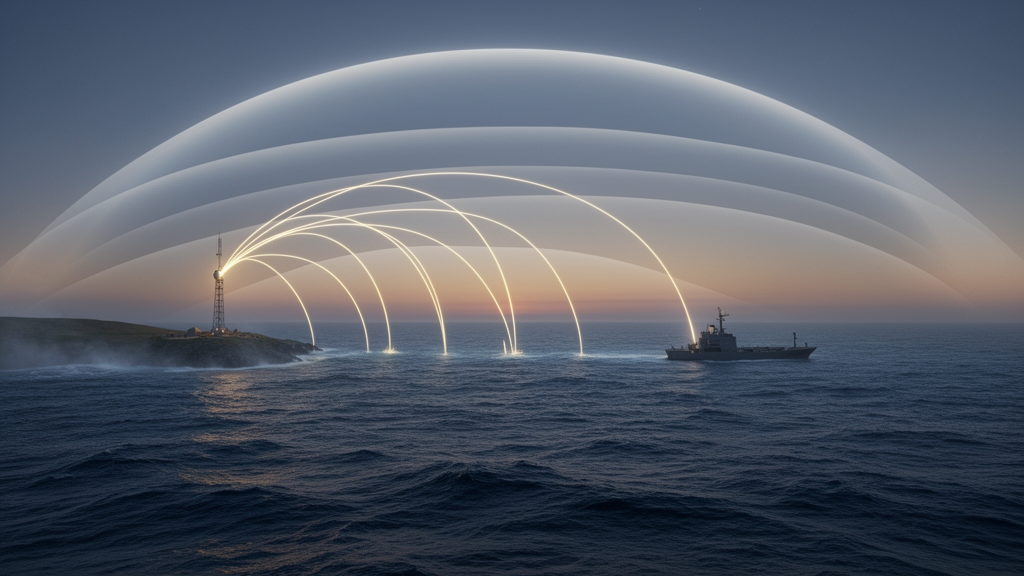
Invisible layers of air over the world’s oceans are quietly reshaping how radio waves travel across the sea, and a new study suggests that climate change is making those layers stronger, more frequent and higher up in the atmosphere than at any time in the modern observational record. The research, published in Nature Climate Change, combines more than eight decades of atmospheric reanalysis data with the physics of electromagnetic propagation to show that global warming is pushing the marine atmosphere toward a state that favors an phenomenon known as atmospheric ducting — a process that can bend radar beams and radio signals far beyond their intended range, or blind them entirely.
Atmospheric ducts are anomalous stratification layers in the lower troposphere in which the vertical gradient of what meteorologists call modified refractivity turns negative. In ordinary conditions, the index of refraction of air decreases gently with height, causing radio waves to curve slightly downward and follow the Earth’s curvature over limited distances. When a duct forms, however, the refractivity drops so steeply within a thin layer that electromagnetic energy becomes trapped inside it, bouncing between the layer and the sea surface much like light in a fiber-optic cable. The effect can extend the detection range of coastal radars dramatically, but it also creates shadow zones where targets vanish from screens and radar clutter overwhelms displays — rendering standard propagation models unreliable precisely when they matter most.
The operational stakes of these hidden waveguides are not academic. Analysts investigating the April 2022 sinking of the Russian cruiser Moskva have suggested that anomalous ducting conditions may have facilitated the unexpected beyond-line-of-sight engagement by Neptune missiles, a reminder that refractivity structure can shape modern naval encounters. Military meteorologists have long tracked ducts for exactly this reason, and the ability to predict these blind zones or extended ranges is often described as decisive in electronic warfare. Yet most of what science knows about ducting comes from short field campaigns rather than long-term climate-scale analysis.
That gap is what motivated a team led by Xiaofeng Zhao and Chunshan Wei of the Army Engineering University in Nanjing, together with colleagues from the National University of Defense Technology, Sun Yat-sen University, the Southern Marine Science and Engineering Guangdong Laboratory and the Beijing Institute of Technology. Since the early 2000s, major experiments such as Wallops-2000, the Rough Evaporative Duct Experiment, the Tropical Air–Sea Propagation Study and the Coupled Air–Sea Processes and Electromagnetic Ducting Research have refined the understanding of how air–sea interactions build refractivity structures. But those campaigns captured weeks or seasons, not decades, and regional climatological studies — of Arctic sea ice influence or West African monsoon dynamics, for instance — left the global picture unexplored.
To close it, the team turned to ERA5, the European Centre for Medium-Range Weather Forecasts reanalysis that reconstructs the global atmosphere hourly from 1940 to the present on a quarter-degree grid. Using model-level profiles, they identified the lowest trapping layer below 2,500 meters at every location and time, extracting three key quantities: how often ducts occur, how strong they are, and how high their tops sit. Duct strength is measured in M-units, a dimensionless convention that expresses the modified refractive index used throughout propagation research. At each grid cell, annual values were regressed against year, with significance judged by a two-tailed t-test at the 95 percent confidence level, and the results were cross-checked with corrections for temporal autocorrelation and spatial multiple comparisons.
The findings are striking. Over the oceans between roughly 60 degrees south and 60 degrees north, duct occurrence probability, strength and top height all show widespread, statistically significant increases. The enhancement accelerated alongside the rapid global warming that began in the late 1970s and noticeably slowed during the so-called warming hiatus from 1998 to 2012 — a temporal fingerprint that immediately suggested a warming-driven cause. Over land, the changes are milder, with the largest positive shifts in duct frequency and strength appearing over South America. The Southern Ocean and Antarctica break the pattern entirely: there, ducting characteristics decline markedly, a regional exception that turns out to reinforce the physical explanation.
That explanation rests on a well-understood asymmetry in how warming changes atmospheric stability. The rate at which temperature falls with height — the lapse rate — is central to duct formation, and the dry-adiabatic lapse rate is essentially temperature-independent. Warming therefore changes the environmental lapse rate mainly by reducing the moist-adiabatic lapse rate, which governs how air cools as it rises when condensation is involved. Over humid oceans, where vertical mixing follows moist-adiabatic processes closely, this reduction increases static stability in the marine boundary layer, favoring the formation of temperature inversions that trap moisture near the surface and steepen vertical humidity gradients — the recipe for more frequent and more intense ducts. Over dry continents, mixing stays closer to dry-adiabatic and stability changes little, which is why land sees only modest shifts.
Antarctica behaves differently for its own reasons. The cold, dry polar atmosphere is already so stably stratified that convection and turbulent mixing are suppressed, limiting vertical heat transport. Preferential near-surface warming then weakens the existing temperature inversion and reduces lower-tropospheric stability. On top of that, warming-driven sea ice loss weakens surface radiative cooling, further damping stability and cutting duct occurrence. The team also notes that rising duct top heights, which a stability-only argument would predict to fall, are consistent with a weakening of large-scale tropical subsidence under global warming: since ducts preferentially form in subsidence regimes near the top of the boundary layer, reduced subsidence can lift the boundary layer and raise the ducts with it. Reconstruction of the leading variability mode tied to global temperature shows a roughly 3 percent increase in duct occurrence probability and nearly a 60-meter rise in duct top height over mid- to low-latitude oceans, with duct strength strengthening by about 0.8 M-units overall.
Separating a long-term climate signal from natural ups and downs required care, because interannual drivers such as the El Niño/Southern Oscillation clearly leave their mark. The team applied empirical orthogonal function analysis to seasonally averaged duct characteristics and then used partial correlations against a suite of climate indices, including ENSO, the Arctic and North Atlantic Oscillations, the Pacific Decadal Oscillation, the Indian Ocean Dipole and global mean surface temperature. When the long-term trend was retained, the leading mode of duct variability correlated significantly and positively with global temperature; once the trend was removed, that correlation largely vanished. ENSO, by contrast, dominated the second mode, with correlations against the Niño 3.4 index exceeding 0.9 and its strongest responses concentrated over the equatorial Pacific, where changes in convective rainfall alter stability and humidity gradients. But because ENSO swings on short timescales and over shifting regions, its net contribution to the global mean trend is limited. Warming, the authors conclude, is the dominant driver of the long-term evolution.
The study carries practical caveats — the analysis tracks only the lowest trapping layer, and with ERA5’s lowest model level at 10 meters, it cannot resolve shallow evaporation ducts — but its implications reach well beyond meteorology. Shipping, maritime radar, coastal surveillance, navigation and satellite-to-sea communications all depend on predictable radio propagation, and a background atmosphere that grows steadily more stratified means longer anomalous ranges, deeper shadow zones and noisier displays over much of the world’s ocean. If warming continues on its current path, the marine boundary layer will keep sliding toward the highly stratified regime the study describes, turning a once-marginal propagation quirk into a first-order consideration for anyone who designs, operates or defends the world’s wireless links at sea. Data and code from the study have been released via Zenodo, allowing forecasters and engineers to begin translating the finding into operational practice.
Subject of Research: Warming-driven intensification of atmospheric ducting over global oceans
Article Title: Warming-driven lower-tropospheric stratification intensifies ducting over global oceans
Article References: Warming-driven lower-tropospheric stratification intensifies ducting over global oceans. (n.d.). https://doi.org/10.1038/s41558-026-02774-y
Image Credits: AI Generated
DOI: 10.1038/s41558-026-02774-y
Keywords: atmospheric ducting, climate change, marine boundary layer, radio propagation, radar, ERA5 reanalysis, El Nino Southern Oscillation, atmospheric stability, refractivity, oceans, telecommunications, electromagnetic waveguides
Cite Scienmag News
Violet Maxwell. (October 15, 2026). Global Warming Is Making the Ocean Air a Giant Radio Waveguide, Study Finds. Scienmag. https://scienmag.com/global-warming-is-making-the-ocean-air-a-giant-radio-waveguide-study-finds/
Violet Maxwell. "Global Warming Is Making the Ocean Air a Giant Radio Waveguide, Study Finds." Scienmag, 15 October 2026, https://scienmag.com/global-warming-is-making-the-ocean-air-a-giant-radio-waveguide-study-finds/. Accessed 15 October 2026.
Violet Maxwell. "Global Warming Is Making the Ocean Air a Giant Radio Waveguide, Study Finds." Scienmag. October 15, 2026. https://scienmag.com/global-warming-is-making-the-ocean-air-a-giant-radio-waveguide-study-finds/


