


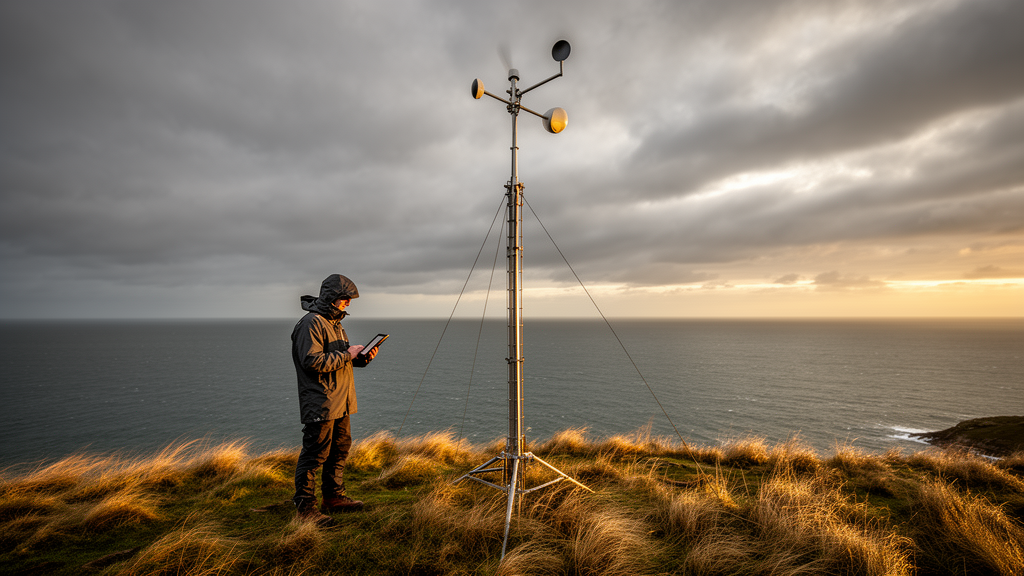
Every wind turbine standing today was designed, in part, for a storm that may never arrive. Buried inside the International Electrotechnical Commission’s design standard for wind turbines is an external condition known as the extreme coherent gust with direction change, or ECD. The definition is deceptively simple: the wind speed must increase by 15 meters per second while the wind direction swings by more than 60 degrees, all within a 10-second window. Because such an abrupt, simultaneous change in speed and direction would hammer a turbine from a completely new angle, the ECD drives the design of many turbine components, most notably the tower itself. It is one of the standard events engineers assume will occur roughly once every 50 years, the so-called 50-year return period that anchors modern structural design.
A new study now argues that this cornerstone event is essentially fictional. Ansh Patel of the Technical University of Denmark’s Wind and Energy Systems department, working with Jakob Mann, Kasper Zinck, Mikael Sjöholm, Ásta Hannesdóttir, and Karunya Raj, reassessed the ECD using data from 319 Vestas turbines operating across the globe. Their conclusion, published as a preprint under review in the journal Wind Energy Science, is stark: of all the extreme wind events they identified, none matched the ECD’s defined characteristics, and a statistical model suggests the true return period of such an event exceeds 200 years, not 50. The finding could reshape how the tallest machines ever built are engineered.
The technical trick behind the study is that the researchers treated each wind turbine as an anemometer. Modern turbines constantly record their own operating data, including rotor speed, pitch angles, and power output, and these signals respond sensitively to changes in the incoming wind. By inverting the turbine’s response, the team could detect wind speed and direction ramps, the sudden ramps in wind conditions that meteorologists have long studied as precursors to extreme loads. This approach transforms a global fleet of turbines into a planetary network of wind sensors, something no conventional meteorological mast campaign could ever replicate at scale.
What causes these ramps? The study points firmly at thunderstorm outflows, also known as cold pools. When a thunderstorm’s downdraft hits the ground, it spreads outward as a dense, chilled sheet of air, and the leading edge, the gust front, produces exactly the kind of rapid wind speed increase that turbines fear. While other atmospheric mechanisms also generate ramps, the researchers found that cold pools most often produce wind direction changes greater than 30 degrees, making them the leading candidate for the ECD’s physical signature. In total, the team identified 75 extreme ramp events across their global dataset.
Here is the twist: none of those 75 events matched the ECD’s defined characteristics. The standard assumes a coherent, simultaneous gust and direction swing of more than 60 degrees over 10 seconds, but the real cold-pool events fell short of that combination. Furthermore, the events were not distributed evenly around the world. They concentrated in specific regions, notably the United States, Germany, Australia, and Argentina, reflecting the geography of thunderstorm climatology rather than any universal atmospheric behavior.
To translate these observations into engineering numbers, the researchers applied a probabilistic gust model to those four regions. The model estimates the likelihood of extreme gust-and-direction combinations occurring over time, and its verdict on the ECD is unambiguous: the return period is greater than 200 years, well above the 50-year return period the IEC standard intends. In other words, the ECD is too conservative, a design event so rare that turbines built to withstand it may never face it in their operational lifetime, even across multiple decades of service.
The consequences for turbine design are substantial. Comparing the extreme loads from representative 50-year events in those four regions to the loads produced by the ECD, the team found a 28 percent reduction in the resultant bending moments at the bottom of the tower. Tower bending moment is a critical quantity in structural design, because the tower must resist the combined forces of wind thrust, rotor weight, and dynamic response without exceeding material limits. A 28 percent reduction in that quantity, if confirmed and adopted into standards, could translate into lighter towers, less steel, lower costs, and potentially taller turbines reaching stronger winds higher in the atmosphere.
The timing of this reassessment is significant. Wind turbines have grown substantially in size over recent decades, with rotor diameters now exceeding 200 meters and hub heights pushing past 150 meters. The need to update design standards has become increasingly pressing, and questions have arisen over whether the ECD accurately captures the most extreme conditions experienced by modern turbines. The study’s authors argue that their findings underscore an urgent need to redefine the ECD, and they believe their work provides a step in that direction. Because the ECD strongly influences tower design, any revision would ripple through the entire structural engineering chain of next-generation turbines.
For now, the study remains a preprint under review, and the discussion is open until November 2026. But the implications extend beyond wind energy alone. The study demonstrates a powerful methodology: using operational data from an entire global fleet as a distributed sensing network, then feeding those observations into probabilistic models to test whether standardized design events match physical reality. If the ECD is indeed a 200-year event masquerading as a 50-year one, the standards that govern the world’s fastest-growing renewable technology may be overdue for a data-driven rewrite, and the turbines of the future could be built for the storms they will actually face rather than the ones engineers have long imagined.
Subject of Research: Data-driven reassessment of the IEC extreme coherent gust with direction change design event for wind turbine towers
Article Title: A data-driven reassessment of the extreme coherent gust with direction change
Article References: Patel, A., Mann, J., Zinck, K., Sjöholm, M., Hannesdóttir, Á., & Raj, K. (2026). A data-driven reassessment of the extreme coherent gust with direction change. https://doi.org/10.5194/wes-2026-175
Image Credits: AI Generated
DOI: 10.5194/wes-2026-175
Keywords: wind energy, wind turbines, extreme coherent gust, ECD, IEC standard, design load case, cold pools, thunderstorm outflow, tower bending moment, return period, probabilistic gust model, Wind Energy Science
Cite Scienmag News
Denise Maddox. (October 15, 2026). The 50-year wind gust that may never come. Scienmag. https://scienmag.com/the-50-year-wind-gust-that-may-never-come/
Denise Maddox. "The 50-year wind gust that may never come." Scienmag, 15 October 2026, https://scienmag.com/the-50-year-wind-gust-that-may-never-come/. Accessed 15 October 2026.
Denise Maddox. "The 50-year wind gust that may never come." Scienmag. October 15, 2026. https://scienmag.com/the-50-year-wind-gust-that-may-never-come/


