


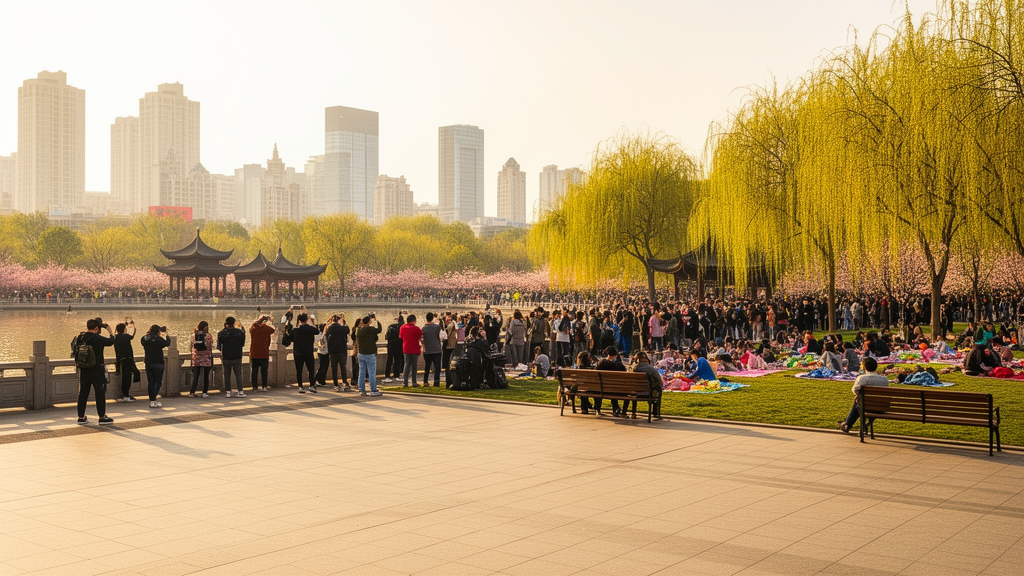
In one of the most densely populated cities on Earth, the pocket of green space between apartment towers is not just scenery; it is where millions of residents in Shanghai get their only regular dose of nature. Yet a new study of the city’s urban parks suggests that what people want from those parks and what the parks actually provide are frequently out of sync, and that the mismatch is written openly in the reviews, ratings and complaints visitors post online.
The research, published in Environmental and Sustainability Indicators by Jianing Zeng and Hongmin Chen, tackles a famously slippery problem in sustainability science: cultural ecosystem services, the non-material benefits people draw from nature, such as recreation, aesthetic pleasure and spiritual enrichment. Unlike timber or clean water, these services are intangible and subjective, which has long made them difficult to measure. The researchers’ approach was to measure both sides of the equation, the supply that parks physically offer and the demand that residents visibly express, and then calculate how well the two align across the city.
Shanghai, home to 24.89 million people with an urbanization rate of 90 percent, had 853 urban parks by December 2024, spanning large urban parks, community parks and tiny pocket parks. From this network the team selected 30 sample parks through stratified sampling, drawing ten from each category. Supply was quantified through an index system covering daily carrying capacity, calculated from park area and opening hours using the national public park design code, transportation accessibility based on nearby subway stations and bus stops, and the diversity of surrounding service functions such as dining, sports, entertainment and cultural facilities derived from digital map data.
Demand was captured on two fronts. Mobile phone signaling data from a typical day in 2023, preprocessed at 500-meter resolution, revealed how many people actually move through each park’s service radius, a measure of revealed demand. Social media popularity on the review platform Dianping, combining ratings with comment volume, served as a proxy for latent demand, the interest and willingness to engage that circulates online even before anyone walks through the gate. The team weighted all indicators using the entropy weight method, then computed two complementary measures: a z-score quadrant analysis that classifies each park into one of four supply-demand types, and a coupling coordination degree model that grades how harmoniously the two systems develop together on a scale from extreme imbalance to high-quality coordination.
The results paint a picture of widespread, geographically patterned mismatch. More than half of the sampled parks, 56.7 percent, fell into the low demand-low supply quadrant, while only 30 percent achieved the high demand-high supply ideal and 13.3 percent were saddled with high demand but inadequate supply. The coupling coordination analysis was equally sobering: 63.3 percent of parks showed some degree of imbalance, and only 36.7 percent reached the transitional development category. Community parks fared best, with 40 percent reaching the barely coordinated level, while 80 percent of large urban parks remained on the verge of imbalance or slightly imbalanced, suggesting that sheer size guarantees nothing about how well a park serves its public.
Geography mattered enormously. Coordination scores declined significantly with distance from the city center, a moderately strong negative correlation confirmed statistically with a Pearson coefficient of -0.600 and a p-value below 0.001. A spatial autocorrelation test further showed that coordination clusters: parks with high scores sit next to other high-scoring parks in inner districts such as Huangpu, Jing’an and Changning, forming hotspots, while cold spots of imbalance cluster in the outer suburbs. Central parks benefit from intense foot traffic, historic prestige and a dense web of surrounding restaurants, museums and transit links, whereas suburban parks suffer from isolation, low accessibility and thin service diversity.
To understand why these mismatches arise, the researchers turned to the words of visitors themselves. They scraped 15,487 reviews, roughly 500,000 words of text, from three representative parks: Tianshan Park as a high demand-high supply case, Pujiang Suburban Park as high demand-low supply, and Situan Happiness Park as low demand-low supply. Using latent Dirichlet allocation topic modeling, tuned to eight coherent topics, alongside word frequency analysis and a lexicon-based sentiment scoring system validated against independent human annotation with an accuracy of 86.3 percent, they mapped what visitors cared about and how they felt about it.
The emotional fingerprints of each park type differed sharply. Tianshan Park earned positive sentiment across all themes in 57 percent of reviews, with balanced, even scores, reflecting a healthy match between expectation and experience. Pujiang Suburban Park showed the signature of frustrated demand: some keyword scores exceeded 20 while others fell below 5, with visitors praising flowers and photography-worthy scenery but complaining about admission fees, dining options and management. At Situan Happiness Park, average sentiment was the lowest of all, and discussion was confined to just three themes, greenery, light recreation and renovation works, revealing a park whose modest offerings barely register in the public imagination. Across every park type, one theme scored worst: park management, with tickets, fees and maintenance drawing consistent criticism.
Grey relational analysis identified the strongest single factor behind coordination: the intensity of human activity, with a relational degree of 0.914, followed by social media topic popularity, subway access and service facility diversity. Bus stops ranked weakest. The finding points to an uncomfortable truth for park planners: building more green space does not by itself create a well-functioning park. Demand must be activated through visibility, online buzz and word of mouth before it can pull supply into balance. Suburban parks with excellent ecology but thin digital footprints remain trapped in a low-low equilibrium that physical expansion alone will not fix.
The authors propose a typology-based governance strategy rather than a one-size-fits-all prescription. High demand-high supply parks need congestion management and quality preservation, not expansion. High demand-low supply parks, typically busy suburban destinations, need better distribution of services within existing grounds, such as mobile kiosks, restrooms and shaded seating concentrated at high-traffic zones. Low demand-low supply parks need demand activation first, through low-threshold events, anchor amenities and digital placemaking on platforms like Xiaohongshu and Douyin, which can trigger a self-reinforcing loop of visitors, commercial services and further visitation. Underpinning all three strategies is a call for a standardized demand-response mechanism: a digital monitoring system that captures visitor complaints in real time and generates early-warning lists, replacing the passive message boards and unanswered reviews of traditional park management. With Shanghai pursuing its goal of a city of 1,000 parks, the study suggests that the harder task is not adding parks but ensuring each one is tuned, through data as ordinary as a review score, to what its visitors actually seek.
Subject of Research: Supply-demand matching of cultural ecosystem services in Shanghai's urban parks using coupling coordination degree and social media text analysis
Article Title: Evaluation of urban parks’ Cultural Ecosystem Services from the Perspective of Supply-Demand Matching: Based on coupling coordination degree and social media text analysis in Shanghai
Article References: Zeng, J., & Chen, H. (2026). Evaluation of urban parks’ Cultural Ecosystem Services from the Perspective of Supply-Demand Matching: Based on coupling coordination degree and social media text analysis in Shanghai. Environmental and Sustainability Indicators, 32, Article 101518. https://doi.org/10.1016/j.indic.2026.101518
Image Credits: AI Generated
DOI: Not provided
Keywords: cultural ecosystem services, urban parks, Shanghai, supply-demand matching, coupling coordination degree, social media text analysis, sentiment analysis, LDA topic modeling, mobile phone signaling data, spatial autocorrelation, urban planning, entropy weight method
Cite Scienmag News
Sloane Callahan. (October 15, 2026). Social Media Reveals Shanghai’s Urban Parks Fail to Match Cultural Services With Visitor Demand. Scienmag. https://scienmag.com/social-media-reveals-shanghais-urban-parks-fail-to-match-cultural-services-with-visitor-demand/
Sloane Callahan. "Social Media Reveals Shanghai’s Urban Parks Fail to Match Cultural Services With Visitor Demand." Scienmag, 15 October 2026, https://scienmag.com/social-media-reveals-shanghais-urban-parks-fail-to-match-cultural-services-with-visitor-demand/. Accessed 15 October 2026.
Sloane Callahan. "Social Media Reveals Shanghai’s Urban Parks Fail to Match Cultural Services With Visitor Demand." Scienmag. October 15, 2026. https://scienmag.com/social-media-reveals-shanghais-urban-parks-fail-to-match-cultural-services-with-visitor-demand/


