


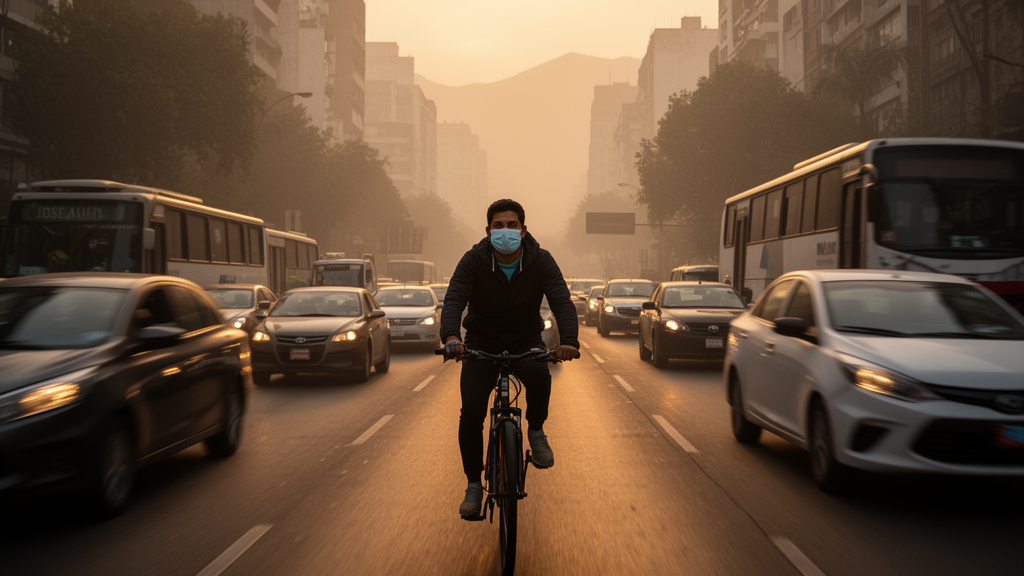
When Mexico City shut down in the spring of 2020, its famously congested streets fell suddenly quiet, and cycling was promoted by city authorities as a safe, individual way to move through a pandemic. Five years later, a long-term monitoring effort has revealed what that experiment meant for the air that cyclists actually breathe. A research team led by scientists at the Universidad Nacional Autónoma de México measured carbon monoxide and black carbon along bicycle lanes in the capital during three distinct periods: July 2020, at the height of the lockdown; September and October 2021, as traffic roared back; and January 2025, once post-pandemic mobility had settled into a new normal. The results, published in the journal Air Quality, Atmosphere & Health, show that the two pollutants tell strikingly different stories about how the city’s recovery reshaped cyclist exposure.
The setting could hardly be more demanding. The Mexico City Metropolitan Area sits at 2,245 meters above sea level and is home to more than 20 million inhabitants and over 6 million registered vehicles. High altitude thins the oxygen that engines burn, dense traffic supplies a constant stream of combustion products, and surrounding mountains and urban geometry hinder dispersion. During the pandemic, public transport was widely perceived as an infection risk, prompting many commuters to shift toward private vehicles, a move that threatened to raise traffic-related emissions even as overall mobility fell. City officials responded by carving out new cycling infrastructure, most prominently an emerging bicycle lane along Insurgentes Avenue stretching roughly 20 kilometers, whose users grew from about 2,000 per day in April 2020 to more than 6,000 by October 2020. Those temporary cycleways, later research has shown, helped sustain ridership long after the emergency ended.
For the new study, the researchers designed a 12-kilometer cycling route through major corridors of the city, deliberately choosing three contrasting lane configurations. Lane A, along Revolución Avenue, offered cyclists an exclusive space but ran close to buses and trucks, with a minimum separation of about two meters from public transport vehicles. Lane B, along Insurgentes Sur Avenue, was physically separated from the bus lane, putting roughly eight meters between cyclists and diesel-powered buses, although private cars and trucks still passed within about two meters. Lane C, a 1.2-kilometer stretch along Félix Cuevas Avenue, was the most exposed scenario of all: cyclists and buses shared the same road space. The route was surveyed 12 times in 2020, 12 times in 2021, and 14 times in 2025, always starting at 07:50 local time and at an average speed of about 15 kilometers per hour to keep conditions comparable.
The technical apparatus was deliberately portable. Black carbon was measured with a micro-aethalometer that determines equivalent black carbon from the change in optical attenuation of particles collected on a filter at 880 nanometers, sampling particles of 2.5 micrometers or smaller at 100 milliliters per minute and logging data every 30 seconds. Carbon monoxide was measured with an electrochemical monitor with a resolution of 0.05 parts per million. Both instruments rode in a backpack with sampling inlets positioned near the cyclist’s breathing zone, while a GPS receiver georeferenced every reading. Because filter-based aethalometers progressively underestimate black carbon as the filter loads up, the team applied an attenuation-dependent loading correction and carried out a formal uncertainty analysis, combining a 2.89 percent relative standard uncertainty from flow verification with an empirical 5 percent field reproducibility term. The result was an expanded relative uncertainty of approximately 11.5 percent for the black carbon measurements and a 2 percent relative uncertainty propagated from the CO calibration gas.
Converting concentrations into dose required attention to human physiology as well as chemistry. The team calculated hourly inhaled exposure using a representative inhalation rate of 2.6 cubic meters per hour for moderate cycling effort, and then estimated an average daily dose for a standardized commuter scenario: 1.5 hours of cycling per day, 250 days per year, over 20 years, for a 70-kilogram adult. Sensitivity analyses with inhalation rates from 2.0 to 4.0 cubic meters per hour confirmed the robustness of the comparisons. Statistical treatment was equally careful: rides rather than individual readings were treated as independent observations to avoid pseudoreplication, temporal differences among years were tested with the Kruskal-Wallis test followed by Holm-corrected pairwise comparisons, and spatial differences among lanes within each year were evaluated with the Friedman test and Wilcoxon signed-rank tests.
The carbon monoxide results trace the arc of the pandemic economy with remarkable clarity. During the July 2020 lockdown, concentrations were low and remarkably uniform along the entire route, averaging between 1.96 and 2.13 parts per million across the three lanes, with no clear weekday-weekend distinction because the usual rhythms of urban mobility had collapsed. By 2021, as cars and motorcycles returned in force, CO concentrations jumped by roughly 76 to 89 percent, reaching means of 3.58 to 4.02 parts per million, and a familiar weekly pattern re-emerged with higher levels on weekdays. Vehicle counts corroborated the shift: car flow nearly doubled from about 18 to more than 30 cars per minute, and motorcycle traffic on Insurgentes Sur and Félix Cuevas avenues tripled. By 2025, CO had fallen to means between 3.00 and 3.20 parts per million, down about 11 to 25 percent from the 2021 peak yet still 41 to 61 percent above lockdown levels, indicating that gasoline-related exposure never returned to its pandemic low.
Black carbon followed a different and more troubling trajectory. This particulate pollutant, a marker of incomplete combustion strongly associated with diesel exhaust from buses and heavy-duty vehicles, was lowest in 2020, when the physically separated lane B recorded the lowest average at 4.68 micrograms per cubic meter while the traffic-adjacent lane A recorded 9.51. After the lockdown, black carbon surged: in 2021, lanes A and C averaged 15.78 and 15.82 micrograms per cubic meter respectively, with lane C, where cyclists shared road space with buses, showing the largest relative increase at 185 percent. One daily measurement in lane C exceeded 50 micrograms per cubic meter. Critically, concentrations did not fall back in 2025. Lanes A, B, and C averaged 16.01, 12.85, and 13.60 micrograms per cubic meter, and while lane B had enjoyed the cleanest air in 2020 and 2021, its 2025 values rose sharply, suggesting that separation from buses alone cannot shield cyclists when corridor-wide traffic and pollutant accumulation intensify. Notably, Mexico has no ambient air quality standard specifically for black carbon, so these values were interpreted as exposure indicators rather than regulatory compliance metrics.
The statistical analysis confirmed the contrast. Daily route-average CO differed significantly among years, rising from a median of 1.97 parts per million in 2020 to 3.79 in 2021 and easing to 3.26 in 2025. Black carbon medians climbed from 6.63 micrograms per cubic meter in 2020 to 11.77 in 2021 and 15.49 in 2025, with no significant difference between the last two years. Spatially, CO varied little among lanes except in 2021, reflecting the diffuse presence of gasoline vehicles, whereas black carbon showed strong lane effects in 2020 and 2021, driven by proximity to buses and trucks, before becoming more generalized along the route by 2025. The exposure calculations translated these patterns into human terms: hourly inhaled CO exposure rose from 7.02 milligrams per hour in 2020 to 11.18 in 2021 before dipping to 9.36 in 2025, while hourly black carbon inhalation climbed from 18.72 to 35.10 and then 36.79 micrograms per hour, an increase of nearly 97 percent relative to the lockdown. Average daily doses followed suit, with the black carbon dose for a regular commuting cyclist nearly doubling after 2020 and remaining at roughly 5.0 × 10⁻⁴ milligrams per kilogram per day through 2025.
The researchers caution that the 2025 campaign took place during the cold-dry season, when Mexico City’s primary pollutants typically accumulate more readily than during the rainy-season campaigns of 2020 and 2021, and that comparable vehicle counts were unavailable for 2025, so the reasons for CO’s partial decline cannot be confirmed directly. Seasonality may have amplified the magnitude of the differences, but it does not overturn the central finding that both pollutants remained well above lockdown levels five years on. The practical message is aimed squarely at urban planners. Bicycle lanes protect health in one way by encouraging physical activity and low-emission mobility, yet the study shows that their design determines how much of the city’s combustion exhaust reaches the lungs of the people riding them. Greater physical separation from buses and heavy-duty vehicles, careful placement of public transport lanes and bus stops, roadside vegetation, and attention to local traffic density all emerged as levers for reducing exposure. As cities worldwide invest in cycling infrastructure, the Mexico City evidence suggests that connectivity and safety, while essential, are only part of the equation: distance from the tailpipes matters too.
Subject of Research: Cyclist exposure to carbon monoxide and black carbon on Mexico City bicycle lanes during and after the COVID-19 pandemic
Article Title: Contrasting cyclist exposure to carbon monoxide and black carbon on bicycle lanes in Mexico City during the COVID-19 lockdown and post-pandemic recovery (2020–2025)
Article References: Peralta, O., Reynoso-Cruces, S., Ávila, A., Salinas, A., Castro, T., Saavedra, I., Alvarez-Ospina, H., Ortínez-Alvarez, A., & Ruiz-Suárez, L. G. (2026). Contrasting cyclist exposure to carbon monoxide and black carbon on bicycle lanes in Mexico City during the COVID-19 lockdown and post-pandemic recovery (2020–2025). Air Quality, Atmosphere & Health, 19(10), Article 238. https://doi.org/10.1007/s11869-026-02128-9
Image Credits: AI Generated
DOI: 10.1007/s11869-026-02128-9
Keywords: cyclist exposure, black carbon, carbon monoxide, Mexico City, air pollution, COVID-19 lockdown, bicycle lanes, urban mobility, diesel emissions, inhaled dose, traffic-related pollution, active transport
Cite Scienmag News
Russell Cooper. (October 15, 2026). Cyclists in Mexico City Face Rising Black Carbon Long After Lockdown Traffic Returned. Scienmag. https://scienmag.com/cyclists-in-mexico-city-face-rising-black-carbon-long-after-lockdown-traffic-returned/
Russell Cooper. "Cyclists in Mexico City Face Rising Black Carbon Long After Lockdown Traffic Returned." Scienmag, 15 October 2026, https://scienmag.com/cyclists-in-mexico-city-face-rising-black-carbon-long-after-lockdown-traffic-returned/. Accessed 15 October 2026.
Russell Cooper. "Cyclists in Mexico City Face Rising Black Carbon Long After Lockdown Traffic Returned." Scienmag. October 15, 2026. https://scienmag.com/cyclists-in-mexico-city-face-rising-black-carbon-long-after-lockdown-traffic-returned/


