


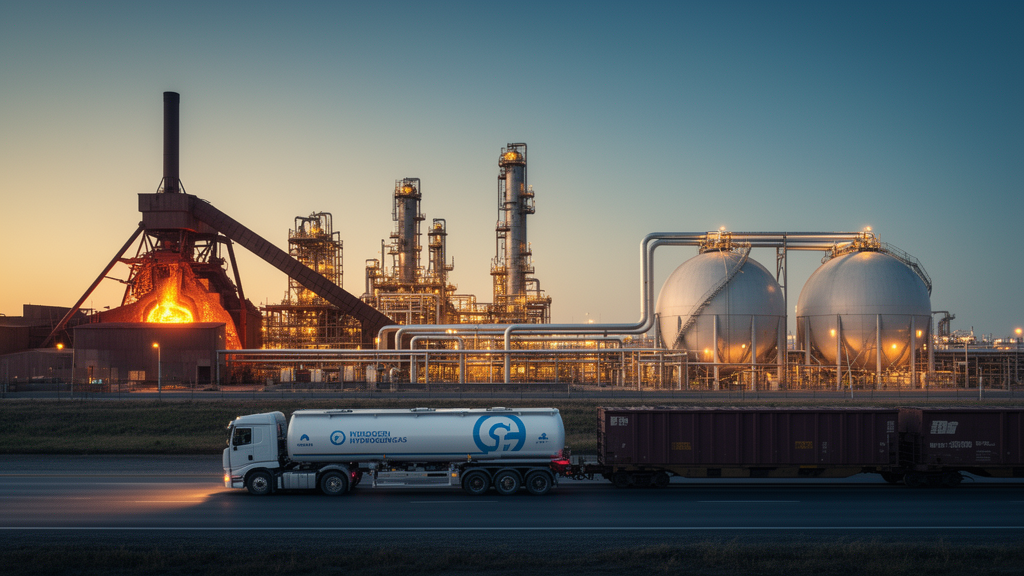
Clean hydrogen has been billed as the Swiss Army knife of the energy transition, a molecule that can slice through emissions wherever batteries and heat pumps cannot reach. But a new analysis from Princeton University researchers argues that the knife is being handed out to the wrong sectors. Writing in Nature Climate Change, a team led by Yujie Wu and Denise L. Mauzerall, with Jesse D. Jenkins among the senior authors, evaluated the decarbonization potential and economic costs of clean hydrogen across ten carbon-intensive sectors around the year 2035. Their verdict is blunt: hydrogen is a scarce, expensive resource, and spending it on the wrong applications could squander both public money and the molecule itself.
The study’s central metric is the levelized cost of carbon mitigation, or LCCM, a figure that captures how many dollars of net cost are required per tonne of carbon dioxide avoided when hydrogen replaces the best available low-carbon alternative in a given sector. This matters because hydrogen rarely competes against a fossil fuel in isolation; it competes against direct electrification, batteries, heat pumps and other clean technologies that are themselves improving rapidly. In sectors where those alternatives are cheap and mature, hydrogen loses decisively. In sectors where no viable alternative exists, hydrogen can be the only game in town.
The researchers’ screening of ten sectors produced a clear hierarchy. Steelmaking, oil refining and ammonia production emerge as so-called no-regret applications, offering the lowest levelized carbon mitigation costs of any end use examined. The technical logic is straightforward. In ammonia synthesis, hydrogen is not a fuel but a chemical feedstock: the molecule itself is the product, and there is no electrified route that avoids needing it. In oil refining, hydrogen is used to upgrade crude streams and remove sulfur, again as an irreplaceable process input. In steelmaking, hydrogen can serve as the reducing agent that strips oxygen from iron ore in direct reduction processes, replacing the coking coal that currently dominates the industry’s emissions. In each case, hydrogen is doing chemical work that electrons cannot easily do, which is precisely where an energy-intensive, costly molecule earns its keep.
At the opposite end of the ranking sit on-road transport and rail, where the study finds hydrogen economically unfavourable compared with direct electrification. The physics is unforgiving. A fuel cell vehicle converts hydrogen to motion through a chain of electrolysis, compression or liquefaction, distribution, storage and reconversion, each step bleeding efficiency. Round-trip efficiency from renewable electricity to wheels can fall to roughly 30 percent or less, whereas battery-electric drivetrains deliver well over 70 percent. For rail, the case is even starker: freight and passenger lines are among the easiest transport modes to electrify with overhead catenary or battery systems, and prior work cited by the team, including a Nature Energy analysis of converting diesel trains to battery-electric power, found the economics strongly favour batteries. Every kilogram of clean hydrogen diverted to a truck or train is a kilogram unavailable to a steel furnace or an ammonia reactor where it would deliver deeper cuts per dollar.
The analysis also confronts an uncomfortable reality about hydrogen’s climate accounting. Clean hydrogen is energy-intensive to produce, and the molecule is a potent indirect greenhouse gas: leaked hydrogen extends the atmospheric lifetime of methane and contributes to tropospheric ozone and stratospheric water vapour. Recent multi-model assessments have assigned hydrogen a global warming potential that, while far below methane’s, is far from negligible over decadal timescales. The Princeton team’s cost figures therefore sit within a landscape where leakage across the supply chain, from production to delivery and dispensing, can erode the climate benefits of even well-intentioned projects. This strengthens the argument for concentrating hydrogen in industrial applications with contained, well-managed handling systems rather than dispersing it across millions of vehicle refuelling points.
Perhaps the study’s most policy-relevant finding concerns the levers governments are actually pulling. The United States, the European Union, China and other major economies have poured support into hydrogen production, through production tax credits under the Inflation Reduction Act, hydrogen hubs under the Bipartisan Infrastructure Law, and national hydrogen strategies and roadmaps. The Princeton researchers find that although policy support is needed to make clean hydrogen cost-competitive, production incentives are not an effective policy lever for steering the molecule into no-regret sectors. Uniform supply-side subsidies, they conclude, risk misallocating limited clean hydrogen supply and public funds, because they reward whoever produces hydrogen rather than whoever uses it where it cuts the most carbon.
The team’s figures on misaligned priorities make the danger concrete. Private-sector demand, driven by subsidies and cost arithmetic, does not necessarily coincide with the applications that deliver the greatest emission reductions per unit of hydrogen. A subsidy regime that inflates production without sector-specific demand signals can therefore channel hydrogen into economically unfavourable uses, such as transport, while steelmakers and refiners wait for supply that never arrives at a price they can pay. The researchers’ simulations of uniform supply-side subsidies show this misallocation directly, and their sectoral competitiveness analysis shows how far green hydrogen remains from cost parity in many end uses even under optimistic 2035 assumptions.
The alternative the authors propose is a demand-side policy architecture tailored sector by sector. For steel, that could include green public procurement, in which governments commit to buying hydrogen-based green steel for infrastructure projects, a lever already being explored by the United Nations Industrial Development Organization and by manufacturers such as Mercedes-Benz, which has committed to purchasing hundreds of thousands of tonnes of hydrogen-produced steel. For ammonia and refining, carbon contracts for difference or clean product standards could guarantee markets for low-carbon output. For transport, the implication is to let direct electrification proceed and reserve hydrogen for the niches where batteries genuinely fail, such as long-haul aviation and shipping, rather than subsidizing fuel-cell trucks and trains into existence.
The timing of the analysis is pointed. The United States has already cancelled more than two billion dollars in funding to regional clean hydrogen hubs, including the California ARCHES hub and the Pacific Northwest hub, illustrating how politically fragile supply-side commitments can be. Meanwhile, global hydrogen reviews from the International Energy Agency continue to document a widening gap between announced projects and implemented capacity, echoing earlier Nature Energy work on the probabilistic feasibility space of scaling green hydrogen supply. If near-term supply is as limited as these assessments suggest, the opportunity cost of misallocation is not hypothetical; it is measured in tonnes of carbon that could have been abated in a steel plant but were instead burned in a truck.
For a molecule that has attracted billions in public investment and near-mythical expectations, the study’s message is a dose of engineering realism: hydrogen is a precision tool, not a universal solvent. The technical case is now quantified across ten sectors, with steelmaking, refining and ammonia standing out as the applications where each kilogram of clean hydrogen buys the most mitigation per dollar. The policy case follows from the arithmetic. Governments that want cost-effective decarbonization should stop asking how to produce more hydrogen and start asking, sector by sector, where it should actually be used.
Subject of Research: Prioritizing demand-side use of clean hydrogen for cost-effective mitigation
Article Title: Prioritizing demand-side use of clean hydrogen for cost-effective mitigation
Article References: Prioritizing demand-side use of clean hydrogen for cost-effective mitigation. (n.d.). https://doi.org/10.1038/s41558-026-02763-1
Image Credits: AI Generated
DOI: 10.1038/s41558-026-02763-1
Keywords: clean hydrogen, climate mitigation, steelmaking, ammonia, oil refining, demand-side policy, Nature Climate Change, decarbonization, Prioritizing, demand-side, clean, hydrogen
Cite Scienmag News
Sloane Callahan. (October 15, 2026). Clean Hydrogen Belongs in Steel, Refineries and Ammonia — Not Trucks and Trains. Scienmag. https://scienmag.com/clean-hydrogen-belongs-in-steel-refineries-and-ammonia-not-trucks-and-trains/
Sloane Callahan. "Clean Hydrogen Belongs in Steel, Refineries and Ammonia — Not Trucks and Trains." Scienmag, 15 October 2026, https://scienmag.com/clean-hydrogen-belongs-in-steel-refineries-and-ammonia-not-trucks-and-trains/. Accessed 15 October 2026.
Sloane Callahan. "Clean Hydrogen Belongs in Steel, Refineries and Ammonia — Not Trucks and Trains." Scienmag. October 15, 2026. https://scienmag.com/clean-hydrogen-belongs-in-steel-refineries-and-ammonia-not-trucks-and-trains/


