


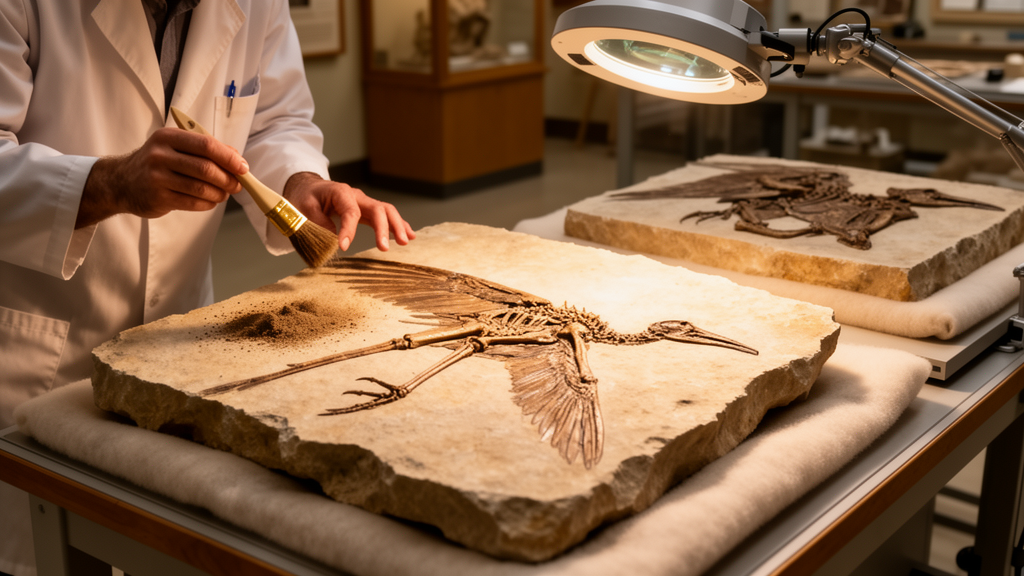
The famous Archaeopteryx, the feathered dinosaur that has symbolized evolution since Darwin’s day, may not be the only bird-like creature from the Solnhofen Archipelago. A new study published in Fossil Record has reassessed the taxonomy of all known Late Jurassic avialan specimens from the famous limestones of southern Germany, and the results are reshaping how paleontologists view the earliest stages of bird evolution. The research, led by a team examining all fifteen known Urvögel specimens, combines specimen-based phylogenetic analyses, principal coordinate analyses of forelimb morphospace, and statistical bone-by-bone length comparisons to test whether these fossils represent a single genus or multiple distinct lineages.
The study’s central question is deceptively simple: how many taxa do the Solnhofen Urvögel actually represent? Since the first specimen was discovered in 1861, just two years after Darwin published On the Origin of Species, Archaeopteryx has been treated as an icon of evolution, a missing link between reptiles and birds. But its taxonomic history is complex. Over the decades, specimens have been shuffled between genera, including Griphosaurus, Archaeornis, Jurapteryx, and Wellnhoferia, before being consolidated back into Archaeopteryx. More recently, the Haarlem specimen was named Ostromia crassipes and the Mühlheim specimen was named Alcmonavis poeschli, only for a 2026 reinterpretation to argue that both belong to Archaeopteryx after all, based on similarities in limb proportions.
That reinterpretation relied heavily on stochastic regression imputation, a statistical method for estimating missing data. The new study argues that this approach was fundamentally flawed for these specimens. Because most of the major long bones are not preserved or are incomplete in the Haarlem and Mühlheim fossils, the imputation was based on only two measurements for the Mühlheim specimen and one for the Haarlem specimen, meaning the comparison with the Archaeopteryx sample was largely based on simulated data. Even the single tibia value used for the Haarlem specimen was itself an estimate, since the bone is missing its distal end. The study also notes that the forelimb-to-hindlimb ratio, the main difference between Archaeopteryx and Anchiornis highlighted in the earlier work, cannot be assessed confidently for either fragmentary specimen, and that limb proportions are decoupled from each other in bipedal taxa, so similar forelimb proportions do not require identical hindlimb proportions.
To avoid these pitfalls, the new research took a different approach. All fifteen Urvögel specimens were added separately to a phylogenetic dataset containing 202 operational taxonomic units and 628 characters, adapted from a recent matrix and expanded with additional taxa from the Late Jurassic of China and beyond. The dataset was analyzed in TNT using New Technology Search methods under both equal weights and implied weights, the latter to reduce the impact of homoplasy that can encode ontogenetic or sexual variation within a taxon. In parallel, a principal coordinates analysis using Maximum Observed Rescaled Distances explored the morphological distances among specimens, and a modified t test compared the non-allometric residuals of the fragmentary Haarlem and Mühlheim specimens against the Archaeopteryx population after allometric size correction.
The phylogenetic results were striking. Under equal weights, the analyses recovered a monophyletic Archaeopteryx that includes not only the well-established London, Berlin, Eichstätt, Solnhofen, Munich, Thermopolis, Altmühl, Schamhaupten, Daiting, and Chicago specimens, but also the fragmentary Maxberg, Ottmann and Steil, and Karlsruhe specimens, which had previously been referred to the genus only tentatively because they do not preserve its diagnostic characters. The Mühlheim specimen, however, was consistently excluded from Archaeopteryx and placed more crownward, as the sister taxon to a clade containing Sapeornis and Euavialae in the equal-weight analysis, and closer to Jeholornithiformes and Pygostylia under implied weights. This position is supported by several anatomical characters, including an angle between the proximal part of the humerus and the humeral shaft that is larger than 35 degrees, a facet for the attachment of the deltopectoral muscle on the humeral crest, and a proximal articular surface of the ulna that forms an oval concavity with slightly raised rims.
The statistical bone-by-bone comparisons reinforced this distinction. When the non-allometric residuals of the Mühlheim specimen were tested against the Archaeopteryx sample, only one comparison out of many showed a significant difference, suggesting that the specimen’s overall forelimb proportions are broadly similar to Archaeopteryx. But when the same test was applied to comparisons with Anchiornis and Microraptor, approximately one-fourth and less than 20 percent of comparisons were significant, respectively, indicating that the Mühlheim specimen is more different from these paravians than from Archaeopteryx. The principal coordinates analysis, however, placed the Mühlheim specimen in isolation, neither within the Archaeopteryx cluster nor within the clusters of more basal or more crownward avialans, and its first principal coordinate value was significantly different from the Archaeopteryx sample with a p value of 0.003, a result that persisted across all character subsamples.
The Haarlem specimen proved far more elusive. This fossil, first misidentified as a pterosaur in 1857 and only recognized as an avialan by Ostrom in 1970, is heavily compacted and corroded, with most of the second digit of the right manus preserved only as a mold with ragged margins. The study re-examined the longitudinal furrows along the manual bones that had been cited as a key difference from Archaeopteryx and a link to the Chinese anchiornithines. While the earlier reinterpretation argued these furrows are taphonomic artifacts of compaction, the new analysis notes that the furrows in the Haarlem specimen extend over the entire length of the phalanges, lack clearly recognizable breaks, and are present on both sides of the bones, confluent distally with the collateral ligament groove, a preservation pattern distinct from the collapse structures common in other Solnhofen tetrapods. The question remains unresolved, and the character was removed from the phylogenetic dataset pending synchrotron analysis.
The study also corrected an error in the earlier literature regarding the estimated length of metacarpal III in the Haarlem specimen, which had been given as 23 mm but is actually approximately 32 mm. After this correction, all significant proportional differences between the Haarlem specimen and Archaeopteryx involving metacarpal III became statistically nonsignificant. The bone-by-bone comparison using the measurements of Wellnhofer showed nine significant differences in proportions, most occurring in the pedal elements, a pattern consistent with the finding that the feet of volant avialans were less constrained than the forelimbs and show greater proportional disparity. The phylogenetic analyses identified the Haarlem specimen as a wildcard taxon at the base of Avialae that must be pruned from the tree sample to recover a monophyletic Archaeopteryx clade, and in many equally parsimonious trees it was found at different positions at the base of Avialae rather than consistently within Archaeopteryx.
Based on these converging lines of evidence, the study concludes that the Mühlheim specimen is anatomically distinct from Archaeopteryx and retains its status as the valid taxon Alcmonavis poeschli, while the Haarlem specimen lacks definitive diagnostic features and is best regarded as Avialae indeterminate. The authors also note that the strong similarities in forelimb proportions between the Mühlheim specimen and Archaeopteryx are most likely due to functional constraints related to volant behavior rather than taxonomic affinity, a finding consistent with the observation that flight adaptations constrain forelimb variation more tightly than hindlimb variation. The forelimb morphospace of basal Avialae shows three distinct clusters for non-volant taxa, Archaeopteryx, and more crownward Euavialae, but the arrangement does not indicate a linear evolutionary trend, suggesting that flight adaptations in the forelimbs followed a mosaic-like pattern of evolution.
The study also found that specimens of Archaeopteryx probably represent more than a single species, though the results from different analyses are currently contradictory and inconclusive. The implied-weight analysis recovered two main clusters, one including the London specimen and the other the Berlin specimen, which could correspond to the previously recognized species Archaeopteryx lithographica and Archaeopteryx siemensii. However, the equal-weight analysis produced different groupings, and the internal taxonomy of the genus remains unresolved. The authors emphasize that further detailed anatomical comparisons are necessary to identify additional intrageneric variation that can be conceptualized as morphological characters, and that the current study represents a further step toward understanding the taxonomy of this iconic genus rather than a final resolution. The phylogenetic analyses also support the finding that Dromaeosauridae is the sister group of Avialae, contradicting previous results that recovered either a monophyletic Deinonychosauria or Troodontidae in that position, and highlighting that the internal relationships of Paraves remain controversial with significant implications for evolutionary scenarios concerning the origin of birds and active flight.
Subject of Research: Paleontology
Article Title: Considerations on the taxonomy of Late Jurassic Avialae ( Theropoda ) from the Solnhofen Archipelago
Article References: Foth, C., & Rauhut, O. W. M. (2026). Considerations on the taxonomy of Late Jurassic Avialae (Theropoda) from the Solnhofen Archipelago. Fossil Record, 29(2), 731-758. https://doi.org/10.3897/fr.29.200245
Image Credits: AI Generated
DOI: 10.3897/fr.29.200245
Keywords: Archaeopteryx, Alcmonavis poeschli, Solnhofen Archipelago, Late Jurassic, Avialae, taxonomy, phylogenetics, paleontology, bird evolution, Fossil Record, Considerations, Late
Cite Scienmag News
Gavin Prescott. (October 15, 2026). Solnhofen Urvögel Reassessed: Alcmonavis Stands, Haarlem Specimen Left in Taxonomic Limbo. Scienmag. https://scienmag.com/solnhofen-urvogel-reassessed-alcmonavis-stands-haarlem-specimen-left-in-taxonomic-limbo/
Gavin Prescott. "Solnhofen Urvögel Reassessed: Alcmonavis Stands, Haarlem Specimen Left in Taxonomic Limbo." Scienmag, 15 October 2026, https://scienmag.com/solnhofen-urvogel-reassessed-alcmonavis-stands-haarlem-specimen-left-in-taxonomic-limbo/. Accessed 15 October 2026.
Gavin Prescott. "Solnhofen Urvögel Reassessed: Alcmonavis Stands, Haarlem Specimen Left in Taxonomic Limbo." Scienmag. October 15, 2026. https://scienmag.com/solnhofen-urvogel-reassessed-alcmonavis-stands-haarlem-specimen-left-in-taxonomic-limbo/


