


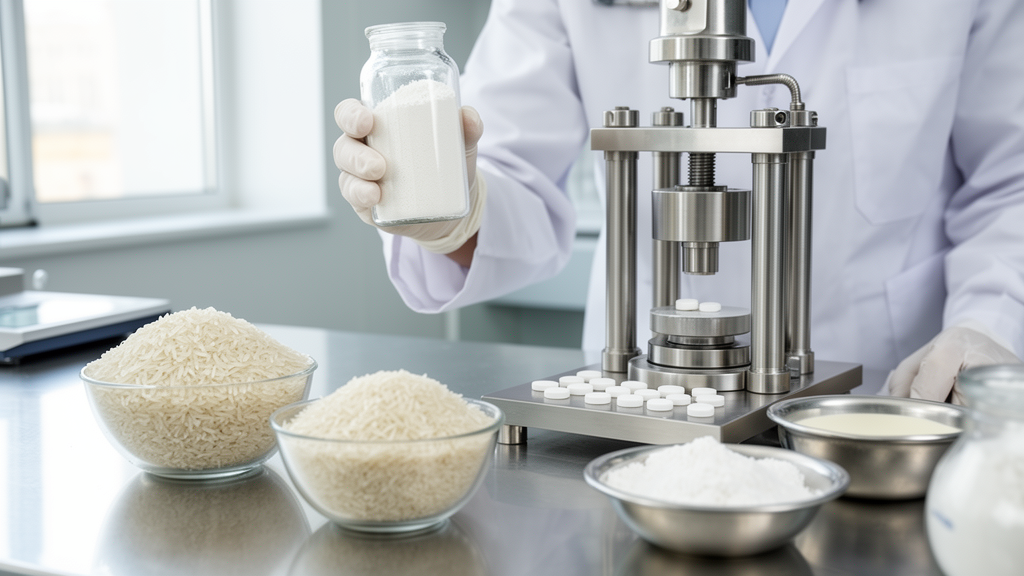
A humble, fragrant rice variety from Assam, India, may be on the verge of a second career in the pharmaceutical industry. Joha rice, long prized for its distinctive aroma and superfine kernels, has now been shown to yield a starch that outperforms the industry-standard corn starch in several critical measures of tablet manufacturing, from compressibility and mechanical strength to resistance against lubricants. The findings, published in the open-access journal Results in Chemistry, position this traditional scented rice as a promising multifunctional excipient for pharmaceutical and nutraceutical tablets, while also revealing a surprisingly low glycemic response that could give it an edge in formulations aimed at health-conscious consumers.
Starch has long been a workhorse of the pharmaceutical industry, serving as a diluent, binder, disintegrant, and thickener in countless tablet and capsule formulations. But the properties of starch vary dramatically depending on the plant it comes from, and researchers are increasingly looking beyond conventional sources like maize, potato, cassava, and wheat to underutilized crops that might offer superior or complementary functional profiles. Joha rice, a traditional aromatic variety grown in the northeastern Indian state of Assam, caught the attention of Srushti Lekurwale and Subham Banerjee of the National Institute of Pharmaceutical Education and Research in Guwahati because of its cultural significance, local availability, and growing body of evidence suggesting nutritional and medicinal benefits, including anti-inflammatory, antioxidant, and antidiabetic properties.
The team isolated starch from Joha rice grains using an alkaline steeping method and systematically compared it against commercially available maize starch, the reference excipient used in pharmaceutical manufacturing worldwide. Their evaluation covered a comprehensive battery of tests: fundamental and derived micromeritic properties, powder compression and compaction behavior, tabletability, compactibility, lubricant sensitivity, hydration capacity, and swelling- and wicking-based disintegration indices derived from dynamic rheological analysis. They also conducted an in vivo acute glycemic response study in Wistar rats to determine whether the isolated starch retained the lower glycemic profile previously reported for whole Joha rice grains.
The results were striking. Joha rice starch exhibited a mean particle size of just 6.18 micrometers, significantly smaller than the 16.4 micrometers measured for maize starch, giving it a specific surface area more than twice as large. This finer granule morphology translated directly into superior compaction behavior. In Heckel analysis, a standard pharmaceutical technique for characterizing how powders deform under pressure, Joha rice starch showed a yield pressure of 90.90 megapascals compared to 107.52 megapascals for maize starch, indicating that it achieved plastic deformation at a lower compression pressure and therefore possessed superior compressibility.
The differences became even more pronounced at higher compression pressures. When compressed at approximately 369 megapascals, Joha rice starch compacts achieved a tensile strength of 2.70 newtons per square millimeter, while maize starch compacts reached only 1.56 newtons per square millimeter under identical conditions. This dramatic difference in tabletability, the ability of a powder to convert into mechanically strong compacts, was attributed to the finer particle size and greater plastic deformation tendency of Joha rice starch, which provides increased surface contact for interparticulate bonding as the compression pressure rises.
Perhaps equally important for real-world manufacturing is the finding that Joha rice starch showed significantly lower sensitivity to magnesium stearate, a widely used lubricant that improves powder flow but can weaken tablet strength by coating particle surfaces and interfering with bonding. The lubricant sensitivity of Joha rice starch was measured at just 0.04, compared to 0.23 for maize starch. This means that Joha rice starch can be effectively blended with lubricants to improve flow properties with minimal compromise in the mechanical strength of the resulting tablets, a considerable practical advantage given that both starches exhibited poor flow characteristics on their own due to their extremely small particle sizes.
The researchers also evaluated the disintegration potential of both starches using a novel approach based on dynamic rheological characterization. By measuring how the viscoelastic properties of starch-water mixtures change across different liquid-to-solid ratios, they calculated swelling and wicking disintegration indices that predict how effectively each starch would promote tablet breakup upon contact with water. Joha rice starch showed a swelling index of 396.57 and a wicking index of 193.86, while maize starch showed values of 466.17 and 138.08 respectively, with no statistically significant difference between the two. This suggests that Joha rice starch would disintegrate tablets at a rate comparable to the industry standard, driven by a combination of water absorption, particle swelling, and capillary action.
Beyond its mechanical performance, Joha rice starch also demonstrated a notably lower glycemic response in the animal model. When gelatinized starch samples were fed to fasted Wistar rats, the predicted glycemic index of Joha rice starch was 42.92, significantly lower than the 73.82 measured for maize starch. The peak blood glucose concentration reached only 99.00 milligrams per deciliter for Joha rice starch compared to 114.33 milligrams per deciliter for maize starch, and the incremental area under the blood glucose curve over 120 minutes was substantially smaller. The researchers attributed this lower glycemic response to the higher amylose content, finer granule morphology, and presence of resistant starch fractions in Joha rice starch, which collectively reduce enzymatic digestibility and slow glucose absorption.
The combination of superior compaction properties, lower lubricant sensitivity, comparable disintegration behavior, and a favorable glycemic profile positions Joha rice starch as a compelling candidate for pharmaceutical and nutraceutical tablet manufacturing. The researchers note that all compaction experiments were conducted using a laboratory hydraulic press rather than an industrial high-speed tablet compression machine, and that further validation using industrial equipment and human glycemic response trials would be needed to confirm the findings at scale. Nevertheless, the preliminary evidence suggests that this traditional Assamese rice variety, already valued for its aroma and nutritional properties, could find a new role as a sustainable, locally sourced excipient in an industry increasingly seeking alternatives to synthetic polymers.
The study also highlights a broader trend in pharmaceutical science: the systematic exploration of underutilized and unconventional starch sources to meet growing industrial demand. As researchers continue to characterize starches from regional crops around the world, varieties like Joha rice demonstrate that traditional agricultural biodiversity can offer tangible technical benefits for modern manufacturing, from improved tablet strength to reduced glycemic impact, while supporting local economies and sustainable supply chains.
Subject of Research: Exploring the excipient potential of Joha rice starch: From preformulation properties to tableting performance
Article Title: Exploring the excipient potential of Joha rice starch: From preformulation properties to tableting performance
Article References: Exploring the excipient potential of Joha rice starch: From preformulation properties to tableting performance. (n.d.). https://doi.org/10.1016/j.rechem.2026.103955
Image Credits: AI Generated
DOI: 10.1016/j.rechem.2026.103955
Keywords: Exploring, excipient, potential, Joha, rice, starch, preformulation, properties, tableting, performance, scientific research
Cite Scienmag News
Alan Morgan. (October 15, 2026). Joha rice starch emerges as a powerful tablet excipient rivaling corn starch. Scienmag. https://scienmag.com/joha-rice-starch-emerges-as-a-powerful-tablet-excipient-rivaling-corn-starch/
Alan Morgan. "Joha rice starch emerges as a powerful tablet excipient rivaling corn starch." Scienmag, 15 October 2026, https://scienmag.com/joha-rice-starch-emerges-as-a-powerful-tablet-excipient-rivaling-corn-starch/. Accessed 15 October 2026.
Alan Morgan. "Joha rice starch emerges as a powerful tablet excipient rivaling corn starch." Scienmag. October 15, 2026. https://scienmag.com/joha-rice-starch-emerges-as-a-powerful-tablet-excipient-rivaling-corn-starch/


