


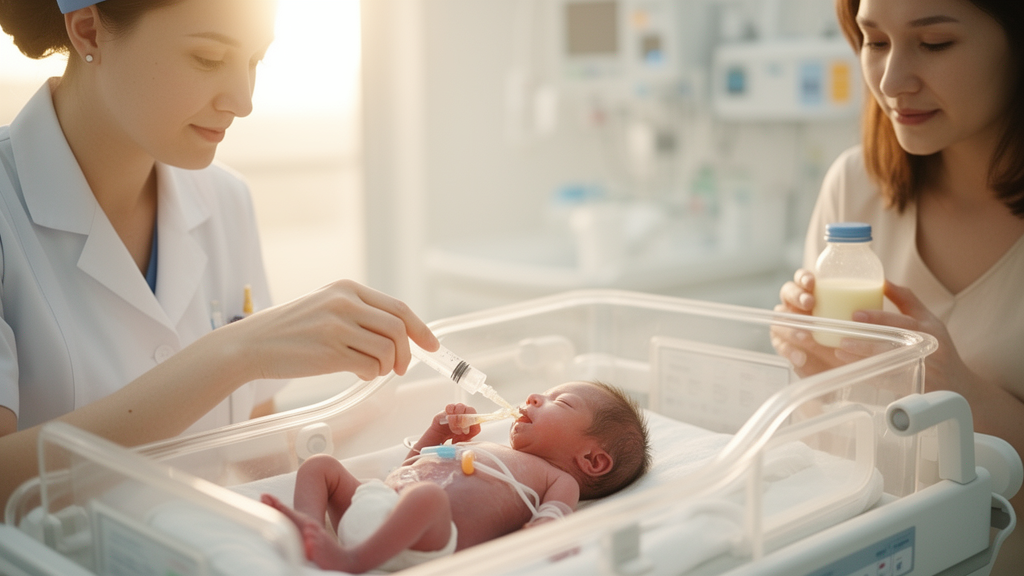
Necrotizing enterocolitis, a devastating intestinal disease that strikes the most fragile newborns, has long been studied in wealthy countries, but data from Latin America have been scarce. Now a prospective multicenter cohort from two Chilean neonatal intensive care units offers one of the region’s clearest pictures yet, and its findings echo a message that neonatologists have been repeating for decades: nothing protects a preterm gut like mother’s own milk.
The study, published in Frontiers in Pediatrics, followed 177 newborns born at 32 weeks of gestation or earlier or weighing 1,500 grams or less, admitted between January 2017 and December 2018 to Hospital Clínico San Borja Arriarán and Hospital Sótero del Río in Santiago. The infants were typical of high-risk neonatal populations, with a mean gestational age of 29.1 weeks and a mean birth weight of 1,252 grams. Over the study period, 14 babies developed necrotizing enterocolitis verified by modified Bell staging criteria and confirmed through independent review by a second neonatologist or a pediatric infectious disease specialist, yielding an incidence of 7.9 percent.
That figure sits squarely within the 6 to 7 percent global range reported in systematic reviews, a point the researchers emphasize. Chile is now classified as a high-income country by CEPAL and the World Health Organization, and the Chilean incidence rates and risk factor profile proved compatible with those documented in high-income settings rather than reflecting a divergent regional epidemiology. For a region where published NEC cohorts remain rare, the study fills a recognized gap in the epidemiological literature.
The statistical machinery behind the analysis was as notable as the findings. Because NEC struck only 14 infants, conventional logistic regression ran into separation and quasi-separation problems, mathematical breakdowns that occur when events are too sparse for stable estimation. The team turned to Firth’s penalized logistic regression, a technique that shrinks estimates to mitigate small-sample bias. Even so, the events-per-variable ratio hovered around 1.8, far below the conventional threshold of ten, so the authors consistently frame their adjusted results as exploratory and hypothesis-generating rather than definitive.
In unadjusted bivariate analysis, two exposures stood out. Invasive mechanical ventilation was associated with a more than fourfold increase in NEC risk, with a relative risk of 4.58, and exposure to indomethacin, a drug used to close a heart vessel called the ductus arteriosus in preterm infants, roughly tripled the risk, with a relative risk of 3.13. Red blood cell transfusion showed a non-significant trend toward increased risk at 2.98, while antenatal corticosteroids hinted at a protective effect that did not reach significance.
But when the researchers folded these variables into multivariable penalized models, the associations with ventilation and indomethacin dissolved. The authors attribute this to confounding by indication: babies who need breathing tubes and indomethacin are, by definition, the sickest ones, and their underlying illness severity, not the interventions themselves, may drive the apparent link. Recent meta-analyses have similarly dismissed indomethacin as a genuine NEC promoter. Reverse causation looms over other exposures too, since ventilation, antibiotics, and transfusions are all responses to clinical deterioration that the earliest, non-specific phase of NEC may itself provoke. The team excluded ventilation initiated as a consequence of NEC severity, but no equivalent safeguard existed for antibiotics, transfusions, or feeding type.
Feeding, the classic NEC battleground, produced the study’s most nuanced result. In the nutrition-focused model, formula feeding carried an adjusted odds ratio of 2.69 compared with exclusive breast milk, making it the most consistent predictor across model specifications, yet the confidence interval stretched from 0.10 to 74.46 and the result was not statistically significant. Mixed feeding showed a weaker, similarly non-significant elevation. The authors are candid: the data neither confirm nor contradict the large body of evidence that human milk, with its antimicrobial and immunomodulatory properties including human milk oligosaccharides, protects the immature gut by fostering healthy microbial colonization and mucosal barrier integrity. Exclusive breastfeeding nonetheless remained the most protective feeding strategy observed, consistent with prior literature.
What happened once NEC developed proved more consequential than what preceded it. Half of the 14 cases had already progressed to Bell stage IIIB, the most severe classification, by the time of diagnosis. Surgery was required in 38.5 percent of cases with available data, and every operated infant was in stage IIIB, an association that was statistically significant. Among the ten NEC cases with observed mortality outcomes, four died, a case fatality rate of 40 percent, and all deaths occurred in stage IIIB infants while none occurred in stage IIA. Shock was likewise tied to death. Within these tiny numbers, disease stage and surgical need became nearly indistinguishable, concentrating the entire burden of severe outcomes in advanced disease.
Laboratory signals hinted at who was heading toward that cliff. Non-survivors showed higher C-reactive protein levels and more pronounced acid-base disturbances than survivors, with median pH dipping to 7.24 and base excess falling to minus 7.35 among the NEC cases overall. These findings align with recent evidence that inflammatory and hematologic markers can forecast progression to surgical NEC, with C-reactive protein rising 24 to 48 hours after diagnosis and platelet counts reaching their nadir within 72 hours, the steepest decline in the first 24 hours. The Chilean team proposes that early monitoring of such biomarkers could flag infants at risk of progression before the intestine reaches the point of no return.
The study’s honesty about its limits is part of its value. Mortality data were missing for 68 of 177 infants, and that missingness tracked with mechanical ventilation and transfusion rather than occurring at random, so the mortality estimates describe only the observed subsample. Feeding protocols were not standardized across units, detailed feeding timing was never captured, and transfusion exposure was recorded only as any versus none, preventing evaluation of transfusion-associated NEC within the clinically relevant 48-to-72-hour window that meta-analyses have highlighted. None of the centers used probiotics. The authors call for future prospective studies with standardized feeding documentation and time-stamped exposure records, and larger cohorts to confirm whether the signals glimpsed here, from formula’s modest odds ratio to the predictive power of inflammatory markers, hold up across the wider Latin American landscape.
Subject of Research: Risk factors and clinical outcomes of necrotizing enterocolitis in preterm infants in Chilean neonatal intensive care units
Article Title: Multicenter cohort of necrotizing enterocolitis in Latin America: evaluation of risk factors and clinical outcomes in Chilean Hospitals
Article References: Sandoval C., A., Delpiano M., L., Pantoja H., M. Á., Aravena U., M., Smith R., J., Pérez A., H., & Espinoza E., S. (2026). Multicenter cohort of necrotizing enterocolitis in Latin America: evaluation of risk factors and clinical outcomes in Chilean Hospitals. Frontiers in Pediatrics, 14, Article 1877057. https://doi.org/10.3389/fped.2026.1877057
Image Credits: AI Generated
DOI: 10.3389/fped.2026.1877057
Keywords: necrotizing enterocolitis, preterm infants, neonatal intensive care, breastfeeding, formula feeding, Bell staging, Chile, Firth penalized regression, C-reactive protein, red blood cell transfusion, neonatal mortality, Latin America
Cite Scienmag News
Harold Sullivan. (October 15, 2026). Chilean NICU study finds breastfeeding may shield preterm babies from deadly gut disease. Scienmag. https://scienmag.com/chilean-nicu-study-finds-breastfeeding-may-shield-preterm-babies-from-deadly-gut-disease/
Harold Sullivan. "Chilean NICU study finds breastfeeding may shield preterm babies from deadly gut disease." Scienmag, 15 October 2026, https://scienmag.com/chilean-nicu-study-finds-breastfeeding-may-shield-preterm-babies-from-deadly-gut-disease/. Accessed 15 October 2026.
Harold Sullivan. "Chilean NICU study finds breastfeeding may shield preterm babies from deadly gut disease." Scienmag. October 15, 2026. https://scienmag.com/chilean-nicu-study-finds-breastfeeding-may-shield-preterm-babies-from-deadly-gut-disease/


