


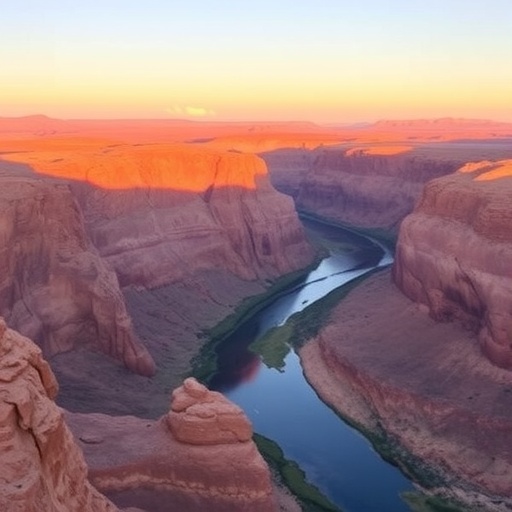
In a groundbreaking study published in Nature Communications, geologists and geneticists have unveiled a comprehensive, tectonically driven narrative of the integration of the Colorado River, dating back approximately 4.8 million years. This research harnesses the powerful synergy between detrital sanidine geochronology and advanced fish genetics to unravel the river’s ancient history and the dynamic processes that shaped one of North America’s most iconic waterways.
The Colorado River, renowned for carving the famed Grand Canyon, has long been a subject of fascination and scientific inquiry. Its development is inherently tied to significant tectonic events that have governed western North America’s landscape since the Miocene. However, the precise mechanisms by which distinct drainage basins merged to form the continuous river we recognize today have eluded scientists—until now.
The research team, led by Karlstrom, Heizler, and Aslan, employed detrital sanidine dating, a sophisticated radiometric technique focusing on potassium-rich feldspar grains found in sedimentary deposits. These durable mineral grains serve as geological timestamps, offering invaluable records of sediment sources and transport histories. By systematically dating these grains across various river segments and tributaries, the team assembled a temporal map of sediment provenance and drainage evolution.
What sets this study apart is the revolutionary integration of fish genetics into the tectonic and sedimentary framework. Freshwater fish populations are intimately influenced by river connectivity and geographical barriers; their genetic divergence mirrors the geological changes that isolate or unite habitats. By analyzing genetic lineages across native fish species inhabiting the Colorado River system, researchers established biological timelines that corroborate the physical evidence from sedimentary minerals.
The outcomes reveal that the river’s present-day network is the result of a progressive, tectonically orchestrated integration. Initially isolated basins underwent structural reconfigurations driven by fault activity and crustal deformation, facilitating episodic connections. These episodic integrations are recorded in distinct pulses of sanidine-dated sediment deposition and biologically in genetic bottlenecks and expansions in fish populations.
More intriguingly, the study identifies precise temporal markers when these drainage connections were established. Around 4.8 million years ago, a critical tectonic event reopened pathways between formerly disjointed drainages. This period coincides with significant uplift along the Colorado Plateau and adjacent basins, highlighting how regional tectonism directly influenced fluvial architecture.
The researchers meticulously teased apart the complex relationship between tectonics, sediment routing, and biotic evolution in a way few have attempted before. Their multidisciplinary approach underscores the importance of cross-field collaboration in earth sciences, demonstrating that integrating physical geology with evolutionary biology can yield transformative insights into ancient environmental changes.
This work advances our understanding of how rivers respond to tectonic forces over geological timescales. It challenges previous models that assumed relatively static drainage patterns by providing concrete evidence that river systems are dynamic, evolving networks shaped profoundly by crustal movements.
In practical terms, the study also enhances predictions of sediment fluxes linked to tectonic events—knowledge crucial for both geohazard assessment and interpreting paleoenvironmental records. The findings have implications for understanding landscape evolution, sediment deposition patterns, and biodiversity responses to shifting river networks.
Furthermore, the genetic data from native fish species reveal previously unrecognized dispersal corridors and barriers. These insights redefine biogeographical models of freshwater ecosystems, emphasizing the role of geological processes in shaping biodiversity distribution. Such knowledge is particularly relevant in the context of ongoing habitat alterations driven by climate change and human activity.
Technically, the geochronological methods employed here capitalized on advancements in laser ablation inductively coupled plasma mass spectrometry (LA-ICP-MS), enabling precise dating of individual sanidine grains previously unachievable. This precision provides unprecedented resolution in sedimentary provenance studies, allowing researchers to connect dispersed deposits to specific tectonic events.
The genetic component applied cutting-edge molecular markers and phylogeographic techniques to unravel evolutionary relationships and migration histories across varied river segments. By combining these datasets, the authors constructed a multidimensional framework linking physical and biological evolution scenarios.
Beyond regional geology and biology, this research offers a template for investigating other ancient river systems worldwide, where tectonics influence hydrology and ecosystems. The methodology establishes a new paradigm for disentangling complex Earth-surface processes and their impacts on life through deep time.
Importantly, the study delivers compelling evidence that tectonic reshaping of landscapes is not just a static geological backdrop but an active driver of ecological dynamics and evolutionary trajectories. This revelation has far-reaching consequences for conservation biology, paleogeography, and geotectonic research.
As scientists continue to refine these integrated approaches, our comprehension of Earth’s past climates, tectonic regimes, and biological responses will deepen, illuminating pathways to anticipate future environmental changes. The Colorado River basin serves as an exemplary natural laboratory for such endeavors, with its storied geological and ecological history now more accessible than ever.
In conclusion, the fusion of detrital sanidine dating and fish genetic analysis represents a pioneering leap forward in tectonic geomorphology and evolutionary biology. This comprehensive narrative of the Colorado River’s integration 4.8 million years ago not only enriches scientific understanding but also captures the imagination, illustrating the intricate dance between Earth’s restless crust and the vibrant life it sustains.
Cite Scienmag News
Violet Maxwell. (July 1, 2026). Tectonic Forces Shape Colorado River History Revealed. Scienmag. https://scienmag.com/tectonic-forces-shape-colorado-river-history-revealed/
Violet Maxwell. "Tectonic Forces Shape Colorado River History Revealed." Scienmag, 1 July 2026, https://scienmag.com/tectonic-forces-shape-colorado-river-history-revealed/. Accessed 3 September 2026.
Violet Maxwell. "Tectonic Forces Shape Colorado River History Revealed." Scienmag. July 1, 2026. https://scienmag.com/tectonic-forces-shape-colorado-river-history-revealed/


