


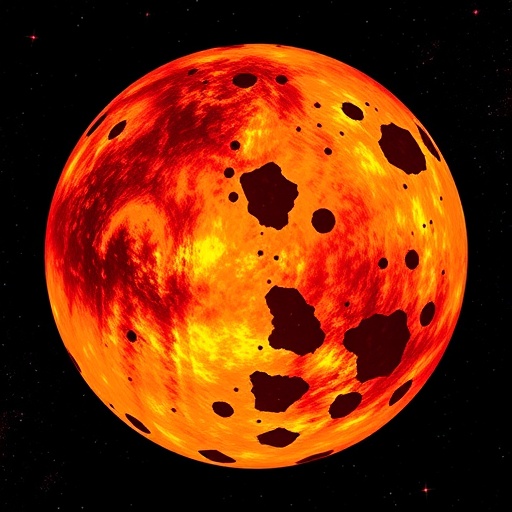
A new study is challenging one of the most familiar assumptions about Earth’s earliest history: that the planet’s ancient rocks should preserve abundant evidence of the colossal impacts that battered the young world. In research published in Nature Communications, I. Szumila, D. Trail, M. Nakajima and colleagues report that the early Earth’s detrital zircon record appears to lack a clear signal from continental impact melt sheets—vast blankets of molten rock created when enormous asteroids or planetary bodies struck the surface.
The finding matters because impact events were not rare curiosities during Earth’s infancy. More than four billion years ago, the Solar System was still clearing its debris, and the growing planets were repeatedly hit by objects ranging from mountain-sized asteroids to bodies capable of reshaping entire regions. The most powerful collisions could melt the crust over continental-scale areas, producing impact melt sheets that later cooled, crystallized and potentially became part of the geological record. If these deposits survived erosion and recycling, scientists might expect them to leave chemical or mineralogical fingerprints in ancient sediments.
The researchers focused on detrital zircons, tiny crystals that have become some of geology’s most important time capsules. Zircon can form in molten rock and incorporate uranium into its crystal structure while strongly excluding lead. Because uranium isotopes decay into lead at predictable rates, the uranium-lead, or U-Pb, dating system allows scientists to determine when a zircon crystallized with extraordinary precision. Zircons can survive weathering, transport and burial, eventually accumulating in sedimentary rocks as “detrital” grains detached from their original source.
That durability makes zircon a powerful archive of vanished landscapes. A single grain can retain information about the age and chemical environment of the magma from which it formed, even after the host rock has been eroded away. Ancient sedimentary basins can therefore act as natural sampling systems, collecting mineral fragments from large areas of continental crust. By studying thousands of grains from early Earth sediments, researchers can reconstruct when crust formed, when it was reworked and which geological processes were active.
The new study asks a deceptively simple question: if giant impacts melted large portions of the early continents, where are the zircons that crystallized from those melts? The absence of a distinctive impact-related population in the detrital zircon record suggests that continental impact melt sheets may have been less effective at producing, preserving or distributing zircon than conventional models assume. The result does not mean that major impacts failed to occur. Instead, it points to a complicated gap between an event happening and its geological signature surviving long enough to be discovered.
Impact melt sheets are extreme geological environments. Rock heated beyond its melting point can spread across a broad surface before cooling, but the resulting material may not necessarily crystallize into abundant zircon. Zircon formation depends on the chemical composition of the melt, particularly the availability of zirconium and the degree to which the melt becomes enriched in elements required for zircon growth. Cooling rate, water content, pressure and later alteration can also influence whether zircon crystals form, remain intact or become concentrated in sediments.
Preservation may be an even greater obstacle. The Hadean and early Archean Earth was tectonically active, volcanically dynamic and subject to intense erosion. Newly formed impact deposits could have been stripped away, buried, metamorphosed or recycled into the mantle before they were able to contribute significant numbers of detrital zircons to surviving sedimentary basins. Continents were also smaller and less stable than they are today, meaning that a melt sheet created on ancient crust may have had little chance of persisting as a recognizable geological body.
The study’s central message therefore reaches beyond impact geology. A missing signal is not automatically evidence that the underlying event did not happen. Geological records are filtered records: they favor materials that form easily, resist destruction and reach environments where scientists can eventually sample them. Detrital zircon data are exceptionally valuable, but they are not a complete census of every rock-forming process. The apparent absence of impact melt zircons may reveal the biases of preservation as much as it reveals the frequency or scale of ancient impacts.
The finding could also reshape how researchers interpret the history of Earth’s earliest crust. If impact melt sheets routinely failed to generate a strong zircon signature, then models that estimate ancient impact rates from zircon populations may need to be reassessed. Scientists may have to rely more heavily on complementary evidence, including shocked minerals, impact breccias, geochemical anomalies, isotope variations and possible impact structures preserved in ancient terrains. Combining these independent clues could provide a more realistic picture of how bombardment altered the young planet.
For the public, the result carries a striking lesson: Earth’s deepest history is not simply waiting in the rocks like a perfectly preserved film. It is more like a damaged and selectively edited archive, in which some of the planet’s most dramatic episodes may be represented only indirectly—or not at all. The missing continental impact melt sheet signal in ancient detrital zircons does not make early impacts less important. It makes them harder to see, and it highlights why understanding Earth’s origins requires both powerful mineral clocks and a careful appreciation of what the geological record can erase.
Cite Scienmag News
Violet Maxwell. (August 11, 2026). Early Earth’s detrital zircons lack evidence of a continental impact melt sheet. Scienmag. https://scienmag.com/early-earths-detrital-zircons-lack-evidence-of-a-continental-impact-melt-sheet/
Violet Maxwell. "Early Earth’s detrital zircons lack evidence of a continental impact melt sheet." Scienmag, 11 August 2026, https://scienmag.com/early-earths-detrital-zircons-lack-evidence-of-a-continental-impact-melt-sheet/. Accessed 3 September 2026.
Violet Maxwell. "Early Earth’s detrital zircons lack evidence of a continental impact melt sheet." Scienmag. August 11, 2026. https://scienmag.com/early-earths-detrital-zircons-lack-evidence-of-a-continental-impact-melt-sheet/


