


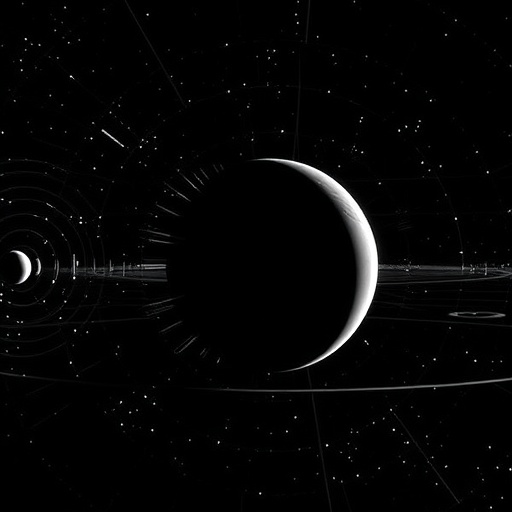
In a groundbreaking breakthrough for exoplanet discovery, NASA’s Transiting Exoplanet Survey Satellite (TESS) has, for the first time, successfully identified a planet through gravitational microlensing—marking a new frontier in planetary detection beyond the traditional transit method. This milestone unveils Gaia23bra b, a distant super-Jupiter orbiting an orange dwarf star, detected thanks to the subtle warping of space-time that reveals planets otherwise hidden from view. Unlike the myriad of planets TESS has discovered through observing tiny dips in starlight caused by transiting planets, this method leverages Einstein’s theory of general relativity to capture fleeting gravitational effects when a foreground star and its planet align perfectly with a background star.
The event, dubbed Gaia23bra b, was initially identified by the European Space Agency’s now-retired Gaia space telescope, which monitors the sky for such rare gravitational microlensing events. During this phenomenon, when the foreground star (lens) passes directly in front of a more distant background star (source), its gravity acts like a magnifying lens, bending and intensifying the light from the background star. This brief alignment significantly brightens the background star’s light, with the exact light curve shape hinting at the presence of orbiting planets around the lens star. Notably, Gaia’s observational cadence was too sparse to fully characterize the planetary signals, but archived TESS data fortuitously captured this precise region with higher temporal resolution, revealing subtle features that betray the presence of a planetary companion.
The detected exoplanet, Gaia23bra b, stands out as an immense gas giant roughly 1.63 times the mass of Jupiter. It orbits its orange dwarf star, which itself possesses about 80 percent of the Sun’s mass, at a distance comparable to Jupiter’s orbit around the Sun. Such wide-separation, massive planets orbiting faint stars are notoriously difficult to detect using the transit method, which relies on planets passing directly in front of their stars from our perspective, causing measurable dimming. The microlensing method, on the other hand, excels at revealing these more distantly orbiting worlds, vastly expanding our understanding of planetary system architectures beyond the compact orbits often spotted by transit surveys.
Dr. Diana Dragomir of the University of New Mexico highlights that this unexpected achievement not only showcases TESS’s broader capabilities but also strongly suggests the existence of more microlensing planet candidates hidden within TESS’s extensive data archive. As TESS continuously surveys the sky, especially the dense star fields along the Galactic Plane, it is increasingly capable of capturing transient microlensing events that are often too subtle or rapid for other space-based telescopes. These discoveries hint at a rich, untapped reservoir of distant exoplanets awaiting identification using data mining and refined analysis techniques.
Gravitational microlensing operates on the fascinating principle that mass curves space-time, as predicted by Einstein’s theory of general relativity. When two stars from our line of sight momentarily align, the gravitational field of the nearer star focuses and magnifies the light from the more distant star. If the foreground star hosts planets, these too distort the gravitational lensing pattern, causing characteristic wiggles or spikes in the brightness curve. Unlike transits that reveal planetary sizes through dips in brightness, microlensing provides decisive measurements of planetary masses and orbital separations, offering complementary data crucial to understanding planetary formation and evolution.
The rarity and transient nature of microlensing events present unique challenges. Unlike periodic transits that repeat regularly and can be studied in depth, microlensing events are singular and do not recur, requiring vigilant monitoring and rapid-response observations. According to Mallory Harris, a Ph.D. candidate at UNM, this fleeting quality means that once a microlensing event passes, astronomers effectively “wave goodbye” to that particular system—highlighting the urgent need for continuous and high-cadence observations to maximize scientific yield from these cosmic alignments.
This discovery is pivotal not only for expanding the catalog of known exoplanets but also for bridging a significant gap in current detection methods’ sensitivity. While transit and radial velocity methods excel at finding close-in, often “hot” planets, microlensing provides a window into planets residing at Earth-like and wider orbital distances. This enables scientists to probe planetary systems that more closely resemble our own solar system, including planets potentially residing in the elusive habitable zones where liquid water might exist.
TESS’s unique contribution lies in its ability to observe wide swaths of the sky with rapid, nearly continuous monitoring. During the Gaia23bra b event, TESS was fortunate to be targeting the same star field, recording data every 200 seconds for nearly two months. These dense observations unveiled subtle perturbations in the star’s brightness that smaller, less frequent measurements would have missed. This synergy between Gaia’s long-term sky coverage and TESS’s rapid cadence illustrates the power of combined datasets for exploring complex astrophysical phenomena.
The discovery also serves as a cornerstone validation for upcoming missions like the Nancy Grace Roman Space Telescope, set to launch in the fall of 2026. Roman will conduct an extensive microlensing survey of the Galactic Center, anticipating the detection of approximately 1,000 microlensing planets and around 100,000 transiting planets. Gaia23bra b exemplifies the kind of detailed planetary characterization Roman aims to achieve, showcasing how high-cadence, space-based observations can push the boundaries of planet hunting beyond what ground-based telescopes can manage.
Despite the dense stellar fields near the Galactic Bulge being a prime hunting ground for microlensing events due to the sheer number of stars aligned, TESS’s relatively large pixels can lead to blending of stellar signals, posing a challenge for precise detections in those crowded regions. However, by surveying other sectors of the Galactic Plane, TESS complements Roman’s focus on the center of the galaxy, potentially revealing planets in diverse environments with varying stellar and chemical properties. This broader coverage is critical for understanding the galactic distribution of planetary systems and their formation histories.
The importance of gravitational microlensing in the search for potentially habitable worlds cannot be overstated. Among all exoplanet detection techniques, it uniquely affords routine sensitivity to Earth-mass planets orbiting at Earth-like distances from their stars, where conditions could be right for life. As microlensing discoveries accumulate, astronomers will be better equipped to assess the frequency and diversity of such planets throughout the Milky Way, thereby enriching our comprehension of where life-friendly worlds may abound.
In conclusion, the microlensing discovery of Gaia23bra b signals an exciting expansion in TESS’s scientific repertoire. This achievement not only showcases an innovative method of exoplanet detection but also underscores the importance of collaborative, multi-mission observations for unraveling the complexities of distant planetary systems. As we anticipate Roman’s launch and future data analyses from missions like Gaia and TESS, the coming decade promises to dramatically deepen our understanding of planets strewn across our galaxy, from scorching close-in worlds to cold, far-flung giants like Gaia23bra b.
News Publication Date: 1-Jul-2026
Web References:
https://science.nasa.gov/missions/tess/nasas-tess-mission-finds-planetary-system-in-new-way/
http://dx.doi.org/10.3847/2041-8213/ae7a50
Keywords
Exoplanets, Gravitational Microlensing, TESS, Gaia, Super-Jupiter, Orange Dwarf Star, Space-based Observations, Planet Detection Methods, Microlensing Event, Nancy Grace Roman Space Telescope, Galactic Plane, Astrophysical Journal Letters
Cite Scienmag News
Grant Pearson. (July 1, 2026). NASA’s TESS Mission Discovers Planetary System Using Innovative Technique. Scienmag. https://scienmag.com/nasas-tess-mission-discovers-planetary-system-using-innovative-technique/
Grant Pearson. "NASA’s TESS Mission Discovers Planetary System Using Innovative Technique." Scienmag, 1 July 2026, https://scienmag.com/nasas-tess-mission-discovers-planetary-system-using-innovative-technique/. Accessed 3 September 2026.
Grant Pearson. "NASA’s TESS Mission Discovers Planetary System Using Innovative Technique." Scienmag. July 1, 2026. https://scienmag.com/nasas-tess-mission-discovers-planetary-system-using-innovative-technique/


