


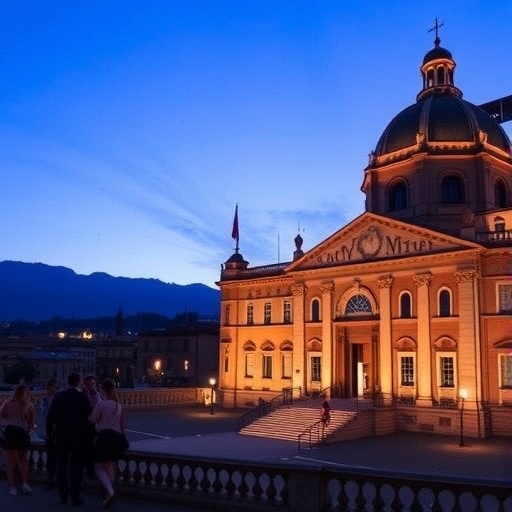
The 46th COSPAR Scientific Assembly has concluded in Florence, Italy, after bringing together more than 3,000 researchers, engineers, space-agency leaders and industry representatives from around the world. Hosted by the Italian National Institute for Astrophysics (INAF), the week-long meeting highlighted the accelerating pace of discovery across space science, while also confronting challenges that could shape humanity’s ability to explore and use space responsibly. Approximately one-third of participants were students or early-career researchers, underscoring the growing role of the next generation in fields ranging from planetary science and astrophysics to Earth observation, space weather and life-support technology.
The Assembly began with a Space Agency Leaders Roundtable moderated by International Astronautical Federation President Gabriella Arrigo and COSPAR President Pascale Ehrenfreund. Senior representatives from the UAE Space Agency, ISRO, the Italian Space Agency, NASA, JAXA, the Canadian Space Agency, ESA, the Korea AeroSpace Administration and China’s National Space Science Center discussed international cooperation and future exploration priorities. Their discussions reflected a space sector undergoing rapid transformation, as national agencies increasingly coordinate missions, share scientific data and work with commercial companies on launch systems, satellites, instruments and human-exploration technologies.
The opening ceremony brought together scientific and political leaders, including INAF President Roberto Ragazzoni, Scientific Programme Committee Chair Marco Tavani and representatives of the University of Florence and Destination Florence. Italy’s Minister of University and Research, Anna Maria Bernini, also addressed participants. The event featured remarks from NASA, ESA and the Italian Space Agency, while Carole Mundell of ESA paid tribute to Roger Bonnet, the agency’s former Director of Science. The 2026 COSPAR Awards were presented during the ceremony, recognising contributions that have advanced international space research and strengthened cooperation across borders.
Scientific sessions covered nearly every major area of modern space research. Researchers examined new results from the Gaia mission, which is building an exceptionally precise three-dimensional map of the Milky Way by measuring the positions, motions and brightnesses of stars. Other discussions focused on the James Webb Space Telescope, whose infrared observations allow astronomers to study the earliest galaxies, star-forming regions and the atmospheres of planets orbiting other stars. The programme also addressed radar remote sensing, a technique that uses radio waves to observe Earth’s surface through clouds and darkness, making it valuable for monitoring ice, forests, oceans, soil moisture and natural disasters.
One of the Assembly’s major interdisciplinary themes was the future of human exploration. Speakers examined sustainable life-support systems designed to recycle air and water, reduce dependence on supplies launched from Earth and support longer missions. Such technologies are essential for lunar bases and eventual journeys to Mars, where resupply is slow, expensive and technically difficult. Researchers also discussed the search for water on the Moon. Frozen water in permanently shadowed polar craters could provide drinking water, oxygen and hydrogen-oxygen propellant, but extracting it will require detailed mapping, specialised drilling systems and careful control of contamination.
Former NASA astronaut Mae Jemison moderated a plenary panel on humanity’s cross-disciplinary exploration of space. The discussion examined how future missions will depend on collaboration between fields that have traditionally operated separately, including biology, robotics, medicine, planetary geology, artificial intelligence, materials science and social sciences. Human exploration is not only an engineering problem: spacecraft must protect crews from radiation, isolation and altered gravity, while mission planners must consider planetary protection and the long-term effects of activities on other worlds. The panel emphasised that successful exploration will require scientific, technological and social systems to develop together.
COSPAR also held its first dedicated event on Dark and Quiet Skies, reflecting growing concern about the expansion of large satellite constellations. Thousands of satellites in low Earth orbit can produce bright trails across astronomical images and increase radio-frequency interference, making faint cosmic signals harder to detect. Optical astronomy depends on collecting extremely weak light from distant objects, while radio astronomy must distinguish natural emissions from human-made transmissions. Participants discussed mitigation strategies, including improved satellite brightness control, coordination with observatories, better orbital planning and dialogue among scientists, governments and industry. The event also considered emerging proposals for orbital mirrors that could reflect sunlight toward Earth at night, a concept that could create additional effects for astronomy, ecosystems and human communities.
The COSPAR Committee on Industry Relations brought together representatives from Lockheed Martin, Northrop Grumman, Thales Alenia Space, L3Harris and United Launch Alliance with academic researchers. Their panel examined how discoveries move from laboratories into operational systems, a transition often described as the “valley of death” because promising technologies can struggle to attract funding, testing opportunities or industrial partners. Discussions included intellectual-property management, orbital-debris risks and space-traffic coordination. As more spacecraft enter orbit, tracking and collision avoidance are becoming increasingly important. A collision can generate thousands of fragments, creating a cloud of debris that threatens other satellites and may remain in orbit for decades.
The Assembly also placed strong emphasis on early-career scientists, mentoring and international mobility. Engineering innovation, disruptive technologies and advocacy for public investment in research were discussed alongside career development and training. Public lectures in Italian extended the programme beyond the scientific community, featuring Roberto Ragazzoni, ESA astronaut reserve member Andrea Patassa and gravitational-wave astrophysicist Marica Branchesi. Their participation helped connect advanced research, including the detection of ripples in spacetime from violent cosmic events, with local audiences. COSPAR thanked the speakers, conveners, reviewers, session chairs and volunteers who supported the Assembly, as well as INAF, AIM Group International, sponsors and partner organisations.
The meeting also set important milestones for COSPAR’s future. Council representatives re-elected Pascale Ehrenfreund as COSPAR President for another four-year term and selected Toulouse, France, as the host city for the 48th COSPAR Scientific Assembly in 2030, scheduled for 20–28 July. Upcoming events will include the 2nd International Forum on Young Space Scientists in Nicosia, Cyprus; the 7th COSPAR Symposium on Life Sciences in Space in Suzhou, China; and the 8th COSPAR Symposium on Planetary Defense and Science after the Apophis Encounter in Yokohama, Japan. Together, these meetings will continue to connect researchers working on the technologies, discoveries and international partnerships that will define the next era of space exploration.
References: COSPAR 2026 Scientific Assembly information and official event announcement
Keywords
COSPAR 2026, space science, space exploration, astronomy, NASA, ESA, Gaia mission, James Webb Space Telescope, lunar water, Dark and Quiet Skies, satellite constellations, orbital debris, space traffic management, early-career researchers, planetary defense
Cite Scienmag News
Grant Pearson. (August 10, 2026). COSPAR’s 46th Scientific Assembly Ends in Florence, Boosting Global Space Research Collaboration. Scienmag. https://scienmag.com/cospars-46th-scientific-assembly-ends-in-florence-boosting-global-space-research-collaboration/
Grant Pearson. "COSPAR’s 46th Scientific Assembly Ends in Florence, Boosting Global Space Research Collaboration." Scienmag, 10 August 2026, https://scienmag.com/cospars-46th-scientific-assembly-ends-in-florence-boosting-global-space-research-collaboration/. Accessed 4 September 2026.
Grant Pearson. "COSPAR’s 46th Scientific Assembly Ends in Florence, Boosting Global Space Research Collaboration." Scienmag. August 10, 2026. https://scienmag.com/cospars-46th-scientific-assembly-ends-in-florence-boosting-global-space-research-collaboration/


