


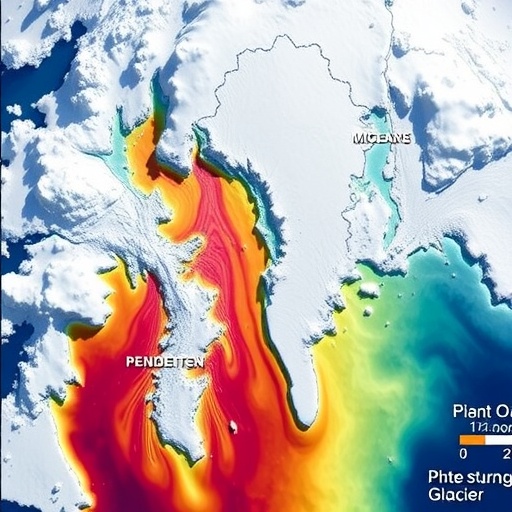
A glacier in West Antarctica may have begun thinning across its entire drainage system at roughly the same time, revealing that the collapse of an ice shelf can influence not only the glacier immediately behind it but also a vast network of tributaries feeding the Antarctic Ice Sheet. The finding, reported in Nature Communications by Johnson, Peters, Nichols and colleagues, reconstructs the Holocene history of Pine Island Glacier, one of the fastest-changing and most closely watched ice systems on Earth.
Pine Island Glacier flows from the interior of West Antarctica toward the Amundsen Sea. Its ice moves through a web of tributary glaciers before reaching a floating ice shelf at the coast. That shelf acts as a brake, or buttress, resisting the seaward motion of inland ice. When the connection between the shelf and the seafloor weakens, the floating platform can lose part of its stabilizing effect, allowing grounded ice upstream to accelerate, stretch and thin.
The new study focuses on a process known as ice-shelf unpinning. Floating ice shelves can become anchored to elevated features on the seabed, sometimes called pinning points. These contact zones generate friction and exert back-stress against the glacier system. If an ice shelf retreats away from one of these anchor points, the loss of resistance can transmit through the ice, changing flow speeds and surface elevation far inland. The research suggests that such a transition affected Pine Island Glacier and its tributaries during the Holocene, the geological epoch that began about 11,700 years ago and includes the present day.
What makes the result especially striking is the apparent synchrony of the thinning. Rather than showing isolated changes confined to separate tributaries, the geological record indicates that multiple branches of the glacier system responded during a common period. In glaciological terms, this points to a system-wide forcing mechanism. The removal of an ice-shelf pinning point provides a plausible explanation because it can alter the stress field across a connected drainage basin, sending a mechanical signal through the glacier network.
Glacier thinning occurs when ice is lost faster than it is replenished by snowfall and the inward flow of ice from higher elevations. As the surface lowers, the glacier can become more vulnerable to further acceleration, especially if the thinning reaches the grounding zone—the boundary where ice resting on bedrock begins to float. A retreating grounding line can expose thicker ice to ocean water, potentially increasing discharge into the sea. This interaction between ice flow, grounding-line migration and ocean-driven melting is one of the central concerns in projections of future sea-level rise.
The Holocene record is valuable because it provides a natural test of how the Antarctic ice sheet behaves after major environmental transitions. Modern satellite observations cover only a few decades, a short interval compared with the time scales of glacier adjustment. Geological evidence can extend the record backward, allowing researchers to identify whether present-day changes resemble earlier episodes of retreat and thinning. The study’s interpretation therefore links contemporary measurements of Pine Island Glacier with a much longer history of ice-sheet instability.
Pine Island Glacier is particularly important because it drains a large portion of the West Antarctic Ice Sheet, a region considered vulnerable to irreversible retreat under sustained ocean warming. Warm deep water entering the Amundsen Sea can reach the underside of ice shelves and melt them from below. Although the new research examines a past episode rather than directly forecasting the future, its implications are immediate: changes at the floating edge of a glacier can reorganize the behavior of inland ice, and those effects may extend far beyond the visible front.
The study also challenges a simplified view of glacier change in which each tributary responds independently to local snowfall, bedrock shape or melt conditions. Tributaries are physically connected through the main trunk and the floating ice shelf. When a key restraint disappears, the resulting changes in stress and velocity can propagate through the drainage system. This means that scientists assessing Antarctic stability must consider not only local thinning rates but also the structural connections that allow one part of a glacier to influence another.
The findings do not imply that Pine Island Glacier is destined to repeat its Holocene history in exactly the same way. Today’s climate, ocean circulation and atmospheric conditions differ from those of the past, and modern warming is imposing new stresses on the system. However, the evidence offers a warning about thresholds: a change that begins at the ice-ocean boundary can trigger a coordinated response across hundreds of kilometres of ice. As researchers improve ice-sheet models, incorporating the mechanical consequences of ice-shelf unpinning could be essential for estimating how quickly West Antarctica may contribute to future sea-level rise.
By showing that Pine Island Glacier and its tributaries experienced synchronous Holocene thinning, Johnson and colleagues add a new dimension to the story of Antarctic change. The study turns an ancient geological signal into a modern lesson: ice shelves are not passive extensions of glaciers, but crucial stabilizing structures. When one of their anchors lets go, the consequences can travel deep into the continent—quietly at first, then across an entire glacier system.
Cite Scienmag News
Violet Maxwell. (August 11, 2026). Ice-shelf unpinning drove Holocene thinning of Pine Island Glacier and tributaries. Scienmag. https://scienmag.com/ice-shelf-unpinning-drove-holocene-thinning-of-pine-island-glacier-and-tributaries/
Violet Maxwell. "Ice-shelf unpinning drove Holocene thinning of Pine Island Glacier and tributaries." Scienmag, 11 August 2026, https://scienmag.com/ice-shelf-unpinning-drove-holocene-thinning-of-pine-island-glacier-and-tributaries/. Accessed 3 September 2026.
Violet Maxwell. "Ice-shelf unpinning drove Holocene thinning of Pine Island Glacier and tributaries." Scienmag. August 11, 2026. https://scienmag.com/ice-shelf-unpinning-drove-holocene-thinning-of-pine-island-glacier-and-tributaries/


