


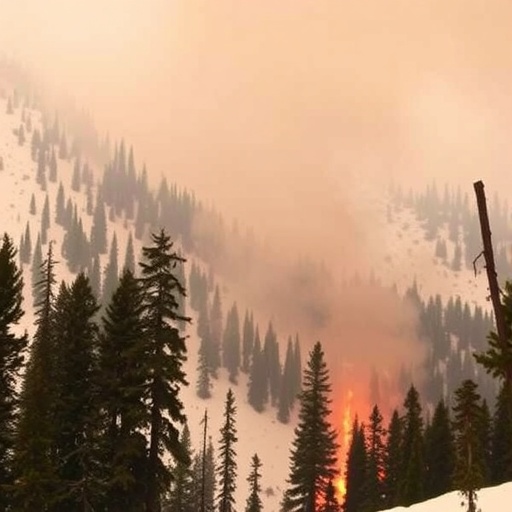
The Pacific Northwest, a region long celebrated for its lush forests and vital winter snowpacks, is experiencing an unsettling shift that could imperil its future water security. Recent research from Portland State University sheds critical light on this challenge, revealing how the aftermath of forest fires amplifies the vulnerability of snowpacks to rapid midwinter melt during rain-on-snow events. This phenomenon threatens not only the region’s delicate hydrological balance but also its flood resilience and long-term water storage capabilities.
Snowpacks in the western Cascades of Oregon serve a crucial ecological and societal function by acting as natural reservoirs. These accumulations of snow store precipitation over the winter months, gradually releasing water through spring and summer. This slow melt ensures continuous replenishment of municipal water supplies, irrigation systems, habitat stability, and hydroelectric power generation. However, the interplay between wildfires and climate-driven rain-on-snow episodes is altering this equilibrium with alarming effects.
At the core of the new findings lies the concept of “cold content” within snowpacks — a thermodynamic buffer allowing snow to absorb heat without immediate melting. When rain, particularly warm midwinter rain, pours over a snowpack, it triggers energy exchanges that can either warm or melt the snow. In unburned forests, dense canopies shade the snow surface, and the snow itself reflects a significant portion of solar radiation, maintaining higher cold content and delaying melt. Conversely, fire-ravaged forests expose the snow to greater solar insolation and deposition of charred debris, which darkens the snow surface and increases its absorption of both shortwave and longwave radiation.
This shift in energy dynamics leads to a perilous decrease in snowpack cold content, effectively saturating the snow ‘sponge’ with heat. According to lead author Sage Ebel, a doctoral student specializing in eco-hydro-climatology, this condition profoundly reduces the snowpack’s capacity to buffer incoming solar and atmospheric heat. The result is an accelerated melting process during rain-on-snow events, effectively doubling snow loss compared to adjacent unburned areas.
Empirical evidence supporting these conclusions arose from extensive monitoring within the Breitenbush River watershed—an ecosystem severely impacted by the 2020 Lionshead fire. PSU researchers established multiple snow observation stations across various elevations within the burned area. The data gathered over the 2023 and 2024 winter seasons consistently showed that mid-elevation sites experienced the most pronounced vulnerability, with rain-on-snow-driven snowmelt contributing up to 26% more of the annual total melt in these burned landscapes.
The implications of this accelerated snowmelt extend far beyond diminished snowpack volumes. Rapid melting episodes increase the volume and velocity of runoff entering rivers and reservoirs, heightening downstream flood risks during winter months traditionally characterized by more stable flow regimes. Water resource managers are thus confronted with a paradox: protecting communities from winter floods while simultaneously securing adequate water storage for the increasingly parched summers. This balancing act becomes even more complex against the backdrop of a warming climate, which fuels both wildfire frequency and intensity and shifts precipitation patterns towards rain rather than snow.
Crucially, this research underscores the necessity of integrating wildfire impacts into hydrological and climatological models. Current snowmelt forecasting often assumes relatively stable forest cover and snowpack behavior. However, the rapidly changing fire regimes compel scientists and water planners to recalibrate assumptions about energy fluxes, snowpack thermodynamics, and melt timing. Enhancing predictive accuracy will improve flood preparedness and water supply reliability, ultimately safeguarding the intertwined natural and human systems dependent on Northwest snowpack dynamics.
Beyond the immediate findings, the study highlights a broader narrative of climate change’s multifaceted consequences. The exacerbation of snowmelt vulnerability in burned forests is a microcosm of the feedback loops linking warming temperatures, vegetation mortality, altered energy balances, and hydrological variability. Addressing these interlocked challenges demands interdisciplinary approaches, integrating earth system science, ecological resilience studies, and adaptive resource management strategies.
The Portland State University team’s interdisciplinary methodology, combining field instrumentation with sophisticated data and statistical analyses, exemplifies contemporary environmental research’s direction. By situating their work within the framework of eco-hydro-climatology, researchers bridge the gap between atmospheric processes, land surface conditions, and aquatic system responses—offering a more comprehensive understanding of how post-wildfire landscapes reshape water resource patterns.
As fire seasons lengthen and intensify across the American West, these insights gain urgency. The findings serve as a clarion call to policymakers and stakeholders that conserving water security in fire-prone, snow-reliant regions demands proactive strategies. These may include forest restoration efforts to rehabilitate canopy cover, infrastructural enhancements for flood control, and prioritized investments in snowpack monitoring networks to detect emerging vulnerabilities in near real time.
In sum, the PSU study delivers a sobering yet vital contribution to the science of climate change impacts. It reveals that forest fires do not merely consume biomass but profoundly alter fundamental hydrological processes by reducing the snowpack’s cold content and accelerating midwinter rain-induced melt. This dynamic threatens to compromise the Pacific Northwest’s traditional water reserves at a time when reliable water supply and flood risk mitigation are more important than ever. The study’s implications resonate beyond Oregon’s Cascades—offering critical lessons for similar snow-dependent regions globally facing intensified wildfire and climatic shifts.
The study has been published in Environmental Research Communications, providing an open-access platform for disseminating these transformative findings. Through scientific clarity and place-based research, Portland State University’s School of Earth, Environment & Society continues to push the frontier on climate adaptation knowledge, underscoring the interconnected nature of ecological disturbances and hydrological resilience in a warming world.
Cite Scienmag News
Violet Maxwell. (April 3, 2026). Study Reveals Wildfires Speed Up Winter Snowmelt in Oregon’s Western Cascades. Scienmag. https://scienmag.com/study-reveals-wildfires-speed-up-winter-snowmelt-in-oregons-western-cascades/
Violet Maxwell. "Study Reveals Wildfires Speed Up Winter Snowmelt in Oregon’s Western Cascades." Scienmag, 3 April 2026, https://scienmag.com/study-reveals-wildfires-speed-up-winter-snowmelt-in-oregons-western-cascades/. Accessed 3 September 2026.
Violet Maxwell. "Study Reveals Wildfires Speed Up Winter Snowmelt in Oregon’s Western Cascades." Scienmag. April 3, 2026. https://scienmag.com/study-reveals-wildfires-speed-up-winter-snowmelt-in-oregons-western-cascades/


