


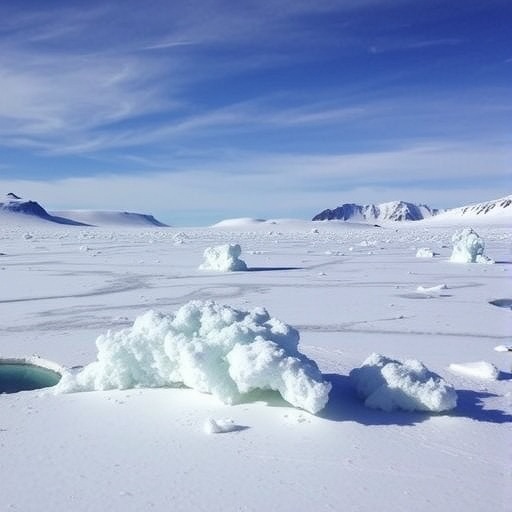
For decades, the scientific consensus has cautioned that melting Antarctic ice shelves pose a significant threat to global sea levels, potentially driving dangerous increases by the century’s end. Yet, groundbreaking research led by Madeleine Youngs, an assistant professor at the University of Maryland’s Department of Atmospheric and Oceanic Science, indicates that these warnings may seriously underestimate the risk. The study reveals a critical oversight in current climate models: the dynamic and complex feedback loop between Antarctic ice melt and the ocean’s intricate circulation system. Published in Nature Geoscience on May 15, 2026, Youngs and her team uncover how these interactive processes amplify ice shelf melting beyond what atmospheric warming alone would predict.
At the core of this research lies a counterintuitive but pivotal discovery regarding meltwater’s role in oceanic thermodynamics. Conventional models have treated ice shelf melting as a static input—ice melts, sea levels rise, and the process proceeds linearly. However, Youngs’ research demonstrates that fresh meltwater fundamentally alters the ocean’s vertical temperature and salinity gradients, weakening the cold, dense water layers that usually act as protective barriers. This disruption allows warmer, deeper ocean currents to access and erode the ice shelf bases more aggressively, setting off a vicious, self-reinforcing cycle of melting accelerated by oceanic feedback. The team’s data-driven simulations suggest this ocean-ice interplay contributes as significantly to sea-level rise as direct atmospheric heating itself.
The mechanism behind this feedback loop hinges on the delicate balance of water temperature, salinity, and density at the ocean floor surrounding Antarctica. Normally, dense, frigid waters settle near the bottom, inhibiting the upward flow of warmer waters toward the ice shelves’ margins. When ice melts and releases large volumes of freshwater into these depths, it decreases water density, disintegrating the stable cold-water barrier. This allows warmer, saline water masses, typically found deeper and further offshore, to surge upward and beneath the ice shelves. As these warmer waters incite further basal melting, the process produces more freshwater—a continuous cycle that accelerates basal ice shelf disintegration at rates far beyond previous projections.
The study’s regional analysis revealed this feedback is not uniformly distributed across the Antarctic coastline. In particularly vulnerable zones such as parts of the Weddell Sea, the positive feedback loop intensifies dramatically. Here, upstream ice melting introduces freshwater which rapidly erodes the cold-water barrier; consequently, warm water intrudes beneath ice shelves, triggering accelerated melting. Such processes heighten the prospect of ice shelf collapse and consequent rapid glacial retreat, significantly exacerbating global sea level rise. This mechanism underpins the critical importance of understanding localized oceanographic and cryospheric interactions that are often oversimplified or omitted in integrated climate models informing global forecasts.
Conversely, some Antarctic regions display a surprising counterbalance to this destabilizing process. Along the West Antarctic Peninsula and sections of the Amundsen Sea—including the notoriously fragile Thwaites Glacier, dubbed the “Doomsday Glacier”—the researchers identified a negative feedback mechanism. Here, meltwater moving westward from upstream regions forms a cold, freshwater barrier that temporarily insulates downstream ice shelves from warmer ocean water. This ephemeral shield delays basal melting, revealing that some areas previously considered the most precarious might experience a short-term reprieve. However, this protective buffer depends entirely on substantial upstream melting, which itself has severe consequences for global sea levels, underscoring the interconnected nature of Antarctic ice dynamics.
Youngs emphasizes that current international climate policies, including those influenced by the Intergovernmental Panel on Climate Change (IPCC), inadequately account for these complex feedbacks. Standard modeling approaches treat meltwater inputs as static parameters rather than dynamic agents altering ocean structure and circulation. The team advocates for treating Antarctic ice shelf melt as an interactive process, continuously modifying oceanic conditions and in turn shaping subsequent melting patterns. Incorporating these meltwater feedbacks into predictive models is essential to achieving a more accurate representation of future sea-level trajectories, especially under high-emission scenarios expected to exacerbate warming and ice loss.
The implications of underestimating this feedback loop are profound given the world’s demographic and economic vulnerabilities. Over 680 million people reside in low-lying coastal areas susceptible to flooding, storm surges, and salination caused by rising sea levels. The IPCC projects Antarctic ice melt could lift global sea levels by 28 to 34 centimeters by 2100 under high-carbon-emission pathways—a forecast now suggested to be potentially conservative. Even seemingly minor deviations above these projections could magnify the social, economic, and ecological costs across coastal megacities, island nations, and critical infrastructure worldwide, making the refinement of these models a top priority for climate risk management and policymaking.
Youngs’ work also draws attention to the nonlinear nature of these feedback loops and their potential role in hastening the arrival of climate tipping points in Antarctica. The synergy between atmospheric warming, ocean warming, and ice melt feedbacks may push ice systems beyond thresholds of irreversible collapse sooner than previously anticipated. This accelerates glacial retreat, alters ocean circulation on continental scales, and injects fresh uncertainty into earth system models. Recognizing the signs, timings, and regional specificity of such tipping points is paramount for designing adaptive strategies and urgent emission reductions aiming to prevent catastrophic outcomes triggered by runaway ice loss.
Moving forward, the University of Maryland team is advancing this line of inquiry with enhanced modeling frameworks that integrate higher-resolution meltwater feedback processes. These next-generation simulations will chart detailed melt trajectories from the present day through the year 2100, with a primary goal of identifying the ice shelves most susceptible to crossing irreversible thresholds. By mapping exactly when and where these critical tipping points arise, the research strives to empower proactive scientific forecasting and resilient policy frameworks capable of mitigating escalating sea-level rise and its global impacts.
The revelation of these interactive feedbacks reshapes our understanding of Antarctic ice-ocean dynamics, demonstrating the ocean’s fundamental and underestimated role in ice shelf melt acceleration. This paradigm shift underscores the urgency of embedding complex cryosphere-ocean feedback mechanisms into climate modeling. Only through such sophisticated integrative approaches can scientists and decision-makers readily anticipate and respond to rapidly unfolding changes in the polar environment—changes that hold the key to humanity’s collective coastal future in a warming world.
The paper, “Antarctic ice-shelf basal melt shaped by competing feedbacks,” authored by Youngs et al., marks a pivotal advancement in glaciology and oceanography and signals a crucial recalibration of how the scientific community approaches sea level rise forecasting. The research was funded by the U.S. National Science Foundation and reflects a collaborative effort to move beyond static models toward dynamic, realistic simulations that acknowledge the chaotic yet patterned nature of Earth’s climate system.
News Publication Date:
15-May-2026
Web References:
http://dx.doi.org/10.1038/s41561-026-01975-6
References:
Youngs, M., et al. (2026). Antarctic ice-shelf basal melt shaped by competing feedbacks. Nature Geoscience. DOI:10.1038/s41561-026-01975-6
Cite Scienmag News
Russell Cooper. (May 15, 2026). Researchers Discover Overlooked Factor Accelerating Antarctic Ice Melt. Scienmag. https://scienmag.com/researchers-discover-overlooked-factor-accelerating-antarctic-ice-melt/
Russell Cooper. "Researchers Discover Overlooked Factor Accelerating Antarctic Ice Melt." Scienmag, 15 May 2026, https://scienmag.com/researchers-discover-overlooked-factor-accelerating-antarctic-ice-melt/. Accessed 5 September 2026.
Russell Cooper. "Researchers Discover Overlooked Factor Accelerating Antarctic Ice Melt." Scienmag. May 15, 2026. https://scienmag.com/researchers-discover-overlooked-factor-accelerating-antarctic-ice-melt/


