


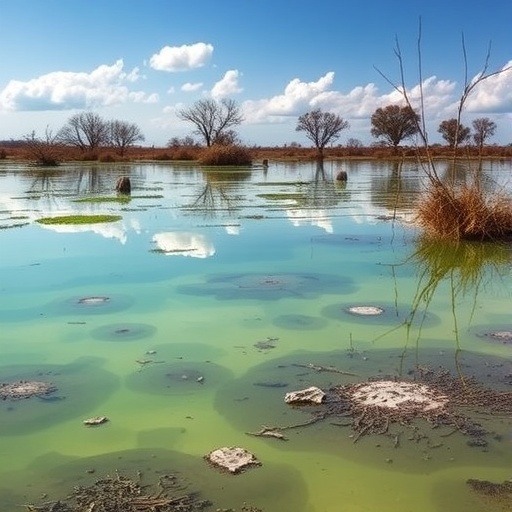
In the realm of climate science, wetlands have long been recognized as major natural emitters of methane, a greenhouse gas significantly more potent than carbon dioxide. However, groundbreaking research from The University of Texas at Austin now reveals that the vast network of tiny, often overlooked wetlands plays a far more significant role in global methane emissions than previously understood. Utilizing advanced technologies such as high-resolution satellite imagery paired with machine learning techniques, this study has identified nearly 160 million small wetlands dispersed across the globe, collectively responsible for about 24% of the methane emissions from non-forested wetlands worldwide.
Traditional methane emission assessments have relied heavily on coarse-resolution satellite data, which typically detect larger wetlands by employing passive microwave sensors. These sensors have the advantage of penetrating dense vegetation, such as forest canopies, providing extensive global coverage. Nevertheless, their spatial resolution limits the ability to identify wetlands smaller than a single coarse pixel, leading to a consistent underestimation of methane emissions from smaller, fragmented wetland systems. The new research circumvents this limitation by harnessing an extensive archive of high-resolution satellite images capable of detecting wetlands as small as 1,000 square meters (roughly a quarter of an acre) up to one square kilometer.
Small wetlands range greatly in size — from physical dimensions comparable to an Olympic swimming pool to areas nearly the size of Austin’s Zilker Park, measuring around 250 acres. While these wetlands might appear insignificant when viewed from a global satellite scale, their aggregate methane emissions have been undervalued in prior climate models. The research team, led by Assistant Professor Fa Li from UT’s Jackson School of Geosciences, meticulously mapped the temporal dynamics of these wetlands from 2003 to 2022, observing subtle but meaningful changes in wetland extent. These variations were then integrated with direct field measurements of methane fluxes to feed machine learning algorithms, producing refined, spatially explicit estimates of methane emissions from these previously undercounted sources.
Methane emission from wetlands primarily results from microbial activity under anoxic (oxygen-poor) soil conditions. Saturated soils impede oxygen diffusion, enabling specific archaea known as methanogens to proliferate and produce methane as a metabolic byproduct. Given methane’s global warming potential, which is approximately 80 times greater than carbon dioxide over a 20-year timeframe, even small contributions from widespread wetland areas exert a notable influence on atmospheric greenhouse gas concentrations and hence climate systems.
A striking revelation from this study was the observed increase in methane emissions from small wetlands by nearly 10% over the two-decade observation period. This trend underscores the sensitivity of these ecosystems to climate variability and land use changes, potentially creating a positive feedback mechanism where warming drives methane release, which in turn exacerbates further warming. Adding complexity, the newly cataloged small wetlands are likely only part of the story; the presence of additional small wetlands beneath dense forest canopies remains elusive because high-resolution optical satellite imagery cannot penetrate thick vegetation, suggesting that current methane budgets might still underestimate natural emissions.
While anthropogenic methane sources such as fossil fuel extraction, livestock digestion, waste management, and rice agriculture constitute roughly two-thirds of global methane emissions and are therefore primary targets for mitigation strategies, understanding natural methane sources remains critical. Natural sources respond dynamically to climate change and ecological shifts, influencing atmospheric methane levels beyond human control. Hence, any comprehensive climate mitigation framework must include improved quantification and monitoring of natural methane fluxes to avoid surprising feedbacks that could offset gains in anthropogenic emission reductions.
In a related policy development, co-author Fa Li has advocated for establishing a global methane observation system, emphasizing that existing observational infrastructure remains insufficient for capturing the complexity of methane emissions worldwide. Current tools such as flux towers—which provide direct methane flux measurements—represent only a piece of the puzzle. To capture the full methane cycle, integration across satellite remote sensing, airborne campaigns, atmospheric concentration networks, and site-based flux towers is essential. Such a multidisciplinary observational framework would enable precise attribution of methane sources and allow verification of emission mitigation effectiveness on local to global scales.
The methodological innovation of combining machine learning with detailed observational datasets marks a significant advance in environmental monitoring. By training models on diverse data inputs including satellite imagery, field measurements, and historical wetland dynamics, researchers have enhanced the spatial resolution and temporal specificity of methane emission estimates. This approach is particularly timely given the escalating urgency to understand the natural greenhouse gas fluxes that influence climate forcing.
Moreover, this research carries important implications for global climate models (GCMs), which historically may have underestimated methane contributions from small wetlands due to coarse resolution inputs. Updated wetland maps that include these smaller, temporally changing aquatic ecosystems will improve model accuracy regarding methane feedbacks under varying climate scenarios. Future iterations of GCMs incorporating these refined datasets could offer more reliable projections needed to inform mitigation policies and international climate agreements.
Given the profound impacts wetlands have on atmospheric chemistry, hydrology, and biodiversity beyond methane emissions alone, the study further emphasizes the need for holistic ecosystem management. Protecting wetlands is critical not only for carbon cycling but also for preserving water quality, supporting wildlife habitat, and buffering extreme weather effects. Integrating methane monitoring with conservation strategies could facilitate dual benefits of climate stabilization and ecosystem resilience.
In conclusion, the discovery and quantification of the massive collective methane emissions from small wetlands represent a paradigm shift in our understanding of the global methane budget. By leveraging state-of-the-art remote sensing and computational technologies, scientists are uncovering hidden dimensions of natural methane sources that must be acknowledged and incorporated into climate policy and research frameworks. As methane concentrations continue to rise globally without a clear source consensus, this work provides a vital piece of the climate puzzle and calls for intensified efforts to develop comprehensive monitoring and mitigation strategies that encompass both anthropogenic and natural methane emissions.
News Publication Date: 8-Apr-2026
Web References:
Cite Scienmag News
Marcus Vaughn. (June 4, 2026). Small Wetlands: A Major Hidden Source of Global Methane Emissions. Scienmag. https://scienmag.com/small-wetlands-a-major-hidden-source-of-global-methane-emissions/
Marcus Vaughn. "Small Wetlands: A Major Hidden Source of Global Methane Emissions." Scienmag, 4 June 2026, https://scienmag.com/small-wetlands-a-major-hidden-source-of-global-methane-emissions/. Accessed 4 September 2026.
Marcus Vaughn. "Small Wetlands: A Major Hidden Source of Global Methane Emissions." Scienmag. June 4, 2026. https://scienmag.com/small-wetlands-a-major-hidden-source-of-global-methane-emissions/


