


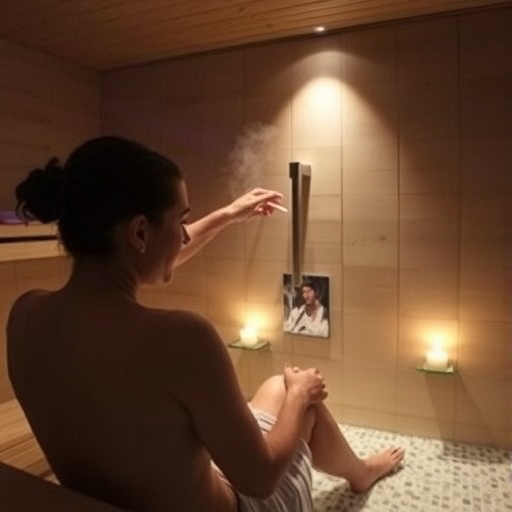
Finnish sauna is often described as a test of heat tolerance: a wooden room, a glowing stove and temperatures high enough to make the air feel almost solid. But new research suggests that the familiar burst of steam may be far more than a cultural detail. Humidity appears to be an independent driver of the body’s response to sauna bathing, influencing heart rate and core temperature alongside the heat itself. The findings come from a collaboration between the University of Jyväskylä, the Finnish Institute of High Performance Sport KIHU and Harvia, with partial funding from Toyota Motor Corporation.
The study examined how different combinations of temperature and relative humidity affected thermoregulation, the set of physiological processes that keep the body’s internal temperature within a safe range. Fifty healthy adults completed four sauna experiments, during which researchers monitored heart rate and body temperature and recorded how intensely participants perceived the heat. By varying sauna conditions and measuring the resulting responses, the researchers were able to separate the effects of temperature from those of moisture in the air—an element that has often received less attention in sauna research.
The cardiovascular response was striking. During ten minutes of sauna bathing, participants’ average heart rate climbed from 79 beats per minute to 121 beats per minute, an increase of more than 40 beats per minute. That rise reflects the body’s effort to move heat away from its core. As the skin warms, blood vessels near the surface dilate, sending more blood toward the skin so that heat can be released into the surrounding environment. The heart must then pump faster to maintain circulation and support the body’s cooling response.
Temperature remained the strongest influence on this reaction, but humidity clearly added to it. When the air became more humid, the increase in heart rate became greater, even when the effect of temperature was considered. “In addition to temperature, the relative humidity of sauna air affects the thermoregulatory responses,” says Iida Laatikainen-Raussi of the University of Jyväskylä’s Faculty of Sport and Health Sciences. “While temperature is still the most significant factor, steam also clearly impacts heart rate and core temperature.”
The reason is rooted in the physics of evaporation. Human beings cool themselves primarily by sweating, but sweat only removes substantial heat when it evaporates from the skin. In relatively dry air, evaporation can proceed efficiently, transferring thermal energy away from the body. In humid air, however, the surrounding atmosphere already contains more water vapor, reducing the gradient that drives evaporation. Sweat may remain on the skin without producing the same cooling effect, leaving the body with fewer options for shedding heat.
That limitation places additional demand on the cardiovascular system. When evaporation becomes less effective, the body must continue sending warm blood to the skin while also maintaining adequate circulation to vital organs and supporting normal blood pressure. The heart responds by increasing its rate of contraction. In a sauna, this process can unfold rapidly because the surrounding air is already hotter than the body’s skin surface, reducing the potential for heat loss through simple radiation or convection. Under those conditions, evaporation becomes especially important—and humidity directly interferes with it.
The participants’ core temperatures rose more modestly than their heart rates, increasing on average from 37.4 to 37.8 degrees Celsius during the sauna exposure. Although the average change was approximately 0.4 degrees, the direction of the response was consistent: hotter and more humid conditions were associated with higher core temperatures. Core temperature is closely regulated by the brain’s thermoregulatory centers, so even a moderate increase indicates that the body is absorbing more heat than it can immediately release.
The results challenge the idea that sauna conditions can be adequately described by temperature alone. Two saunas with similar thermometer readings may create noticeably different physiological stresses if their humidity levels differ. A brief release of water onto heated stones can transform the thermal environment within seconds, increasing the amount of water vapor in the air and changing how readily sweat evaporates. For sauna users, that means the sensation of a sudden, intense “wave” of heat is not simply psychological: it reflects a measurable shift in the conditions confronting the body’s cooling system.
According to the researchers, humidity may have been underestimated in earlier sauna studies because variations in moisture were not always measured or reported in sufficient detail. Differences in stove design, ventilation, room size, bathing practices and the timing of steam release can all alter the relationship between air temperature and relative humidity. The new findings therefore point toward more carefully controlled research, particularly studies that record both variables continuously rather than treating the sauna as a fixed-temperature environment. They may also help explain why people can experience similar temperatures as dramatically different depending on the amount of steam present.
The study does not establish that sauna bathing is unsafe for healthy people, nor does it determine how long an individual should remain in a sauna. Instead, it provides a more precise picture of why the experience can place a substantial load on the body. A heart rate rising from 79 to 121 beats per minute in ten minutes demonstrates that sauna bathing is not a passive exposure; it is an acute cardiovascular and thermoregulatory challenge. The next generation of sauna research, the authors suggest, should treat humidity as a central experimental variable. In the traditional Finnish sauna, the steam may not merely intensify the experience—it may be one of the main forces shaping the body’s response.
Web References: https://doi.org/10.1080/23328940.2026.2698162
References: Iida Laatikainen-Raussi et al., “Temperature and humidity independently influence thermoregulatory responses during Finnish sauna bathing,” Temperature. DOI: 10.1080/23328940.2026.2698162
Cite Scienmag News
Russell Cooper. (August 3, 2026). Study Finds Steam Intensifies Physical Strain During Sauna Bathing. Scienmag. https://scienmag.com/study-finds-steam-intensifies-physical-strain-during-sauna-bathing/
Russell Cooper. "Study Finds Steam Intensifies Physical Strain During Sauna Bathing." Scienmag, 3 August 2026, https://scienmag.com/study-finds-steam-intensifies-physical-strain-during-sauna-bathing/. Accessed 3 September 2026.
Russell Cooper. "Study Finds Steam Intensifies Physical Strain During Sauna Bathing." Scienmag. August 3, 2026. https://scienmag.com/study-finds-steam-intensifies-physical-strain-during-sauna-bathing/


