


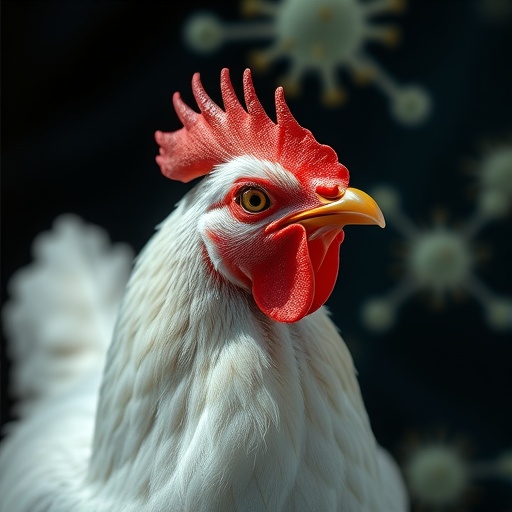
A genome-wide analysis of Marek’s disease virus has identified 10 regions of the viral genome associated with increased virulence, including the ability to cause severe tumors and evade vaccine protection in chickens. The findings offer new clues about how this avian herpesvirus has evolved under sustained vaccination pressure and may help researchers design vaccines that remain effective against future, more dangerous strains.
Marek’s disease is caused by a highly contagious herpesvirus that primarily infects chickens. The disease can produce tumors in multiple organs, paralysis caused by nerve damage, severe immune suppression and death. Although the virus does not infect humans, it represents a persistent threat to poultry health and food production because it can spread rapidly through densely populated flocks. Viral particles can also remain infectious in poultry-house dust, allowing transmission between birds and across farms.
Vaccination introduced in the 1970s dramatically reduced the economic impact of Marek’s disease. However, the vaccines generally do not prevent infection or eliminate viral transmission. Instead, they primarily delay the development of disease and reduce mortality. This creates an evolutionary environment in which the virus can continue circulating while strains with greater pathogenicity emerge. Over time, some viral lineages have acquired the ability to cause more severe disease and overcome protection provided by earlier generations of vaccines.
To investigate the genetic basis of these changes, researchers at Penn State and the U.S. Department of Agriculture analyzed the complete genomes of 65 Marek’s disease virus strains. The samples were drawn from a USDA collection and represented viruses collected between 1962 and 2016. Each strain had previously been assigned to one of four standardized pathotypes, or disease categories, based on the severity of illness it produced and its capacity to break through vaccine protection. The collection therefore allowed the scientists to compare viral genomes across a broad range of virulence.
The researchers first aligned the genome sequences to identify genetic differences among the strains. They detected nearly 800 single-nucleotide variants, in which one DNA base differed between viruses, as well as several insertions and deletions involving longer segments of genetic material. These changes provided the raw material for reconstructing the evolutionary relationships among the viruses. A phylogenetic analysis showed that all of the most virulent strains in the dataset descended from a common ancestor, suggesting that the capacity to overcome vaccine protection may have arisen within a particular branch of the viral family tree.
The team then applied a genome-wide association study, or GWAS, to determine whether particular viral variants occurred more frequently in strains associated with severe disease. In a GWAS, genetic differences are statistically compared with a measurable biological trait—in this case, the pathotype of each virus. Such associations do not by themselves prove that a variant directly causes increased virulence, but they can highlight genomic regions that deserve functional investigation. The analysis identified 10 variants significantly associated with virulence, including several that had not been reported in earlier studies.
The strongest association involved a tandem repeat, a sequence in which a stretch of DNA is duplicated one or more times. Tandem repeats can influence viral biology by altering the length or activity of a protein, changing gene regulation or affecting how efficiently a virus replicates. Because repeat number can sometimes change more readily than single DNA bases, these regions may provide viruses with a flexible mechanism for adapting to new conditions. The researchers said the next step will be to test whether the identified variants directly alter viral replication, tissue damage, immune evasion or vaccine breakthrough.
The results also clarify why Marek’s disease remains difficult to control despite widespread immunization. First-generation vaccines reduced disease caused by earlier viral strains, but increasingly virulent viruses eventually emerged that could breach their protection. Later vaccines offered stronger defense, and third-generation formulations can protect chickens against many of the most aggressive strains known today. Nevertheless, researchers have reported so-called hypervirulent viruses capable of causing disease even in vaccinated flocks. Understanding which viral genes contribute to this progression could support the development of vaccines that target more conserved features or stimulate broader immune responses.
The study reflects more than a decade of coordinated research involving field surveillance, experimental virology, evolutionary biology and computational genomics. By combining historical virus samples with standardized disease measurements, the researchers were able to examine viral evolution across several generations of vaccine use rather than studying isolated outbreaks. The 10 associated regions now provide a focused set of candidates for laboratory experiments. If their effects are confirmed, they could become molecular markers for monitoring emerging strains and evaluating the risk posed by viruses circulating in poultry populations. The work may ultimately help shift Marek’s disease control from reacting to vaccine failures toward anticipating the genetic changes that make those failures possible.
News Publication Date: 29-Jul-2026
Web References: https://doi.org/10.1126/sciadv.aee9024
References: Science Advances article, “Genome-wide analyses of an avian herpesvirus identify 10 loci associated with tumorigenicity and vaccine escape,” DOI: 10.1126/sciadv.aee9024.
Cite Scienmag News
Kristina Jarvis. (August 3, 2026). How a deadly chicken virus evades vaccines designed to contain it. Scienmag. https://scienmag.com/how-a-deadly-chicken-virus-evades-vaccines-designed-to-contain-it/
Kristina Jarvis. "How a deadly chicken virus evades vaccines designed to contain it." Scienmag, 3 August 2026, https://scienmag.com/how-a-deadly-chicken-virus-evades-vaccines-designed-to-contain-it/. Accessed 3 September 2026.
Kristina Jarvis. "How a deadly chicken virus evades vaccines designed to contain it." Scienmag. August 3, 2026. https://scienmag.com/how-a-deadly-chicken-virus-evades-vaccines-designed-to-contain-it/


