


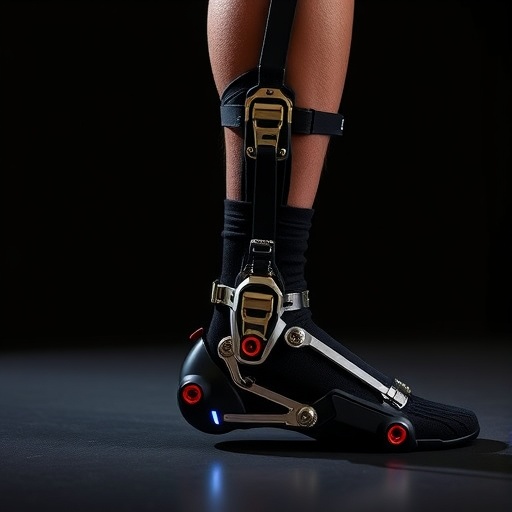
A team of researchers in Shanghai has developed a soft wearable exoskeleton for the ankle joint that combines real-time gait recognition with machine-learning-driven control tuning, an approach that allowed the device to deliver peak assistance forces of up to 120 newtons while keeping force-tracking errors below 5 percent during level walking. The system, described in a new paper in the International Journal of Intelligent Robotics and Applications, also reduced activation of the gastrocnemius muscle—the large calf muscle that powers push-off during walking—by roughly 10 percent, a sign that the device and its wearer were genuinely working together rather than fighting each other.
The work was led by Jianjun Yan of the Shanghai Key Laboratory of Intelligent Sensing and Detection Technology at East China University of Science and Technology, together with colleagues at the institute and the Shanghai Aerospace Control Technology Research Institute. Their central insight is that a wearable robot assisting a joint as biomechanically complex as the ankle cannot rely on a single control loop. Human walking varies from stride to stride and from person to person, so a controller that is tuned perfectly for one wearer at one moment may perform poorly seconds later. The team’s answer is a layered architecture that separates “what assistance should be delivered” from “how that assistance is physically delivered,” and then makes both layers adaptive.
At the top of this hierarchy sits the decision layer. Here, a gait recognition model processes sensor data in real time to identify what the wearer is doing—distinguishing, for example, the characteristic patterns of level walking—and translates that recognition into a specific assistance profile. The profile is not arbitrary: it is shaped around the desired biological ankle joint torque, meaning the exoskeleton tries to reproduce the torque trajectory that a healthy ankle would naturally generate during the gait cycle. Because plantarflexion torque peaks sharply during the push-off phase of stance, timing is everything. Assist too early and the device fights the wearer’s own muscles; assist too late and the metabolic benefit largely evaporates. To solve this timing problem, the researchers embedded an enhanced finite state machine into the decision layer. A finite state machine is a control construct that moves the system through a fixed set of discrete states—here, the phases of the gait cycle such as heel strike, loading response, mid-stance and terminal stance—and triggers transitions when sensor thresholds are crossed. The “enhanced” element allows the machine to predict, rather than merely detect, the arrival of each phase, so the assistance profile can be pre-positioned in time and delivered with millisecond-relevant precision.
Once the decision layer has produced a target assistance trajectory, the execution layer takes over the job of physically realizing it. This is where the study makes its most distinctive technical contribution. The researchers coupled a conventional PID (proportional–integral–derivative) controller with Bayesian optimization, creating what they call an iterative adaptive control scheme. PID control remains the workhorse of industrial robotics because it is simple, fast and stable, but its gains—the numbers that determine how aggressively the controller reacts to error—must be tuned by hand, and a soft exoskeleton is a notoriously difficult plant to tune for. Soft materials, cable transmissions and the compliance of human tissue introduce delays, hysteresis and nonlinearities that shift with posture, loading and fatigue. A gain set that produces crisp tracking in the laboratory can oscillate or lag once the wearer accelerates or the fabric interface creeps.
Bayesian optimization offers a principled way out of this problem. Instead of a human engineer iterating gains through trial and error, the algorithm builds a probabilistic surrogate model—a statistical belief about how the controller’s performance depends on its parameters—and uses that model to decide, at each iteration, which parameter combination to try next. The strategy balances exploration of uncertain regions of the parameter space against exploitation of configurations already known to perform well, and it does so with remarkably few physical experiments, which matters enormously when each “experiment” involves a person actually walking in the device. The iterative scheme continuously compensates for tracking error, adjusting the control parameters online so that the delivered force profile stays locked onto the desired assistance profile even as conditions change. The approach echoes a growing body of work in which Bayesian methods are used for safe, automatic parameter tuning in robotics, adapting ideas that have matured in machine learning to the unforgiving real-time constraints of a wearable device.
The experimental results quantify how well the architecture performs. During level walking, the exoskeleton delivered peak assistance forces reaching 120 newtons while peak tracking errors stayed within 5 percent of the target profile. In force-control terms, that is a demanding figure: the assistance profile rises and falls within a fraction of a second during push-off, and any combination of actuator delay, cable stretch or sensor noise would tend to widen the gap between commanded and realized force. Holding that gap to 5 percent at peak force suggests that the Bayesian-tuned PID loop is successfully compensating for the messy dynamics that make soft exoskeletons hard to control. Robustness, the researchers emphasize, was a defining property of the system’s behavior across trials.
The physiological outcome is arguably more meaningful than the force numbers alone. Electromyographic measurements showed that activation of the gastrocnemius dropped by approximately 10 percent when the exoskeleton was assisting. This reduction is the clearest evidence that the mechanical assistance was being accepted and used by the wearer’s neuromuscular system. When an exoskeleton’s timing or amplitude is wrong, wearers often increase co-contraction to stabilize the joint, and metabolic cost can actually rise; muscle activation falling rather than rising indicates that the biological ankle torque profile produced by the decision layer, and the precise timing delivered by the state machine, matched what the body expected. Improved human–exoskeleton coordination of this kind is precisely the property that earlier generations of rigid, hard-tuned exoskeleton controllers struggled to achieve.
The ankle is a sensible target for this technology. Ankle plantarflexion during push-off contributes substantially to the positive work of walking, and studies dating back to unpowered ankle exoskeletons demonstrated that well-timed assistance at this joint can meaningfully reduce the energy cost of walking. Soft exosuits—fabric-based devices that transmit forces through anchors and textile straps rather than rigid linkages—promise assistance without the weight and joint-alignment problems of rigid frames, and have shown clinical value in populations such as stroke survivors. But softness comes at a control price, and the field has been converging on the view that personalization is the key variable: human-in-the-loop optimization studies have shown that exoskeleton assistance tuned to the individual delivers far greater metabolic benefit than generic, one-size-fits-all profiles. The Shanghai team’s multi-layer strategy extends this personalization theme from the offline tuning of assistance parameters into the online, stride-by-stride adaptation of the low-level controller itself.
The layered design also has a practical engineering logic. Separating decision and execution means the gait recognition model, the torque profile generator, the finite state machine and the force controller can each be upgraded independently. A better recognition network could be swapped in without touching the force loop; a different actuator could be accommodated by retuning only the Bayesian-PID layer. This modularity matters for translating laboratory exoskeletons into devices suitable for rehabilitation clinics, industrial workplaces or everyday mobility assistance, where robustness across heterogeneous users and unscripted environments—not peak performance under ideal conditions—is the binding constraint. The researchers report that their adaptive strategy maintained strong robustness in force tracking throughout testing, suggesting the architecture can absorb the variability that real-world use would introduce.
The study was supported by the Major Research Plan of the National Natural Science Foundation of China under grant number 91748110, and the authors declare no competing interests. While the reported experiments focused on level walking, the underlying framework—recognition-driven assistance profiles, phase prediction through an enhanced state machine, and Bayesian-tuned force control—is, by construction, extensible to other locomotion modes such as ramp ascent, stair climbing and loaded walking, each of which places different demands on the ankle. Future work building on this architecture will likely explore precisely those extensions, along with longer-duration trials to test how the adaptive controller behaves as muscle fatigue, suit slippage and sensor drift accumulate. For now, the results stand as a concrete demonstration that machine-learning optimization at the control level can translate directly into softer, more synchronized human–machine collaboration at the level of a single, decisive push off the ground.
Cite Scienmag News
Denise Maddox. (September 3, 2026). Bayesian optimization enables layered adaptive control for soft ankle exoskeletons. Scienmag. https://scienmag.com/bayesian-optimization-enables-layered-adaptive-control-for-soft-ankle-exoskeletons/
Denise Maddox. "Bayesian optimization enables layered adaptive control for soft ankle exoskeletons." Scienmag, 3 September 2026, https://scienmag.com/bayesian-optimization-enables-layered-adaptive-control-for-soft-ankle-exoskeletons/. Accessed 10 September 2026.
Denise Maddox. "Bayesian optimization enables layered adaptive control for soft ankle exoskeletons." Scienmag. September 3, 2026. https://scienmag.com/bayesian-optimization-enables-layered-adaptive-control-for-soft-ankle-exoskeletons/


