


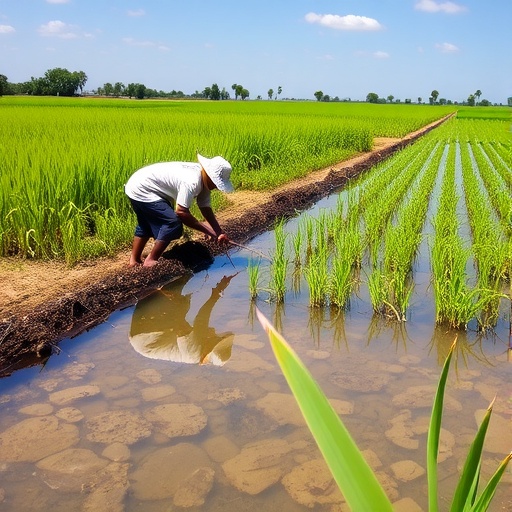
Schistosomiasis, a debilitating chronic disease caused by parasitic worms, continues to affect over 220 million individuals worldwide, predominantly in sub-Saharan Africa. Despite sustained efforts involving widespread mass drug administration campaigns, the illness remains entrenched as one of the most pervasive neglected tropical diseases. The complexity of schistosomiasis transmission, closely tied to environmental and socio-economic factors, has often thwarted straightforward intervention strategies. Rice farmers, whose livelihoods depend on flooded paddy fields, are disproportionately affected since these environments serve as ideal habitats for freshwater snails that harbor the parasites responsible for the disease.
In a groundbreaking study published in Nature Sustainability, researchers have explored an innovative, integrated ecological approach that leverages the symbiotic relationship between rice cultivation and fish farming to curb the spread of schistosomiasis in the northern Senegal River basin—a region marked by high disease prevalence. The intervention focuses on rice-fish co-culturing, a method that reintroduces native fish species into rice paddies to naturally limit the population of disease-transmitting freshwater snails. This approach not only addresses the pressing public health challenge but also aims to enhance agricultural productivity and alleviate poverty, creating a multifaceted impact.
One of the study’s principal investigators, Professor Jason Rohr of the University of Notre Dame, emphasized the rarity and significance of such triple-win solutions: strategies that concurrently improve human health, boost food production, and promote environmental stewardship. His team’s innovative approach challenges the prevailing notion that these goals must be pursued in isolation or at odds with each other. Instead, through ecological restoration and adaptive agricultural practices, the rice fields transform into ecosystems that support native fish species, thereby disrupting the life cycle of the schistosomiasis parasite.
The researchers conducted extensive fieldwork involving more than 400 households in rural Senegal. Epidemiological data extracted from this cohort revealed a troubling disparity: children of rice farmers exhibited significantly higher schistosomiasis infection rates than their non-farming counterparts. This finding underscored the unique vulnerability faced by these farming communities, tethering disease incidence directly to occupational exposure. While current pharmacological treatments exist, such as praziquantel, these drugs do not prevent reinfection, allowing continuous cycles of morbidity and perpetuating entrenched poverty.
To mechanistically combat reinfection, the team introduced two native fish species into the rice field ecosystem: the African Bonytongue and Nile tilapia. These species are known for either preying upon freshwater snails or competing with them for vital resources, effectively reducing snail populations without the need for artificial feeding. Over the course of two controlled trials, the fish populations not only survived but thrived, demonstrating the ecological sustainability of the intervention. Crucially, this biocontrol approach aligns with local biodiversity and leverages indigenous species adapted to existing environmental conditions, minimizing ecological risks.
Quantitative analyses revealed a marked decrease in the density of schistosomiasis-hosting snails within rice fields containing both fish species. The reduction in snail intermediate hosts significantly lowers the chances of human infection by disrupting the parasite’s lifecycle at a critical juncture. The reduction in disease risk constitutes a transformative public health benefit, particularly for communities whose proximity to contaminated water has long dictated infection prevalence.
The intervention also yielded substantial agronomic gains. Rice yields increased by more than 25%, a remarkable improvement that speaks to enhanced soil nutrient profiles and the synergistic ecological effects engendered by fish presence. The fish contribute to nutrient cycling within the paddies, improving soil fertility and crop growth. Moreover, farmers gain an additional source of income by harvesting and selling the fish, amplifying economic resilience and helping to break the poverty-disease nexus common in these regions. This dual benefit of food security and financial empowerment positions the rice-fish co-culturing model as an exemplary sustainable agriculture innovation.
Emily Selland, the study’s lead author and a doctoral researcher within Rohr’s laboratory, highlighted the interdisciplinary nature of this solution. By adapting a traditional agricultural practice innovatively applied in other global regions, the research bridges the gap between ecology, epidemiology, and sustainable development. Such cross-sectoral collaboration is vital for designing interventions that are contextually relevant and scalable. The implications extend beyond schistosomiasis control, offering a blueprint for tackling complex health challenges through environmentally integrated solutions.
Future research directions are already underway to assess the feasibility of scaling up this intervention across other schistosomiasis-endemic rice-growing zones. Scaling challenges include tailoring fish species selection, local ecological compatibility, and socio-economic management frameworks to ensure adoption and sustainability. If successful, this method could revolutionize the approach to infectious disease control, food security augmentation, and poverty alleviation in vulnerable agricultural communities worldwide.
Professor Rohr also pointed out that such integrated farm-based interventions resonate with the broader goals of global sustainable development. By working synergistically with natural ecosystems instead of imposing disruptive, mono-dimensional interventions, the rice-fish co-culturing method embodies a paradigm shift—one where resilience, health, and productivity are enhanced in tandem. This approach underscores the importance of biodiversity conservation as an indispensable pillar of public health interventions.
The research team was diverse, including experts from the University of Notre Dame, Stanford University, Cornell University, UC Santa Barbara, and local aquaculture innovation stations in Senegal. This multidisciplinary collaboration fortified the scientific robustness and practical applicability of the study, integrating ecological theory, epidemiology, agronomy, and socio-economic analysis.
Funding support from esteemed bodies such as the U.S. National Science Foundation, the Notre Dame Poverty Initiative, and the Stanford Sustainability Accelerator enabled this innovative research. Their support helped create a model for future explorations that aim to merge ecological restoration with social impact, an approach poised to redefine how we address entrenched tropical diseases and their socio-economic underpinnings.
As the call to action intensifies globally toward sustainable health and development solutions, this research stands as a testament to the power of nature-based, integrated strategies. By mimicking and harnessing ecological processes within agroecosystems, the rice-fish co-culturing intervention offers a transformative pathway to dismantling the vicious cycles of disease, poverty, and food insecurity in schistosomiasis-endemic regions.
News Publication Date: 11-May-2026
Web References:
- Nature Sustainability Article: https://www.nature.com/articles/s41893-026-01833-8
- DOI Link: http://dx.doi.org/10.1038/s41893-026-01833-8
Cite Scienmag News
Alan Morgan. (June 4, 2026). Rice-Fish Farming: A Dual Solution for Schistosomiasis Control and Enhanced Food Production. Scienmag. https://scienmag.com/rice-fish-farming-a-dual-solution-for-schistosomiasis-control-and-enhanced-food-production/
Alan Morgan. "Rice-Fish Farming: A Dual Solution for Schistosomiasis Control and Enhanced Food Production." Scienmag, 4 June 2026, https://scienmag.com/rice-fish-farming-a-dual-solution-for-schistosomiasis-control-and-enhanced-food-production/. Accessed 3 September 2026.
Alan Morgan. "Rice-Fish Farming: A Dual Solution for Schistosomiasis Control and Enhanced Food Production." Scienmag. June 4, 2026. https://scienmag.com/rice-fish-farming-a-dual-solution-for-schistosomiasis-control-and-enhanced-food-production/


