


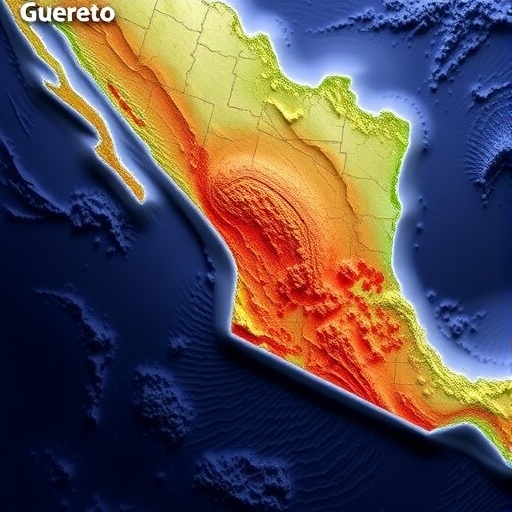
A new study of the Guerrero gap offshore Mexico is challenging a widely held assumption about how the structure of a subducting tectonic plate controls the way faults release seismic energy. Published in Communications Earth & Environment, the research finds that variations in slip along the megathrust are only weakly connected directly to the physical structure of the incoming plate. The result adds an important layer of complexity to efforts to understand one of Mexico’s most closely watched seismic zones.
The Guerrero gap is a segment of the Mexican subduction margin where the Cocos Plate dives beneath the North American Plate. Unlike many portions of the boundary, this region has experienced a relative absence of large, recently recorded earthquakes, even though it is capable of storing enormous tectonic stress. That combination has made the area a focus of research into earthquake hazards, slow slip, and the processes that determine whether accumulated strain is released suddenly or gradually.
At a subduction zone, the incoming oceanic plate does not descend as a perfectly smooth slab. Its surface may carry ridges, volcanic seamounts, fractures, sediment, and variations in crustal thickness. As these features enter the trench, they can alter the geometry and frictional behavior of the plate interface. Scientists have therefore often expected a direct relationship between the structure arriving at the trench and the distribution of slip along the megathrust, the broad fault where the two plates meet.
Slip describes the relative movement between the plates during an earthquake or a slower tectonic event. In some sections of a subduction boundary, the fault may remain locked for years or centuries before rupturing in a powerful earthquake. Elsewhere, the same interface can creep continuously or release energy through slow-slip events that last weeks or months and produce little or no shaking. Mapping where and how this movement occurs is central to estimating seismic risk, but the physical controls remain difficult to isolate.
The study by T. Acquisto, A. Bécel, V. M. Cruz-Atienza and colleagues examined whether changes in slip behavior at the Guerrero gap could be directly explained by the structure of the plate entering the subduction zone. Its central conclusion, reflected in the paper’s title, is that the relationship is limited. In other words, incoming plate architecture may influence the fault system, but it does not provide a simple one-to-one explanation for why some parts of the interface slip differently from others.
That finding matters because it shifts attention away from single-factor explanations. If a seamount, ridge, fracture zone, or change in crustal properties does not consistently correspond to a particular style or amount of slip, then researchers must consider a wider combination of influences. These may include the composition and thickness of sediments in the trench, the pressure of fluids within the fault, the roughness and orientation of the plate boundary, temperature, mineral transformations, and the history of previous earthquakes and slow-slip episodes.
Fluids are especially important in this setting. Water carried downward by the oceanic plate can be released as minerals change under increasing pressure and temperature. The resulting fluids may raise pore pressure within the fault zone, reducing the effective force pressing the two plates together. In principle, that can make the interface more likely to slide. Yet fluid pathways are highly variable and may be controlled by fractures and permeability rather than by the large-scale shape of the incoming plate alone, helping explain why structural correlations can be weak.
The Guerrero gap is also a natural laboratory because its offshore environment allows scientists to compare processes beneath the seafloor with signals measured on land and at sea. Seismic waves, seafloor mapping, geodetic measurements, and models of fault motion can reveal different aspects of the plate boundary. Each method has limitations: seismic imaging can blur small structures, geodetic observations may average behavior over broad areas, and models depend on assumptions about the fault’s geometry and friction. Combining these approaches is therefore essential for separating robust patterns from apparent connections.
The study’s message is not that incoming plate structure is irrelevant. Rather, it suggests that its effect is indirect, filtered through the complex physical conditions of the subduction interface. This distinction could influence how scientists interpret earthquake forecasts and hazard maps. A visible feature on the oceanic plate should not automatically be treated as a reliable marker of a locked patch, a slow-slip zone, or a future rupture boundary. More realistic assessments will need to integrate geology, fault mechanics, fluids, temperature, and the timing of past deformation.
For the public, the research offers a reminder that earthquake science is increasingly precise but not yet simple. The absence of a straightforward structural fingerprint does not remove the seismic threat at the Guerrero gap, nor does it predict when a major earthquake might occur. Instead, it highlights why the most dangerous faults require detailed, multidisciplinary monitoring. By showing that slip variability cannot be explained directly by incoming plate structure alone, the researchers provide a more nuanced framework for understanding how Mexico’s subduction margin stores and releases tectonic energy.
Cite Scienmag News
Violet Maxwell. (August 5, 2026). Limited links connect slip variability, incoming plate structure at Mexico’s Guerrero gap. Scienmag. https://scienmag.com/limited-links-connect-slip-variability-incoming-plate-structure-at-mexicos-guerrero-gap/
Violet Maxwell. "Limited links connect slip variability, incoming plate structure at Mexico’s Guerrero gap." Scienmag, 5 August 2026, https://scienmag.com/limited-links-connect-slip-variability-incoming-plate-structure-at-mexicos-guerrero-gap/. Accessed 4 September 2026.
Violet Maxwell. "Limited links connect slip variability, incoming plate structure at Mexico’s Guerrero gap." Scienmag. August 5, 2026. https://scienmag.com/limited-links-connect-slip-variability-incoming-plate-structure-at-mexicos-guerrero-gap/


