


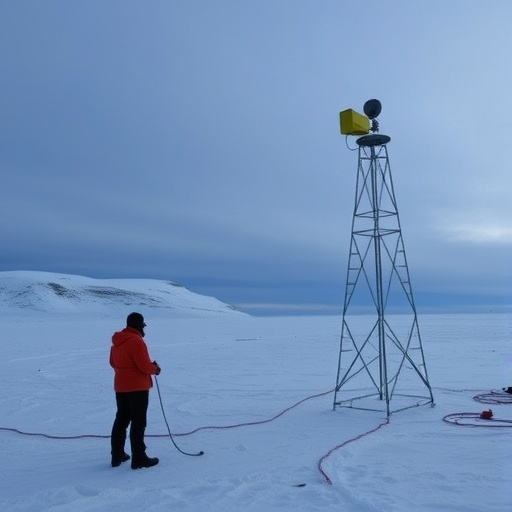
In the rapidly changing Arctic landscape, weather patterns are becoming increasingly unpredictable and hazardous, posing a significant threat to the indigenous and local communities dependent on accurate, timely meteorological data. These communities, spanning regions such as Alaska, Canada, Russia, and the Nordic countries, frequently make critical, sometimes life-or-death decisions grounded in localized weather forecasts. Whether planning travel routes or timing hunting and fishing activities, their safety and sustenance intertwine with the precision and reliability of atmospheric information.
Presently, the state-of-the-art global and regional weather prediction systems exhibit limitations when addressing such urgent community needs at a localized scale, particularly within the unique atmospheric conditions of the Arctic lower troposphere. Globally, meteorological models offer robust forecasts on continental or larger scales, yet their efficacy diminishes near the ground in polar regions, where observational data scarcity creates significant uncertainty. Satellite technologies, although invaluable, struggle to peer through the dense and reflective ice and snow-covered surfaces characteristic of polar zones, while traditional atmospheric sensing techniques such as radiosondes and drones come with prohibitive costs, complex logistics, and operational challenges that impede widespread deployment in remote and resource-limited areas.
Responding to this crucial gap in Arctic atmospheric monitoring, researchers led by Professor Jun Inoue of Japan’s National Institute of Polar Research and Dr. Hajo Eicken of Germany’s Alfred Wegener Institute have conceptualized an innovative framework for on-demand atmospheric observations. This approach harnesses recent advances in miniaturized electronics and ultralight balloon technology to create low-cost, community-operated profiling systems capable of capturing detailed meteorological variables in real time. These variables include temperature gradients, relative humidity, barometric pressure, and wind velocity profiles within the boundary layer — data essential for enhancing short-term, high-resolution forecasting accuracy.
The crux of this design lies in its operational flexibility and affordability: lightweight radiosonde-like instruments can be launched spontaneously by community members, research institutions, or local organizations during imminent hazards such as Arctic cyclones, wildfire smoke intrusions, or sudden coastal flooding events. By delivering targeted atmospheric snapshots when and where they are most needed, these on-demand systems can meaningfully supplement existing sparse observational networks, thereby feeding more granular data into both conventional numerical weather prediction models and emerging AI-powered forecasting frameworks.
Decades of polar meteorological research underpin the promise of these additional data inputs. Past field campaigns deploying traditional radiosondes have conclusively demonstrated that even a limited increase in atmospheric soundings over the Arctic dramatically improves the predictability of extreme phenomena including cold-air outbreaks and intense storm systems. Nonetheless, the high personnel expertise and financial burdens tied to classical radiosonde launches have limited their scalability and sustained use — shortcomings the new approach aims to overcome by democratizing atmospheric data acquisition.
By decentralizing control of atmospheric sensing to community stakeholders, the proposed system promotes a paradigm shift toward participatory meteorology. Local institutions and Indigenous knowledge holders, equipped with intuitive, cost-effective sensor payloads and minimal training, could initiate observations tailored to their distinct environmental and social contexts. The real-time transmission of this rich atmospheric data through radio or satellite links ensures swift assimilation into forecasting pipelines, facilitating more timely and accurate alerts that inform daily decision-making and disaster preparedness.
Importantly, the implications of community-driven, on-demand atmospheric sensing extend beyond polar latitudes. Regions characterized by complex topographies, such as mountainous zones, or isolated insular and coastal settlements share similar observational gaps and acute vulnerabilities to climatic extremes. The modularity and portability of these ultralight atmospheric profilers position them as universally adaptable tools for enhancing localized weather awareness and climate resilience globally, particularly when coupled with sophisticated AI models that optimize data assimilation and predictive outputs.
As the Arctic continues to experience drastic transformations fueled by global warming, fostering adaptive capacities through enhanced meteorological insight becomes paramount. The envisaged system delivers a dual promise: augmenting scientific understanding of polar atmospheric dynamics while empowering communities to actively participate in shaping their environmental futures. Moreover, the upcoming Fifth International Polar Year (IPY-5), slated for 2032–2033, presents a strategic opportunity to further develop and deploy community-ready atmospheric observations, intertwining international scientific collaboration with grassroots climate action.
This innovative approach epitomizes a convergence of technological miniaturization, participatory science, and artificial intelligence-driven meteorology — a triad poised to revolutionize how weather forecasts serve vulnerable populations residing in some of Earth’s most challenging environments. As efficient, context-specific observation networks proliferate, they pave the way for disaster resilience strategies informed by hyperlocal data, ultimately safeguarding lives and livelihoods amid an uncertain climatic future.
Professor Jun Inoue, with extensive expertise in atmospheric sciences within polar domains and a prolific publication record, underscores the transformative potential of integrating ultralight balloon-based sensor systems into existing meteorological frameworks. His vision advocates lowering entry barriers to atmospheric data collection, thus enabling real-time observational bursts tailored to emerging hazards and community priorities. Such innovation promises to recalibrate meteorological services toward inclusivity, responsiveness, and enhanced accuracy.
The National Institute of Polar Research (NIPR) in Japan, under Prof. Inoue’s leadership, remains at the forefront of polar environmental research, combining cutting-edge science with capacity-building initiatives. As a key member of the Research Organization of Information and Systems (ROIS), NIPR operates across Arctic and Antarctic observatories, linking interdisciplinary efforts to unravel polar ecosystem dynamics, climate processes, and socio-environmental interactions.
In conclusion, the pioneering framework for on-demand atmospheric observations not only addresses critical meteorological blind spots in the Arctic but also signals a broader shift to community-centered climate adaptation strategies worldwide. By empowering local actors with accessible and advanced tools, this initiative illustrates the potential to forge resilient, informed societies capable of navigating and mitigating the escalating challenges posed by climate change.
News Publication Date: 9-May-2026
Web References:
https://doi.org/10.1038/s44168-026-00383-1
https://www.nipr.ac.jp/english/index.html
https://www.rois.ac.jp/en/
References:
Inoue, J., Eicken, H., et al. (2026). Toward community-ready weather observations in a rapidly changing Arctic: bridging local needs, extreme events, and climate adaptation. npj Climate Action. https://doi.org/10.1038/s44168-026-00383-1
Cite Scienmag News
Sloane Callahan. (June 4, 2026). Real-Time Weather Monitoring Enhances Climate Resilience in the Arctic. Scienmag. https://scienmag.com/real-time-weather-monitoring-enhances-climate-resilience-in-the-arctic/
Sloane Callahan. "Real-Time Weather Monitoring Enhances Climate Resilience in the Arctic." Scienmag, 4 June 2026, https://scienmag.com/real-time-weather-monitoring-enhances-climate-resilience-in-the-arctic/. Accessed 3 September 2026.
Sloane Callahan. "Real-Time Weather Monitoring Enhances Climate Resilience in the Arctic." Scienmag. June 4, 2026. https://scienmag.com/real-time-weather-monitoring-enhances-climate-resilience-in-the-arctic/


