


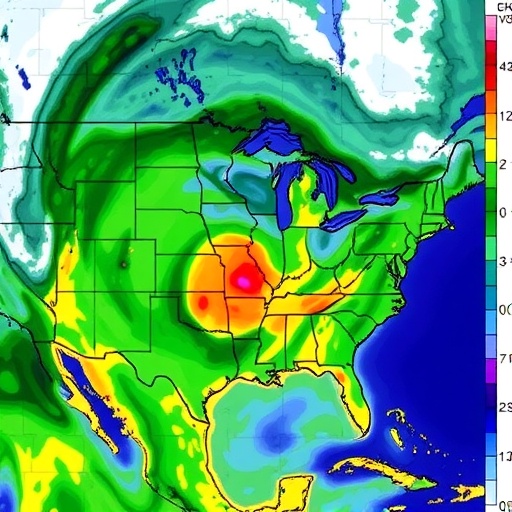
In a remarkable breakthrough that could transform long-range weather forecasting, researchers from Florida State University have developed a novel method to predict winter weather months in advance with unprecedented accuracy. This advancement holds the promise of delivering extended lead times to crucial sectors including agriculture, energy management, water resources, and public health, enabling more proactive measures against severe weather impacts. At the heart of this innovation is a sophisticated understanding of the stratospheric polar vortex (SPV), a critical atmospheric feature that has long challenged meteorologists in predictive modeling beyond short-term horizons.
The SPV is a gigantic ring of frigid, fast-moving air circulating the poles during winter, acting as a containment barrier for cold Arctic air. Its activity fundamentally shapes weather patterns across the Northern Hemisphere by controlling whether frigid air stays locked near the poles or spills into mid-latitude regions such as North America and Eurasia. Historically, efforts to forecast the SPV’s behavior have been constrained by a short predictive window, typically limited to a couple of weeks at best, due to the system’s complex, dynamic nature and sensitivity to multiple atmospheric drivers.
Challenging traditional forecasting paradigms, the Florida State team, led by Michael Secor—a recent Ph.D. graduate from FSU’s Department of Earth, Ocean, and Atmospheric Science—and his advisor Professor Ming Cai, adopted an innovative approach that foregoes day-to-day simulation of SPV dynamics. Instead, they analyzed the vortex’s broader, annual evolution and embedded climate signals to reconstruct its future states. This strategy leverages the cyclical, elliptical orbit-like patterns exhibited by the vortex throughout the year, suggesting a predictability rooted in its long-term climatic context rather than transient fluctuations.
Central to this method is incorporating well-known climate oscillations such as the El Niño-Southern Oscillation (ENSO), which modulates atmospheric conditions by altering sea surface temperatures across the Pacific Ocean. By integrating ENSO phases—El Niño’s warm phase and La Niña’s cool phase—into the prediction model, the researchers harness prior knowledge of Earth’s coupled ocean-atmosphere system to forecast SPV strength and morphology well ahead of the winter season. This advances the predictive accuracy beyond what conventional real-time data-dependent models can achieve.
To develop these long-lead forecasts, Secor’s team formulated a mathematical representation treating the SPV’s annual behavior as an elliptical orbit in a multidimensional parameter space. This abstraction encapsulates key vortex characteristics such as intensity, shape, and position, allowing for the reconstruction of daily SPV states through backward integration from predicted annual parameters. The upshot is a practical and powerful forecasting toolkit that extends the forecast horizon significantly while maintaining or improving the accuracy of short-term predictions.
The significance of this approach was underscored by its successful hindcasting of notable weather phenomena, including Tallahassee’s record snowfall event in January 2025, demonstrating the model’s skill in capturing extreme weather linked to SPV anomalies. By predicting when the vortex is likely to weaken and allow cold air incursions into populated mid-latitudes, the method provides actionable insight for policy makers and industries sensitive to weather variability.
Beyond improving the immediacy and accuracy of winter forecasts, this innovative framework shines light on the predictability of subseasonal-to-seasonal climate variability, suggesting that many extreme weather events may be less stochastic than previously assumed. The embedded nature of these variations in annual climatic cycles opens new avenues for forecasting related atmospheric phenomena and enhances our fundamental understanding of atmospheric dynamics.
Furthermore, this research hints at broader applications for refined climate prediction models, with potential improvements in forecasting the ENSO cycle itself, which has far-reaching consequences for global weather systems. Since ENSO influences hurricane activity, precipitation patterns, and temperature regimes across continents, enhanced predictability in this arena would amplify societal benefits by mitigating risks linked to extreme climate events.
This pioneering work is a testament to the value of cross-disciplinary collaboration within the geophysical sciences. The research team also included Jie Sun, a faculty member specializing in Earth system dynamics, contributing crucial insights that strengthened the robustness of the models. The study’s publication in the Journal of Geophysical Research: Atmospheres and its selection as an Editors’ Highlight—an accolade bestowed on fewer than two percent of all submissions—reflect the high scientific merit and innovative character of the findings.
For Michael Secor, this research represents the culmination of his academic journey, born from a childhood fascination with weather and nurtured through rigorous doctoral studies. His achievement exemplifies the transformative potential of combining deep technical expertise with creative problem-solving in meteorology, offering a hopeful glimpse into the future of climate resilience and adaptive capacity.
As climate variability intensifies globally, tools that extend the predictability of critical atmospheric phenomena such as the SPV are indispensable. This research not only enhances forecast horizons but also encourages a paradigm shift towards interpreting climate patterns as deterministic elements embedded within natural cycles rather than random, unpredictable phenomena. The promise of this approach lies in its ability to equip societies with longer preparation times for adverse weather, ultimately reducing socioeconomic vulnerabilities and advancing climate-smart decision-making.
For those interested in delving deeper into this research, the full study titled “Elliptical Orbit Representation for the Annual Evolution of the Northern Hemisphere Stratospheric Polar Vortex. Part II: Long-Lead Forecasts of Wintertime S2S Anomalies” is available in the Journal of Geophysical Research: Atmospheres. Through continued exploration and validation, such breakthroughs herald a new era of meteorology where the interplay between oceanic patterns and stratospheric dynamics informs reliable, long-term weather forecasting.
News Publication Date:
12-Mar-2026
Web References:
https://agupubs.onlinelibrary.wiley.com/doi/10.1029/2025JD044222
References:
Michael Secor, Ming Cai, Jie Sun, Journal of Geophysical Research: Atmospheres, DOI: 10.1029/2025JD044222
Cite Scienmag News
Russell Cooper. (May 15, 2026). FSU Researchers Innovate Technique to Extend Winter Weather Forecasts from Weeks to Months. Scienmag. https://scienmag.com/fsu-researchers-innovate-technique-to-extend-winter-weather-forecasts-from-weeks-to-months/
Russell Cooper. "FSU Researchers Innovate Technique to Extend Winter Weather Forecasts from Weeks to Months." Scienmag, 15 May 2026, https://scienmag.com/fsu-researchers-innovate-technique-to-extend-winter-weather-forecasts-from-weeks-to-months/. Accessed 3 September 2026.
Russell Cooper. "FSU Researchers Innovate Technique to Extend Winter Weather Forecasts from Weeks to Months." Scienmag. May 15, 2026. https://scienmag.com/fsu-researchers-innovate-technique-to-extend-winter-weather-forecasts-from-weeks-to-months/


