


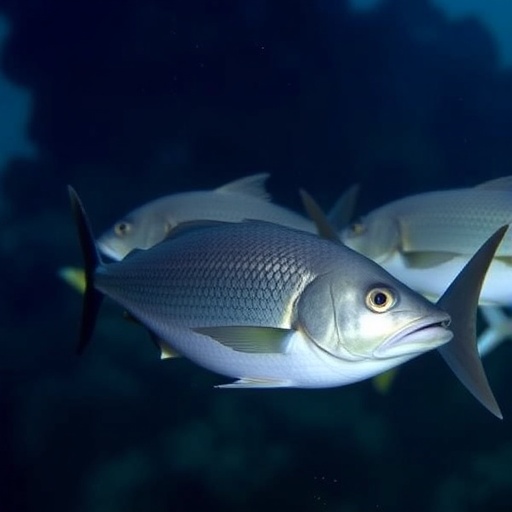
In a groundbreaking study conducted in the oyster-rich waters of Hiroshima Bay, researchers from Hiroshima University have unveiled remarkable sex-specific reproductive movement patterns in black sea bream (Acanthopagrus schlegelii), a species widely recognized for its commercial value throughout East Asia. Employing ultrasonic biotelemetry—a sophisticated tracking technology that allows researchers to follow live aquatic animals without the need for direct visual contact—this research provides the first detailed field-based insight into how male and female black sea bream behave differently during their spawning season in the wild. These revelations challenge previously held assumptions about broadcast spawning fish, offering a nuanced understanding of their reproductive strategies within complex coastal habitats.
The black sea bream, belonging to the sparid family, is notorious for the difficulties researchers face when attempting to observe its reproductive behavior in natural settings. Unlike many terrestrial species, these fish do not exhibit overt sexual dimorphism, making it nearly impossible to distinguish males from females based on external characteristics alone. Moreover, their spawning occurs predominantly around sunset and night, compounded by the turbid waters of coastal regions such as Hiroshima Bay, rendering direct observation nearly infeasible. Ultrasonic biotelemetry circumvents these challenges, enabling continuous monitoring of fish movements with high spatial and temporal resolution by tracking ultrasonic transmitters attached to selected individuals.
The study occurred over a three-year span, focusing on an active oyster farming region—a habitat that intricately weaves three-dimensional structure with ecological function, facilitating both shelter and feeding opportunities for black sea bream. Oyster farms establish arrays of suspended ropes and rafts that create complex underwater environments. Ironically, these artificial structures play a pivotal ecological role, serving not only as a refuge from predators but also as critical spawning grounds. Into this milieu, the research team introduced ultrasonic transmitters to eight reproductively active males and five females, carefully verifying their reproductive state through the release of gametes prior to tagging. This rigorous approach yielded robust data sets that illuminated the divergent behaviors of males and females during the critical spawning window.
Analysis of the telemetry data revealed a striking dichotomy. Male black sea bream demonstrated extensive spatial roaming, patrolling larger areas surrounding the oyster rafts. More notably, males exhibited frequent vertical movements—ascending and descending in the water column—particularly during the twilight period when spawning activity peaks. Quantitatively, males performed more than triple the number of these vertical movements compared to females, indicating a highly active search or mating behavior. These vertical oscillations may facilitate encounters with multiple potential mates or influence the dispersal of sperm in the water column, enhancing fertilization success in the broadcast spawning context.
Conversely, female black sea bream displayed markedly restricted movements. They largely remained stationary near specific oyster rafts, exhibiting a “waiting” behavior rather than active roaming. This confinement likely optimizes energy expenditure, preserving vital resources necessary for the energetically costly production and release of oocytes—female gametes—whose development demands far greater metabolic input compared to spermatozoa. Remaining close to a known spawning site may also reduce predation risks during this vulnerable reproductive phase. The spatial segregation of sexes during spawning underscores a strategic divergence in reproductive investment and behavior.
The significance of these findings extends beyond mere documentation of distinct movement patterns. They highlight how sex-specific reproductive roles manifest spatially and temporally within naturally complex aquatic environments. The behavior of males patrolling widely may be a concerted strategy to increase reproductive encounters, acting as mobile agents actively seeking opportunities to broadcast sperm across territories rich in resting females. In contrast, the females’ sedentary strategy aligns with energy conservation and potentially precise spawning site selection—ensuring maximal fertilization success while mitigating unnecessary energy loss.
This research also posits that oyster rafts function as critical “hidden spawning stages,” transforming human-made aquaculture structures into naturalistic reproductive arenas. These zones of dense vertical infrastructure likely foster higher encounter rates between males and females, shaping reproductive dynamics and influencing gene flow within local fish populations. By linking reproductive behavior with habitat complexity, the study forges a novel understanding of how anthropogenic environments impact marine life reproduction—both positively and negatively.
The deployment of ultrasonic biotelemetry technology underscores an innovative frontier in marine field biology, overcoming the observational limitations imposed by low visibility and nocturnal behavior. Through comprehensive tracking, researchers captured unprecedented detail about the dimensions and timing of reproductive movements, illuminating subtle yet critical behavioral nuances that have long remained elusive. Tracking data combined with direct reproductive assessment creates a powerful synergy in behavioral ecology, bridging gaps between laboratory findings and in situ natural behavior.
Moreover, the discovery of these sex-specific movement patterns in a broadcast-spawning fish challenges previous notions that such species engage in relatively simple, indiscriminate broadcast spawning. Instead, it reveals a complex interplay of active male searching and female site fidelity, suggesting that broadcast spawning can involve intricate behavioral adaptations influenced by energy constraints, predation risk, and habitat structure. These insights push forward theoretical models of fish behavioral ecology, emphasizing the evolutionary and ecological significance of spatial strategies in reproduction.
Looking forward, the research team emphasizes the need for longer-term tracking efforts that encompass larger sample sizes and integrate additional technologies like biologging and improved telemetry systems. Such comprehensive studies would enable more precise identification of actual spawning events and facilitate a deeper understanding of environmental cues and physiological triggers governing reproductive movement. This multidisciplinary approach could revolutionize fish reproductive ecology, with broad implications for conservation and fisheries management in coastal zones worldwide.
Given the commercial importance of black sea bream across East Asia, insights from this research hold substantial implications for sustainable fisheries practices. By appreciating how males and females use habitats differently during spawning, fisheries managers can devise strategies to protect critical spawning habitats and times, ensuring population viability. In particular, maintaining or enhancing oyster farming structures may serve dual roles in supporting fishery yields while preserving ecological function. This balanced outlook fosters harmony between human economic activities and marine biodiversity conservation.
This study marks a landmark advancement in understanding how sex-specific reproductive behaviors manifest in broadcast spawning sparid fish, providing a vivid example of how environmental complexity, behavioral ecology, and technological innovation can converge to unravel nature’s intricate patterns. As scientific tools like ultrasonic biotelemetry become increasingly accessible, the field stands poised for exciting discoveries that will deepen humanity’s knowledge of marine ecosystems and enhance stewardship of vital aquatic resources.
Cite Scienmag News
Alan Morgan. (May 15, 2026). Observing Reproductive Behavior of Black Sea Bream: Patrolling Males and Waiting Females in the Wild. Scienmag. https://scienmag.com/observing-reproductive-behavior-of-black-sea-bream-patrolling-males-and-waiting-females-in-the-wild/
Alan Morgan. "Observing Reproductive Behavior of Black Sea Bream: Patrolling Males and Waiting Females in the Wild." Scienmag, 15 May 2026, https://scienmag.com/observing-reproductive-behavior-of-black-sea-bream-patrolling-males-and-waiting-females-in-the-wild/. Accessed 6 September 2026.
Alan Morgan. "Observing Reproductive Behavior of Black Sea Bream: Patrolling Males and Waiting Females in the Wild." Scienmag. May 15, 2026. https://scienmag.com/observing-reproductive-behavior-of-black-sea-bream-patrolling-males-and-waiting-females-in-the-wild/


