


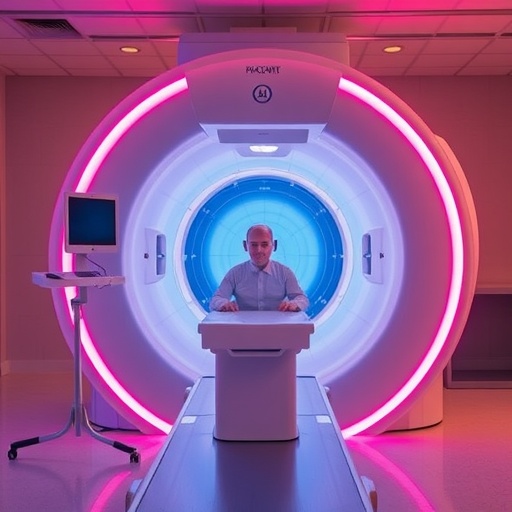
A groundbreaking international clinical trial led by researchers at University College London (UCL) and the London School of Hygiene & Tropical Medicine (LSHTM) has demonstrated the striking effectiveness of artificial intelligence (AI) technology in planning life-saving radiotherapy treatments for cervical and prostate cancers. This pivotal development holds profound implications, particularly for low- and middle-income countries where the burden of cervical cancer is disproportionately high, and access to radiotherapy is severely limited.
Cervical cancer remains a major global health challenge, with approximately 94% of deaths occurring in low- and middle-income countries, where in 2022 alone, 350,000 women succumbed to the disease. Radiotherapy constitutes the cornerstone of curative treatment for cervical cancer; however, only an estimated 10% of patients in low-income nations and 40% in middle-income countries receive this vital therapy. The scarcity of healthcare professionals skilled in radiotherapy planning has been a critical impediment in scaling up access to treatment.
The AI-based radiotherapy planning technology evaluated in this study addresses these challenges by automating the intricate process of radiotherapy plan formulation. Traditionally, radiotherapy planning is painstakingly complex, requiring oncologists to delineate tumors and surrounding at-risk tissues on computed tomography (CT) scans, alongside physicists’ meticulous calculations to determine optimal radiation beam configurations. This process, typically extending over several days or weeks, is resource-intensive and depends heavily on specialized personnel.
Known as the Radiotherapy Planning Assistant, the AI software developed by the University of Texas MD Anderson Cancer Center under Professor Laurence Court’s leadership leverages advanced machine learning algorithms to identify target structures and compute optimal radiation beam arrangements autonomously. This innovation dramatically truncates planning times to just over an hour, potentially revolutionizing radiotherapy delivery by reducing patient wait times and enabling broader access in resource-constrained settings.
The ARCHERY trial, encompassing over 1,000 cancer patients across India, South Africa, Jordan, and Malaysia, rigorously evaluated the AI’s capability in delivering gold-standard radiotherapy plans for cervical, prostate, and head and neck cancers. Notably, the trial demonstrated that the AI technology generated radiotherapy plans meeting international best-practice standards in more than 95% of cervical cancer cases, an extraordinary benchmark suggesting readiness for routine clinical implementation.
For prostate cancer, the AI-generated plans achieved a high standard in 85% of cases, an outcome considered clinically acceptable for regular use. These findings underscore the AI system’s versatility and promise for enhancing radiotherapy planning across diverse cancer types and healthcare settings. Results pertaining to head and neck cancer are forthcoming, anticipated to further validate the technology’s utility.
Professor Ajay Aggarwal, chief investigator based at LSHTM and Guy’s & St Thomas’ NHS Trust, emphasized the transformative potential of AI in meeting the World Health Organization’s cervical cancer elimination goals by improving treatment access worldwide. The abbreviated planning process not only expedites therapy initiation but also helps alleviate the global shortage of specialized radiotherapy professionals, a persistent barrier to care.
Co-investigator Professor Mahesh Parmar from UCL highlighted that radiotherapy facilitates the cure of approximately 40% of all cancer cases yet remains inaccessible to millions. He underscored the unique scale and rigor of the ARCHERY trial, contrasting it with prior technology assessments typically limited to small, high-income country cohorts, which carry risks of bias and limited generalizability. This trial represents a landmark in validating AI interventions in oncology globally.
The clinical oncology community has greeted these results with considerable enthusiasm. ESTRO President Professor Matthias Guckenberger praised the potential of AI to not only maintain but potentially enhance the precision of radiotherapy treatments, which demand accurate targeting to maximize tumor eradication while minimizing collateral damage to healthy tissues. He remarked on the economic benefits, noting that while radiotherapy machines are capital intensive, optimized utilization through AI could improve cost-effectiveness and accessibility.
The ARCHERY trial was generously funded by the National Institutes of Health (NIH) in the United States, the Rising Tide Foundation, and the UK’s Medical Research Council, with coordination by the UCL Innovative Clinical Trials Unit. The extensive international collaboration included leading centers such as Cape Town University, Stellenbosch University, Tata Medical Centre (Kolkata), Tata Memorial Hospital (Mumbai), University of Malaya Medical Centre, King Hussein Cancer Center, Ghent University, and the UK Radiotherapy Trials Quality Assurance Group, reflecting a truly global effort to advance cancer care.
Radiotherapy planning’s inherent complexity lies in both anatomical contouring and dosimetric optimization — tasks meticulously performed by oncologists and physicists who manually segment tumor volumes and organs at risk within volumetric scans before defining radiation beam parameters. The Radiotherapy Planning Assistant harnesses convolutional neural networks and sophisticated dose calculation models to replicate these functions with remarkable speed and accuracy, promising to standardize care quality regardless of geographic or economic constraints.
By enabling extensive deployment of high-quality radiotherapy plans, especially in regions where skilled personnel are scarce, this AI technology can drastically improve treatment reach and outcomes. The resultant reduction in planning time not only enhances clinical workflow efficiencies but also has profound implications for patient survival and quality of life in both high-resource and underserved settings.
As AI continues to integrate into healthcare, trials like ARCHERY affirm that technological advances must be validated through large-scale, multicenter studies to establish unequivocal benefits for patients and practitioners alike. This ensures that AI-driven innovations deliver on their promise to democratize access, improve efficacy, and optimize resources in the relentless global fight against cancer.
News Publication Date:
Not specified
Web References:
Not specified
References:
Not specified
Cite Scienmag News
Nathaniel Bowman. (May 17, 2026). AI Tool in Radiotherapy Advances Global Fight to Eradicate Cervical Cancer. Scienmag. https://scienmag.com/ai-tool-in-radiotherapy-advances-global-fight-to-eradicate-cervical-cancer/
Nathaniel Bowman. "AI Tool in Radiotherapy Advances Global Fight to Eradicate Cervical Cancer." Scienmag, 17 May 2026, https://scienmag.com/ai-tool-in-radiotherapy-advances-global-fight-to-eradicate-cervical-cancer/. Accessed 3 September 2026.
Nathaniel Bowman. "AI Tool in Radiotherapy Advances Global Fight to Eradicate Cervical Cancer." Scienmag. May 17, 2026. https://scienmag.com/ai-tool-in-radiotherapy-advances-global-fight-to-eradicate-cervical-cancer/


